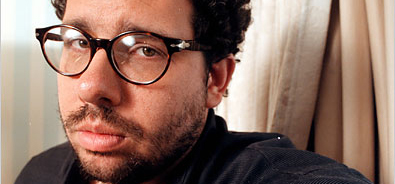
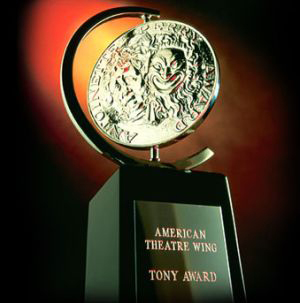
Bespectacled Donald Marguiles looks like a writer out of central casting. And as a playwright, he is indeed pleased. When you write for theater, he said the morning after the Tony Award nominations were announced, as opposed to film or television, where the hope is the writer will recede into the woodwork, everyone works to portray your vision. His play Time Stands Still garnered important Tony nominations for the fine Laura Linney and the play itself. Of course it is bewildering what gets picked, what doesn't. Brian D'Arcy James, for example, said the playwright, is Broadway's Best Kept Secret.recent posts
- Adrien Brody and Tessa Thompson Debut on Broadway in The Fear of Thirteen
- Lorne Premieres at Lincoln Center: Glimpsing Lorne Michaels Backstage at Saturday Night Live
- Alden Ehrenreich and Patrick Ball: The Men in Becky Shaw on Broadway
- Audra McDonald and “Original Nepo Baby” Gwyneth Paltrow: Honorees at the NYWFT Muse Awards 23 March 2026
- Zach Bryan Buys the On the Road Scroll/ Happy Birthday, Jack Kerouac!
-
Bespectacled Donald Marguiles looks like a writer out of central casting. And as a playwright, he is indeed pleased. When you write for theater, he said the morning after the Tony Award nominations were announced, as opposed to film or television, where the hope is the writer will recede into the woodwork, everyone works to portray your vision. His play Time Stands Still garnered important Tony nominations for the fine Laura Linney and the play itself. Of course it is bewildering what gets picked, what doesn't. Brian D'Arcy James, for example, said the playwright, is Broadway's Best Kept Secret.A revival of his Collected Stories has Linda Lavin a contender with Linney for the Best Actress in a Play award. The two-woman drama about a prominent writer and her student begins with the younger woman's sycophantic attentions to the older one set in her Greenwich Village apartment. By the end of Act I, they are locked in an embrace and I wondered, where's the drama? Where's the conflict? But by the end, the interplay of younger and older gives way to a subtle, edgy, competitive discomfort; the drama becomes a devastating meditation on the predatory nature of artists. Where does one's material come from? And quite amazingly, by the end, you are taking sides. For me, Linda Lavin's character, Ruth Steiner, is most vulnerable. This seasoned actress gives a nuanced performance: a gesture of the hand, raised brow conveys the complex range of her feelings as she has her life story ripped off. Don't be surprised however if you side with the younger, Lisa Morrison (Sarah Paulson): Isn't this what you taught me? she asks innocently. She didn't fool me one bit.I loved Promises, Promises, and risk my critical detachment to express the delight this production delivers. The “modern” decor, the dancing, high kicking men in suits, women-secretaries with their round Marilyn Monroe rumps-so 60's, with office politics revolving around the use of one worker's available apartment for extra marital shenanigans. But when Katie Finneran as Marge MacDougall, a floozy Sean Hayes as Chuck Baxter picks up in a bar enters in Act II, I nearly fell out of my seat laughing. Ensconced in owl, her pas de deux with Hayes is a hilarious take on a one-night stand. This time of course he gets to use his apartment for himself but finds it unexpectedly occupied. With the wise additions of some Burt Bacharach classics to the score, this show is stunning. And forget about that controversy about gay actors playing straight roles! What could be more chaste than Baxter and his paramour Fran Kubelik (Kristen Chenoweth) at the end playing board games in the apartment? Friendship wins.It always seems odd that plays can disappear after only a handful of performances and can still glean Tony nods. Case in point Enron, the British import that recently shut down, but not before Stephen Kunken who is excellent in the role of Andy Fastow, the music (Best Original Score), Lighting Design and Sound Design also received well deserved Tony recognition. But what about Norbert Leo Butz as Jeffrey Skilling, Gregory Itzin as Kenneth Lay, and the ensemble that also includes The Classical Theater of Harlem's Ty Jones who also give striking performances in this physically demanding show. Expertly conceived as it was, the play's mechanics-techno sound, sleek chrome look– gave me a chill, as did the subject it was based upon. It may be too soon to translate the American titan Enron's collapse to the American people, no matter how finely tuned the production. -
The passion of Christ as played out in iconography and theater since the beginnings of Christendom is terrifying, controlling, inflammatory, think of the dreary, racist 2004 Mel Gibson movie, but in Sarah Ruhl's poetic and sly vision, the Passion is also hilarious. It's still the story of Christ, for God's sake, nailed to the cross, the principles still include shady Romans in robes and Jews in tallises, but the difference is, this play asks key questions. And it also entertains.Developed over years from a two-act version to the current Epic Theater Ensemble production in Brooklyn–at the Irondale Center, within the deconstructed walls of a former Sunday school, part of a Presbyterian church–this daunting epic-length play of three and half hours flies by, thanks to the superb ensemble including Dominic Fumusa, fine in a variety of roles including a Vietnam vet and Polly Noonan, witty as the village idiot, under the direction of Mark Wing-Davey.
Three sets of amateur actors perform a passion play: Act I opens in a village in Northern England in 1575, under Queen Elizabeth's rule, Act II jumps to 1934 Bavaria during Hitler's regime, and then Act III, to Spearfish, South Dakota, 1969, and Reagan era 1984; Ruhl's Passion is layered, asking, what does it mean to play these iconic figures? The virgin, the martyr, Pontius Pilate, how do these roles impress themselves upon the actors who repeat their performances year after year, imprinting their psyches as matters of religion interweave with the inner world of imagination, and the outer of politics.
Sight gags, flying saints, translucent fish, snakes, all manner of theatrical amusement is deployed within the gym-like space, the cross's formidable “INRI” on one side and a menacing Nazi banner on the other. One of the funniest scenes takes place in the Garden of Eden with actors, attired as naked, attaching fig leafs to wooly genital hair. And the women, the two Marys, (Kate Turnbull and Nicole Wiesner) go gaga over Hale Appleman's “J,” hot in his slipping loincloth, as he gets nailed, again. T. Ryder Smith as powdered and pearled Queen Elizabeth, mustachioed Hitler, and apple-cheeked Reagan provides the necessary imperious airs.
At the play's opening on Wednesday where actors Philip Seymour Hoffman and Daphne Rubin-Vega partied with playwrights Tracy Letts and Winter Miller, producers exulted at the coup. Now that Sarah Ruhl is, well, Sarah Ruhl-her current play, In the Next Room or the vibrator play, nominated for a Tony Award for Best Play, Lincoln Center and Manhattan Theater Club wanted to debut Passion Play. But Ruhl made clear that she wanted a building that was not a theater per se, but a historically relevant structure, and she wanted everyone to be able to attend. To that end, some tickets can be purchased for $5.
-
The more Jane Rosenthal quipped, they had renamed the Tribeca Film Festival for the Oscar winning documentarian Alex Gibney, the less her words felt like a joke. The prolific Gibney made My Trip to Al Qaeda, the untitled Eliot Spitzer, and a segment of the closing night Freakonomics, all huge hits at Tribeca. As if these historic, epic scaled entertainments weren't enough, he just released another signature documentary probe, Casino Jack: The United States of Money, about scandalous lobbyist Jack Abramoff. After seeing Fiddler on the Roof as a boy, Abramoff became a religious Jew, had a fling with filmmaking, and is currently and famously in jail. As with all of Gibney's work from Enron: The Smartest Guys in the Room to his work in progress about Eliot Spitzer, his films entertain by examining and provoking our sense of discomfort with the Zeitgeist. Thinking of him as the historian of our time, I sat down with Alex Gibney in the offices of Magnolia Pictures on April 20.RW: When you made Taxi to the Dark Side, you were also editing your film about Hunter S. Thompson, finding comic relief in the iconic writer's story as compared with the grim tale of torture in Bahrain prison? Similarly, was there comic relief to balance Casino Jack?AG: The comic relief was in the film. The lifeguard-an American international global organization is actually run by a lifeguard, Dave Grosh, who is shucking oysters and a yoga instructor. Grosh said to me in an interview, 'I am not qualified to run a Baskin Robbins, much less an international operation.' Not to mention Jack's filmmaking career, or Tom Delay on Dancing With the Stars. That was the appeal of this film, that it was deadly serious and wildly funny.RW: Were there any interviews that were hard to get?AG: They were all hard to get. With every project I start out on, there's no footage. It's always a big slog to find the footage and we did–stuff that nobody has ever seen before. It's easy to get armchair analysts to talk, but to get people on the inside to talk is very, very hard. That's why the film took over 3 years to make. We had to put it aside while we waited for people to get out of prison, and decide whether or not to talk to us.RW: Who was hardest to get?AG: Bob Ney, Adam Kadim, and Sue Schmidt were reluctant to be interviewed right off the bat. Some of the folks in the Marianas. That was one of my most productive and riskiest trips. We were going a long way not knowing who would be willing to talk. And we got a few to talk that really made a difference.RW: That sequence was hilarious.AG: And desperately sad at the same time: That guy who talks to Congressman Miller to ask if he would buy his kidney so he could go back to China. The hilarity of those trips: It's like Neverland: the snorkeling is great, the golf is great, the drinks are great. You can go see strip shows, hookers, and then you take a 15 minute tour of a sweat shop and report that everything is fine.RW: What were some of the surprises you found out about Jack Abramoff and his world?AG: We track his career as a young zealot, coming up as a young ideologue with Ralph Reed and Grover Norquist. One of the stunts they pulled was this right wing Woodstock in Angola, going over there with the contras. It was a known episode but nobody had any footage. We finally found a man in London who had been a cameraman for CBS at the time who had 20 hours. That makes for a fantastic sequence, both the immediacy of it and the absolute insanity of it. These guys joining hands and singing the equivalent of “Kumbayah.”RW: Given the difficulties, what drew you to this subject?The story is so wild, so outrageous, so much fun, so darkly analytical about a fundamental problem in American democracy; we are allowing congressmen and senators to be bought and sold like sneakers. And everyone will protest, 'no, this isn't so; there is no quid quo pro.' It is true. Even if on any particular bill someone votes against the contributor, at the end of the day the process is so dehumanizing, and it goes both ways. Corporations will say every week, 'we get shaken down by congressmen and lawmakers,' and now we are paying congressman and senators to raise money. The Jack Abramoff story shows us how bad that policy is, really not about the lobbyist. Jack Abramoff was a vehicle for something that was bigger than him and that was money. That is the conclusion that the movie reaches: Is he a bad apple or evidence of a rotten barrel?RW: In Taxi to the Dark Side, you interview your father. Does this film reflect lessons he taught you?AG: My father passed on to me the idea of being relentlessly curious. When I interviewed him for Taxi, he was close to his death, but even then he was so attuned to what was going on around him, his sense of determined curiosity is what he passed on. In the Abramoff story I thought, you know, I don't really know enough about my own government, I am not sure that any of us knows how the government really works. We are all cynical about it, but we don't really know. It is like going into the kitchen of a Chinese restaurant and seeing how the sausage gets made.RW: What do you want people to get out of this film?AG: I want them to be entertained. But I want them to develop a righteous anger about how much money is perverting our democracy. If we don't get angry it is going to get worse. A lot of purse conscious Republicans should get angry about how money is thrown around in Washington. Congressmen and senators are being greased.RW: Are you indicting the Democrats?AG: The Jack Abramoff scandal is a Republican scandal. Chuck Schumer, a dyed in the wool liberal, is an unbelievable shill, campaigning for things that are deeply undemocratic-i.e. the Hedge Fund loophole. Firemen and teachers pay a tax rate of 25% or 30 %. Hedge fund managers worth hundreds of millions of dollars pay 15%. Why? Chuck Schumer has become their protector and every time somebody takes that unfair loophole away, he kills it in the Senate because he and his pack are getting hundreds of millions of dollars. It's obscene. We didn't have time to get into Schumer in the film but there is a clue there that it is not just Republicans. I never met him. By all accounts he is a nice guy. That's another thing I learned from doing these films: everybody's nice. But that doesn't mean he hasn't done something deeply corrupt. Schumer will defend his decision, well I'm from NY and Wall St. is NY. So I would say, what about firemen and teachers, why should they pay double? It makes my blood boil.RW: You are showing an untitled Spitzer documentary. Is there a connection between questions raised about government, politics, and money in Jack's story with Eliot Spitzer?AG: The Spitzer story is more complicated. Unlike Casino Jack, there's no easy prescriptive answer to Eliot Spitzer, but I was interested in him as a character, in his rise and his fall. He is one of the few who understands the political economy, the wicked games that are played in the financial community, and he knew how to get tough. The SEC wasn't doing it. I admire him.After the scandal happened, everybody was talking about it; still is, because it cuts very deep. How do we choose our public officials? What do we need them for? What about relations between men and women? How do we parse that? Spitzer is not the only powerful man who was unfaithful to his wife, but it was a spectacular moment because the way he presented himself he was so unlikely a character a candidate for using prostitutes. He prosecuted people for having done the same.There's no doubt that his enemies were gleeful. That's part of the film, the political blood sport. And al ot of the people who went after him, as with Clinton, were guilty of the same or similar crimes. Eliot Spitzer didn't corner the market on hypocrisy.RW: What about the other films that are part of this year's Tribeca Film Festival?AG: My Trip to Al Qaeda, Lawrence Wright's journey into the Middle East shows the threat that we face, the threat that we are becoming more like the terrorists than we imagine.Freakonomics is about corruption. The subject of my segment is sumo wrestling. I love the spectacle of these huge men in loin clothes, but there's something this subject has to say about corruption in human behavior. As a filmmaker, shooting those sumo wrestlers is fantastic. -
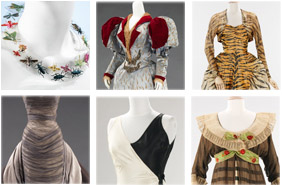
When last I ran into her, Diane von Furstenberg was photographing an antique shoe with curlicue heel-I imagine for inspiration– at the Brooklyn Museum's excellent new “American High Style: Fashioning a National Collection.” Sibling to the Metropolitan's “American Woman: Fashioning a National Identity,” viewed this week, the show features masterworks from the Brooklyn Museum costume collection: fashion as fine art in the work of Charles James, Charles Frederick Worth, Madeleine Vionnet, Steven Arpad, and many others. The shoe collection is one of the most unusual, with Ferragamos, Delmans and Valentinos. And a display at the Met features a rack of extraordinary lacy footwear. But as anyone-even the likes of Anna Wintour who wore a Proenza Schouler day dress to the press conference, posing for the discerning lens of Bill Cunningham– will tell you, women do not live by shoes alone.Wednesday night in the DVF Design Studio in the meatpacking district, Diane von Furstenberg hosted the annual Independent Filmmaker Project gala in honor of daughter Tatiana von Furstenberg and Fransesca Gregorini's movie “Tanner Hall” to open this fall. Sipping champagne and red bull cocktails, New York's downtown film community and well wishers including Blythe Danner, Mamie Gummer, Uma Thurman, Ed Burns, Mira Nair, Alexander Olch, Jean Doumanian, Christine Vachon, Cynthia Rowley, to name a mere few, watched clips of the film. Patricia Clarkson and Amber Tamblyn wore hot pink look alike sheaths and first mocked shock and dismay and then a forgiving embrace. Anthony Bregman came from the Westchester shoot of his new movie “Oranges” starring the winning “Please Give” actors Oliver Platt and Catherine Keener.Dressed in hippie chic, DVF huddled in deep talk on a banquette with talented young photographer Francesco Carrozzini whose giant portraits of Keith Richards and Scarlett Johansson with Liev Schreiber hung over the elegant dinner. -
Last week at the Tribeca Film Festival's premiere of Alex Gibney's documentary based on the play, My Trip to Al-Qaeda, author Lawrence Wright's explained how he found himself in the midst of controversy after having scripted the 1998 action adventure, The Siege, proclaiming the true threat of terrorism. And then: 9/11 elevated his words to prophesy. A clip of Denzel Washington appears in the film within the film carrying the weight of this message, of a demonic scheme: fear becoming the instrument of our demise. A day later, Denzel Washington was carrying another kind of weight at the Broadway revival of August Wilson's Fences. An Everyman to whom attention must be paid, to echo Arthur Miller's words about his salesman, the character Troy Maxson is the center of a domestic drama, a sanitation worker in 1957 Pittsburgh with a house and yard, a wife ( a stunning performance by Viola Davis), struggling with parenting, his loss of dreams, and a secret life; ultimately through August Wilson's genius, he struggles with his position beyond the titular fence. While James Earl Jones is memorable from the original, Washington's swagger and frailty, his timing with Wilson's poetry, makes this Troy Shakespearean.Among those reveling with Washington's family, and the Fences cast and crew, on that rainy night at the Bryant Part Grill: Chris Rock, Spike Lee, Jessica Lange, Harry Belafonte, Mike Nichols, John Patrick Shanley, Emily Blunt and her beau John Krasinski, and Courtney Vance from the original Broadway cast. Without a doubt, as Tony time approaches, watch this play garner every award, Best Actor and Actress, Best Dramatic Play. -
In 2008, a performer named Runaround Sue told me she made the call to the 150 burlesque artists in NYC and got Jonny Porkpie, Legs Malone, and Nasty Canasta to join her for a raunchy romp: tassels spinning from every body part, stripping down past the bikini line, peek-a-boo fan dancing, and serious body contorting illustrating that sound business advice from “Gypsy,” “You Gotta Have a Gimmick.” Remember, Mama Rose resisted the degradation of her child vaudeville act into burlesque. Now, a new documentary directed by Leslie Zemeckis, “Behind the Burly Q,” reveals a history of this corner of show business.Gypsy Rose Lee gets a moment or two in this film, noted for her oratory skill, but the film's real stars are the flaming redhead Tempest Storm, the demure Blaze Starr, Kitty West who was in her heyday Evangeline the Oyster Girl performing on the half shell, Sherry Britton, Margie Hart, Rita Grable, Lili St. Cyr, and Dixie Evans, billed the “Marilyn Monroe of Burlesque.” Alan Alda speaks about his childhood as a form of child abuse-for what he was exposed to behind the scenes, as the son of Robert Alda, a “straight” man who warmed up the audience for the steamy acts to come. Burlesque comes off as a sociological event, offsetting the poverty of the Depression era, in a pre-feminist world, where, as one star put it, “Nothing is sexier than a woman crawling, if she knows how.”Sharon Stone introduced a special screening this week, saying she had this in common: nudity and sex. That got a laugh from the crowd at MoMA who remember her crotch flashing moment in “Basic Instinct.” In fact co-star Michael Douglas joined the celebrants for dinner at the legendary 21 along with Brian Koppelman, the producer/director of his new film “A Solitary Man.” In homage to the stars of her film, Leslie Zemeckis and her producer wore glamorous gold lame gowns. Thanks to the superb seating skills of Peggy Siegal, our table had a high concentration of documentarians with Kate Davis whose “Stonewall” is soon to open and Chris Hegedus and D. A. Pennebaker, who reminisced about the stripper he worked with in the '50's: “Ah Gyps, I miss her.”St. Tropez may be far away from early 20th century America, but the fabulous Cagelles in the Broadway revival of “La Cage aux Folles” at the Longacre Theatre certainly took their cues from burlesque. In the musical's denouement, Jean-Michel's future mother-in-law (Veanne Cox), a prude in French twist lets her hair down as a dancer to avoid the gendarmes; burlesque-like, her silver skirt is snatched as she bumps and grinds, and a long glove is sexily cast to the side. She is having “The Best of Times,” as is the audience. Kelsey Grammer (Georges) and Douglas Hodge (Albin/ Zaza) make for a gorgeous couple. Albin appears to be a mere scene stealing drama queen at first, but her cunning saves the day. When Georges and Albin kiss, ooh la la.And last night, after the Tribeca Film Festival premiere of the docufantasy, “Arias with a Twist,” burlesque meets camp as the flamboyant entertainer, Joey Arias performed at Dominion. Pal Sherry Vine sang “I Just Shit My Pants” and Raven Oak, “Fly Me to the Moon.” Then Arias performed “Don't Explain,” accompanied by Alex Gifford on piano and the dazzling, elegant puppetry of Basil Twist. Pulling off her jacket and leathers down to black lace, Joey took some deep crotch flashing bends for the joyful crowd. -
The Brooklyn Museum has my number: fashion and food, making their Brooklyn Ball The Party of the Season.The spectacle starts with an olfactory assault on the 5th floor for cocktails. Pursuing the nose-pinching yet oddly enticing stinky pong, we see yellow waxen masses hanging from the ceiling with heat lamps: an elaborate cheese drip is underway, eight feet above a monumental wooden crate festooned with Carr's crackers.Needing a drink immediately, we grab from an assortment of glasses on yet another crate and look for a bar, weirdly absent. Blandly monochrome canvases have spigots with wall text: screwdriver, lemonade, white wine, rum & coke. Filling up with dirty martini (sans olive), we find a side room, a slanted wooden floor with a small island of greens, a landscape out of Waiting for Godot. Plucking a parsnip, we enter another room with water basins and paper toweling to rinse. Chloe Sevigny is among the veggie washers.This interactive dining experience, a combination of installation and performance art called “Icons,” is the work of Jennifer Rubell.Descending the stairs to 4, for a preview of the exhibition “American High Style: Fashioning a National Collection,” is the Metropolitan Museum's Harold Koda. This show, presented in partnership with the Metropolitan Museum's Costume Institute, begins with footwear. A woman after my own heart, Diane von Furstenberg in a gold evening coat takes a shot of a 1939 Steven Arpad shoe, the curlicue carved heel forming a wedge. Zac Posen holds court near a trio of manikins in Schiaparelli and Charles James. He is celebrating his new collaboration with Target. Former hat designer turned photographer Bill Cunningham snaps the fashionable ogling fashion: Norell, Valentino, Balenciaga.
Next, dinner on 3 in the Beaux-Arts court: those massive crates: giant thighs of beef on one, a dozen turkeys, rabbit, whole pigs with tools for hacking off and slicing. Piled high accompaniment: romaine lettuce on one, asparagus, radish and bean combo on another, fava beans. Mario Batalli serves rabbit.
“Which are the best bits,” we ask. “Right here,” he says, pointing out the chest. “This is most crispy.” We fill our plates and join a museum-length communal table, seating for hundreds.The after party on 1 features a tarot reader, an origami artist, the Bumby's, a masked couple who could tell you about yourself by merely observing, for example accurately saying a particular guest had a strict Catholic upbringing. A trio of drag queens beckons to tell me how to improve my look: six foot tall “Donatella” suggests I wear bigger shoes and dye my hair platinum (like hers?).
-
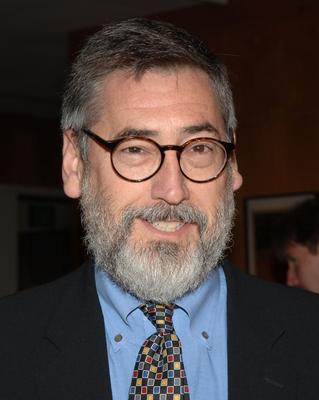
Volcanic ash from Iceland may have paralyzed air traffic in Europe preventing honoree John Landis from reaching the west coast of Florida for his tribute, but at the Sarasota Film Festival, the show must go on. “What should we do?” asked the affable Mark Famiglio, festival president who playfully is listed as “Head Poobah,” half joking, knowing that attendees would opt to party hearty anyway.In its 12th year, the festival is much like many, screening top notch films in a gorgeous location, here among palms and marinas, golf courses and gulf beaches, but this festival has a twist attempting to redefine the business of how films are financed. A group of successful producers and other industry leaders in the world of independent filmmaking, “hand picked” by the festival board's vice president Robert Warren, among them Ted Hope, Mike Ryan, Ira Sachs, Anthony Bregman, Josh Braun— convened yesterday for the festival's Investment Lab. “Material, material, material,” said Rich Jaycobs evoking the language of real estate, is still the starting point for decision making on any film project.
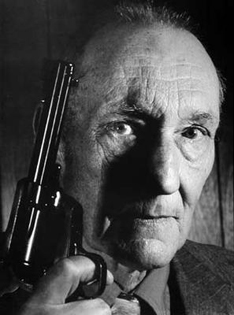
Most interesting was the trajectory of the day, from conference to the evening's staged reading of Oren Moverman's screenplay for a movie version of the book Queer by William S. Burroughs, to be directed by Steve Buscemi.
You wouldn't expect a film on this material, so fascinatingly subversive, based on the life of the American writer and beat era culture icon who happened to be homosexual, a heroin addict, and who by the way accidentally killed his wife in a William Tell routine in Mexico City, to be the centerpiece of a mainstream enterprise, a showcase for the business of film.
So the magic, the blend of inspiration and talents, that made the reading work so well came as something of a happy surprise. With rocker/ poet Patti Smith introducing, Buscemi's Olive Productions partner Stanley Tucci narrating, Buscemi as Lee, Lisa Joyce as the ill-fated Joan, Ben Foster as Allerton, and John Ventimiglia in a variety of roles, the audience had the privilege of being in on the early stages of a film in process. And the result was thrilling. Investors must be lining up.
-
A farce in the manner of Feydeau, Ken Ludwig's 1986 Lend Me a Tenor revived at the Music Box Theater and directed by Stanley Tucci, has laughs aplenty as doors -and bodies– slam in a 1934 Cleveland hotel suite.
In anticipation of a production of Verdi's Otello, the opera's impresario, Saunders, sweats the arrival of the starred tenor. Finally blustering in, his jealous wife in tow, the renowned “Il Stupendo” needs a nap. A drug-induced sleep threatens: will this show go on?
And how! Okay, you have to suspend your disbelief big time for this corny material: Tito Merelli, the tenor, just happens to have two costumes on hand, convenient for Max, the impresario's homme d'affaires to step in. Two Otellos in black face and regal robe spell mistaken identity. One sings, the other is taken for a crasher. Guess which?A high point of Act II is when each Otello makes it with a starry eyed fan, on a couch in the suite's sitting room, and in the bedroom, a visual split screen. The women are deliciously clueless: An infatuated Maggie, Saunders' daughter, played cutely by Mary Catherine Garrison; an overheated soprano, Diana, played coyly by Jennifer Laura Thompson; and, the temperamental, forgiving wife Maria played with zesty accent by Jan Maxwell. Only Brooke Adams is off as Julia, the chair of the opera gala with strait-laced haute grandeur; more matronly prudery would be funnier.Ah the men: Tony Shalhoub handsome in tux as Saunders, Anthony LaPaglia, bloated in brocade, and the surprise: Justin Bartha is charming as Max. Maggie had thrown herself at him, thinking he was the Italian tenor. Her, “I'm glad it was you,” suggests that times in the '30's midwest were racy indeed as imagined in this delightful period comedy. -
The mood was exultant at Veranda where a party for the movie Breaking Upwards was underway after last week's IFC premiere. “I can't believe what's happening here,” I heard celebrants say, even if one was the director/ writer/ star Daryl Wein's mother. But then again, mothers are big part of this startlingly fresh take on the tried and often tired genre of romantic comedy.
When the film's Zoe and Daryl schedule days off on their relationship, each of their mothers (Julie White and Andrea Martin) weigh in like a Greek chorus. As actors portraying themselves, Daryl Wein evokes the angst driven vintage Woody Allen and Zoe Lister-Jones, the spot on timing of Julia Louis-Dreyfus, as each navigates New York, and the vagaries of the heart in a committed yet young and restless relationship.
That's not to be confused with real-life 20-something Zoe and Daryl whose break up story this is. With references to tweets and texts, this movie moves at the rate of the Zeitgeist. The timely subject of Love-and how to make it last- is timelessly gadget-proof. As characters, they are so appealing it comes as a relief that the story of these two NYU Tisch graduates is not over even when this very smart and funny movie is.
Others attending this premiere included the fine Mamie Gummer (her mom Meryl Streep is mentioned ironically in the film), Ebon Moss-Bachrach (so good as Tom in The Glass Menagerie at Guild Hall last summer), Ezra Miller (City Island), and Pablo Schreiber (The Wire). Heather Burns, memorable twirling fire tipped batons in Miss Congeniality, plays a small role in Breaking Upwards. She said she was thinking about Sandra Bullock during this scandal-ridden time for the recent Oscar winner's marriage, finding the betrayal sad. Of Jesse James, “I really liked him.”
-
Dame Edna Everage and Michael Feinstein make a fine couple, if you enjoy a visual oxymoron: the former is the alter ego of the Australian Barry Humphries, known for his large outsized glamour. The latter is the charming song man of The Regency, diminutive, understated, elegant. Each a consummate performer, together they make for an entertaining evening combining highlights of the American songbook with Dame Edna's signature comedy, and somehow, by the end you find yourself happily in a sing along waving priapic gladioli and intoning, “Thrust, thrust, thrust.”How did you get here? The show is based on the conceit that each has booked this space, and now, egos flair, the two vie for dominance. The brainchild of the stars plus playwright Christopher Durang and Lizzie Spender, the daughter of Stephen Spender and Barry Humphries' wife, All About Me, utilizes these talents for what amounts to a glorified high school sing, and yet, it is deliciously engaging, hilarious.Dame Edna's wardrobe is a study in what to wear if you are insecure enough to have to prod the audience, you do miss me? She needn't worry, a man in the front row had on identical glasses with rhinestoned wings. Feathers, bling, one creation is more monumentally bedazzling than the last, as the lilac haired comic shows off her gams in red high heels. Backing her up are two buff bouncers who double in dance (Gregory Butler and Jon-Paul Mateo). Even the stage manager (Jodi Capeless) gets into the act. Exclaiming this a Sondheim-free zone, just as it's been announced, the Henry Miller Theater will be named for this Broadway great, Dame Edna does a fine “Here's to the Ladies Who Lunch.”Michael Feinstein pays homage to comedian Paul Lind's turn on Hollywood Squares, recalled a seminal moment when the host posed this question, “Men reach their sexual peek as teens. At what age for women?” Lind replied, “Who cares?” You get that he's gay. But prepare yourself for this image, when Dame Edna offers to straddle his instrument. -
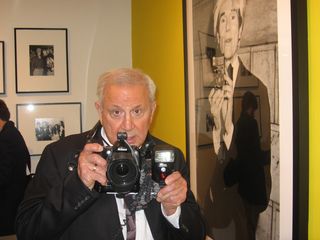
On Wednesday, a posh crowd filed into MoMA for the opening night of the 39th New Directors/New Films series, a collaboration of the museum and the Film Society of Lincoln Center. As he would for any such opening, the New York Times society and style photographer Bill Cunningham in blue jacket snapped away, capturing the well-turned out and a la mode.Eschewing the red carpet where another type of party photographer had the likes of Anna Wintour and Carmen dell' Orefice posing, Cunningham waited at the entrance for a lady in a tiered hat, a brocade coat, some elegant, eccentric froufrou the merits of which only he could discern. New Yorkers are used to his trend spotting preoccupation, except that on this special night, the film was a documentary about him. And not only hadn't he seen “Bill Cunningham New York,” he disappeared before he could. As the producer knowingly introduced, “He's allergic to attention.”
Less biopic, more homage, this portrait of an artist, a first feature by Richard Press, is also a history of New York. One of its great pleasures is a subplot about the artists' residences above Carnegie Hall where Bill Cunningham, now 81, has lived in a file cabinet lined cubicle –bathroom down the hall– for his entire career: as a milliner under the name William J, and fashion photographer for Details, Women's Wear Daily, New York Times, from the end of World War II till today, as those spaces are being converted to offices. We see footage shot by Andy Warhol of his neighbor Editta Sherman's private performance in tutu and feathers of “The Dying Swan,” as well as her photos of Warhol, Elvis and Dali. At 98, she will be the last to be relocated to some fine apartment elsewhere, but still.
Editta Sherman joined the MoMA celebration, carrying a 1978 publication, Facades, photography by Bill Cunningham with Sherman as model in period dress, bustled and corseted. On hand too: frequent Cunningham subjects Patrick McDonald and Kenny Kenny.
Bill Cunningham may be attention phobic but ladies who dress are not. Anna Wintour-Cunningham has been photographing the Vogue editor since she was a teen– says, “One dresses for Bill.” Naturally the challenge of dressing for this night was nerve-wracking. Alas, my vintage Moschino cocktail number with Roy Lichtenstein print failed to catch his eye, even though it had others shooting throughout the night. An aficionado of haute couture, he must have known it was only the designer's bridge line, “Cheap and Chic.”
-
The films of Canadian Atom Egoyan can be political and intellectual, especially when his attention is on the Armenian genocide, but in his new movie Chloe, opening this week, he returns to the themes of an early work, Exotica (1994), in a Freudian teaming of mind and sex.Viewers may want to see Chloe for the unusually sensitive attention to feminine detail: shapely ankles in strappy stilettos seen from underneath adjacent toilet stalls, lacy lingerie as the mature Julianne Moore as Dr. Catherine Stewart, a gynecologist, makes her toilette, juxtaposed with the young Amanda Seyfried as Chloe, a call girl, readying for a client, or just the voyeuristic thrill of seeing these two women in bed.Liam Neeson is Professor David Stewart, the role interrupted by Natasha Richardson's death. He's involved with Chloe too, but in this suspenseful story, not the way you think.
Chloe is the first of Egoyan's films to be made from someone else's script, in this case the writer has a resume of controversial and kinky screenplays to her name: Secretary (2002) and Fur: An Imaginary Portrait of Diane Arbus (2006), both directed by Steven Shainberg. So I was curious to talk to Erin Cressida Wilson. The following takes place in a Thai restaurant on 8th Avenue and 23rd street, just before the film's New York debut.
RW: One thread uniting your work is the sexual freedom and expression of the women. How and when did you know that sexuality for women was such a frontier?
ECW: It was a process. I grew up in San Francisco, a very sexual and expressive environment. Then I went to Smith College, an all-woman college, as you know, and they have a tee-shirt, “A Century of Women on Top.” I started to ask this question: do I have to be an aggressive on top woman to be a feminist? I was a feminist by the fact of my upbringing. My mother is a very independent woman who did what she wanted to do.
In the '80's there was political correctness about women, so when I went into the theater at that time, I was suddenly being told, you're a woman, you can work with this female director, and then I would write about something and she would say, but that's abuse. I don't know if that's abuse. I am writing about complex feelings between people that don't fall into a category. I struggled in the 80's: doesn't anybody agree with me that I can write about the complexities of human desire without being political? My political agenda is, let's not be political about this. At one point I just said, I give up. I'm just going to write dirty books.
I'm going to write what I want to write. I met Lillian Anna Slugocki who had just started producing a radio show of erotica on WBAI. You could say anything you wanted except for the swear words. These radio performances were eventually picked up by the Public Theater, becoming one of the first shows at Joe's Pub and a total success. We made a book of this material called The Erotica Project. At the same time I started to do Secretary and people at Sundance said, I'm not sure what I think about it. That was the moment when what I had been saying and praying for, for over a decade, suddenly landed. Steve [Shainberg] and I created a way to make sexual politics topical, Okay, women have desires and they may not be what's on the political agenda for feminists, and it doesn't mean she's not a feminist, but this is what we want to say. And since then, it's been infinitely easier.
RW: Of course, your characters would be championed as feminists now by intellectuals like Camille Paglia.
ECW: Yes, I didn't have those people to look to in my young 20's. Of course when I was a young child none of this mattered: It was free love, do what you want. My mother was an extremely free woman with her self, intellect and body. I knew people at Smith who said you can't be a feminist unless you are a lesbian–radical statement, perhaps important for people to move forward, but it didn't jive with my psyche.
RW: How did you get to Fur?
ECW: Secretary had just come out. And Steve said, how'd you like to look at Diane Arbus? I spent a lot of time alone looking at her photographs, and Patricia Bosworth's biography. We didn't want to do the usual thing. I wanted to write a fantasy about the birth of an artist. I took images from her work and facts from the book and created a fantasy of the birth of an artist, to create my portrait of Diane Arbus.
At the same time as I was writing I was pregnant and I had an upstairs neighbor whose noises I fell in love with. I loved my Manhattan apartment, and its sounds. I lived next door to Jeremy Steig for 20 years; his flute would basically make love to me day and night. In my fantasy about her, Arbus found her higher self, psyche and artist's mind in the man in the beast upstairs.
RW: Who is Chloe?
ECW: She's me. It took 4 years to write because I made Fur and Chloe producer Ivan Reitman-a wonderful, sensitive and great guy–was making another film. He worked very closely on the script with me. My joke is, I started out as Chloe and I ended up as Catherine. I related to Chloe, the young woman who loved to seduce people; I felt incredible empathy for her, and in the first draft she was totally fleshed out, but Catherine was middle aged and I didn't know if I could write a woman of that age. Wait, I thought, remembering a boyfriend sleeping with a 21 year old. I re-birthed myself into a woman who is no longer a little “flibbertygibbet.” I started to feel for Catherine and knew her.
RW: As Catherine develops, Chloe becomes less of a character and more emblematic.
ECW: Yes, she's a fantasy. She's a woman who makes herself a fantasy and she is a fantasy. She re-eroticizes the family and makes them fall back in love, but they have a strange incestuous secret now; in a way it is an incest story of mother and son. A mother brings in a nightmare situation to her son.
RW: How did this project come to Atom Egoyan?
ECW: I met him at a party when we did Secretary. I gave him my Book of Erotica. He said, how can we make this? And then Ivan brought up his name-they're both Canadian.
RW: You run the Dramatic Writing Program at University of California, Santa Barbara. What advice do you give your students?
ECW: Be yourself. Keep mistakes. That mistake can be the key to telling the story. If I had told the story of Fur to a normal executive they would have said no to everything. A guy upstairs covered in fur! In a way it's all a mistake. Pay attention to what falls into your life. Let it be more than an intellectual experience. I don't understand writers who don't like to write. Why do they do it? Writing is like having the greatest lover in the world. It will do exactly what you want.
RW: What's next for you?
ECW: Untitled Woman Walks Out, a pilot for HBO. Growing up, I saw a lot of women walk out on their families with devastating results. I want to follow the devastation and that woman. I am also adapting Lisa See's book, Peony in Love, for Tony and Ridley Scott at Fox 2000. Taking place in 16th century China, it's about a girl who falls in love but can't have the man she wants. She starves to death and comes back to him as a ghost.
RW: Are you happy with Amanda Seyfried's performance as Chloe?
ECW: Joyous. I saw Mamma Mia! after shooting Chloe. I used to be an actress and I know that playing the happy, simple, girl-next-door can be incredibly difficult. It takes guts to run around and sing those songs, and I know her now and she's not that giddy girl. Her acting chops in Mamma Mia! are equal to that in Chloe.
*************
A few days later at the Chloe premiere party, Thompson Hotel on the Lower East Side, Erin Cressida Wilson wanted me to meet Amanda, surely the picture of an open, free new woman. Seyfried was toying with the top of her electric blue cocktail dress, grousing that she could not wear a bra, and had to be reminded that Chloe in various stages of dress and undress, didn't wear one either.
-
Today Tallulah is synonymous with drama queen. In “Looped” on Broadway, you learn why: the first glimpse of Valerie Harper, television's soft, Mary Tyler Moore sidekick Rhoda, as screen legend Tallulah Bankhead, wearing a full length mink, blue satin dress, diamond brooch, and crocodile bag screams it, as she enters a recording studio late for a looping session– indeed loopy, bellowing “Fuck Los Angeles!” Her Bentley minus GPS as this is 1965 got lost in the canyons. Referring to one advantage of the East coast: New York is built for idiots, she presses on, referring to numbered streets, and then brings the joke home: “If you get lost in Manhattan, you don't deserve to be found.”
Deploying one zinger after another-“Bisexual: Buy me something and I'll be sexual”– Harper's Tallulah tosses her head coquettishly, bats her false lashes, vamps and grimaces, kicks back some scotch, snorts cocaine, and befriends the film editor named Danny, a character invented by the playwright Matthew Lombardo, shaping a drama out of her drama. Just getting this uber-diva to deliver a single line of garbled dialogue from “Die! Die! My Darling!,” her last film, a flop that is now a cult classic, Danny verges on a nervous breakdown.
Delineating two kinds of men, “those who want to fuck me and those who want to be me,” she asks Danny, “Which one are you?” Neither, he replies, losing it. Brian Hutchison as Danny does exasperated very well. In his limited role as foil for what is essentially a one-woman show, he prods, remembering her in “Streetcar,” and she delivers. Bankhead may be remembered as a monster of bad behavior in real life, but under the direction of Rob Ruggiero, this weirdly affecting caricature gets a lot of laughs.
Valerie Harper's stand-out performance is the reason to see “Looped.” The iconic screen legend, she epitomizes a Tallulah.
-
As the key players were introduced at the premiere screening of “The Runaways” on Wednesday night at the Sunshine Theater, my heart leapt up: wow! Look at that girl power: Joan Jett, Cherie Currie, the young actors who portray them onscreen Kristen Stewart and Dakota Fanning, and Floria Sigismondi, the writer/director, a young woman with her front lock teased high, a boyish pompadour over an evening gown. And then the movie had me by the throat: evoking the menace and creepy dark side of the 'seventies, the drugs and sex and lack of guidance for independent minded talented girls as it limned the rise and demise of the all-girl rock band, The Runaways.
Then the walk to the Bowery Hotel: The downtown streets were lined with rock fans holding dog-eared Joan Jett albums. Yikes! Is this the same Bowery as the now shuttered CBGB's? If the after party hosted by Tommy Hilfiger and Quintessentially, and DJ'd by The Misshapes, had not been so elegant, it would have been just like old times. A mix of rockers Debbie Harry and Bebe Buell, Kathleen Hanna of le Tigre, actors Chloe Sevigny, Martha Plimpton, Zach Braff, and Moby, Oren Moverman, Richie Rich, Stella Schnabel, Apparition's Bob and Jeanne Berney celebrated. Kirstie Alley, newly fat again with a reality show on A&E to celebrate that, sat on a banquette.
Agreeing that the '70's were scary, Joan Jett, an executive producer on this project, noted, they were also fun, and while she is having fun now, it's different, more controlled. Drummer Thommy Price who has worked with Jett on her band Blackhearts loved the movie and said, “I kind of wonder what might have been,” had Cherie not burnt out. “Runaways” is based on her memoir.For her debut feature film, Floria Sigismondi, a director of music videos for 15 years was sure that shooting in Detroit was a bad idea. Her attention to period detail is so exact, California was key, finding there, as is, she said, those seedy bathrooms and kitchens, places that usually are the first to be renovated surprisingly intact. Yes, Dakota Fanning was really singing “Cherry Bomb” with Kristen Stewart really playing electric guitar: “She is so natural; she really knows how to put her self there,” Sigismondi lauded Stewart's work.
Remarkably a near Joan Jett look alike, Noomi Rapace stars in a Swedish movie based upon the best-selling first book of Steig Larsson's Milennium Trilogy, “The Girl With the Dragon Tattoo.” At a special screening at Scandinavia House, director Niels Arden Oplev, introduced his movie modestly, noting that it would be just your normal everyday family story of decades old deep dark secrets that come to the surface-eh, serial murders-Nazi affiliation-except for the character Lisbeth Salander played by Rapace, who joins a journalist in an investigation about the case of a missing niece long ago. The rogue Goth girl rises up as she's having sex; on her back the title dragon curls up, lifting the material and making it fascinate. -
Rosie O'Donnell tells pals she has deal to return to daytime TV in 2011. Roger friedman reports that Rosie Will replace Oprah as talk show queen. Rosie was overheard at Bway watering hole Joe Allens telling friends her return deal is almost signed for syndicated show. Would be biggest deal ever. More to come -
Lincoln Center's Alice Tully Hall was packed for the opening night of the Rendez-Vous with French Cinema; in 2008, you may recall, the opening night featured Marion Cotillard's Oscar winning turn as Edith Piaf in “La Vie en Rose.” This year's opener, a Cold War espionage thriller, Christian Carion's “Farewell” stars the actor/ directors Emir Kusturica and Guilllaume Canet, with cameos by the Americans Fred Ward and Willem Dafoe, illustrating something of the synergy of world cinema.Antoine de Clermont Tonnerre, President of French Unifrance introduced the elegant evening recounting a scene from Woody Allen's “Happy Ending,” where the film within the film was trashed by American critics for its incoherence, and loved as genius by the French. His punch line: Thank goodness for the French.With Rendez-vous, Americans may agree, but in reverse, observing the special qualities of these French offerings: Francois Ozon's “The Refuge,” for example, is the story of a pregnant ex drug addict and the gay brother of the baby's father, suggesting open possibilities for parenting. Christophe Honore's “Making Plans for Lena” stars an excellent Chiara Mastroianni as a divorced mother of two who unravels emotionally during a summer holiday in Brittany.A James Bond spoof, Michel Hazanavicius's “OSS 117-Lost in Rio” may challenge many Americans' sense of humor about the Holocaust, anti-Semitism, racism, and sexism. As my child observed about “The Producers,” “it offends everyone.” Hazanavicius, in town to introduce his film had no problem with possible rancor. What's next for him? The director said he is scripting a silent movie. -
One powerful message of the play Next Fall is contained in its title. Simply, don't put things off: life may not wait till next fall. Or, as one character Holly (Maddie Corman) says, “One minute you are doing the crossword puzzle, and the next you are here.”Here is a hospital waiting room where Luke, a friend and employee at her flower shop, languishes in a coma after a hideous accident. As hope for Luke remains uncertain, we see him in flashback played energetically by Patrick Heusinger in this multilayered play by Geoffrey Nauffts and directed by Sheryl Kaller that had its world premiere in a sold-out Naked Angels production last summer. Extended several times, Next Fall –with its original ensemble cast –is now on Broadway in the intimate Helen Hays Theater. In the spirit of the title, see it now.Waiting with Holly are several others: Luke's divorced parents, the racy Arlene (Connie Ray) and fundamentalist Butch (Cotter Smith), his agnostic Jewish boyfriend Adam (Patrick Breen), and another friend, Brandon (Sean Dugan), whose relationship with Luke is rather mysterious. The play deftly moves into scenes of Luke's life with these characters revealing his conflicts with his homosexuality (he prays after sex); his need to keep his life hidden from the aptly named Butch.Especially poignant is Luke's relationship with Adam, a seeming mismatch, whose most immediate problem is, as non-family, his inability to see Luke at this critical time. The scenes that play out how they met, how Luke keeps the truth about Adam from Butch, are funny in the manner of Seinfeld episodes. Your laugh is bittersweet: these wonderfully drawn characters keep you painfully aware that the vibrant young man at center is in trouble. -
As it prepares its ninth season, it is noteworthy that several movies opening theatrically in the next few weeks premiered at last year's Tribeca Film Festival, among them Conor McPherson's “The Eclipse' and Bette Gordon's “Handsome Harry.” Another is a sweet-hearted gem named for its primary location, City Island.“City Island” is set in the small fishing community, a part of the Bronx that feels remote from New York City, providing a backdrop for a family story where each member has something to hide. Andy Garcia leads a cast that includes Alan Arkin, Julianna Margulies, Emily Mortimer. His own daughter Dominik Garcia-Lorido plays his film daughter, a college student who has a secret vocation as a stripper in a Bada Bing type bar.
Dominik said she refused to have her father on set for some of her scenes. Yes, there's one that any parent would find difficult: clad in a sequined bikini, the shapely Dominik pole dances upside down.
As written and directed by Raymond De Felitta, transgressions big and small are neatly and humorously confessed and forgiven. Screened this week at the Directors Guild Theater, the film exuded a good nature that spilled over into the party at Rouge Tomate where Griffin Dunne, Christine Baranski, Tovah Feldshuh, Sandra Bernhard, Michael Stuhlbarg, Richard Kind, Ruben Blades, Rodriguez Narciso, Vera Wang, and Hugh Jackman joined the cast for supper. Parker Posey and her friend Emma Tapley wore cute dresses, coincidentally designed by Cynthia Rowley who dined at a table nearby.
Julianna Margulies, this year's Golden Globe winner for her work in the CBS series, “The Good Wife” was having a good year indeed. Accolade after accolade, the actress perched on sky-high heels said, she promised her husband, it won't always be this exciting. Let me enjoy this now. You could say that “City Island” provides her a comic variation on the wronged spouse she plays on television, when she thinks her husband is cheating on her with a “Holly Golightly-” esque character played by Emily Mortimer.
New York may be the place to reinvent oneself, but on City Island people stay close to their roots. At the party, Andy Garcia shook hands vigorously with fellow Cuban American Narcisco Rodriguez and said, “I am so proud of you.”
-
Actor, writer, director Bob Balaban paced about the cavernous Cipriani 42nd Street, a wad of papers clenched in his hands, as only an accomplished professional with a speech to make could. One of the artists to receive Guild Hall's annual award for Lifetime Achievement, the bespectacled Balaban, who as a teen appeared in the classic “Midnight Cowboy,” flies off to Minnesota this week to act in a new film, “The Convincer” with Billy Crudup; the Bridgehampton part-timer also has a children's book series coming out, “The Creature from the 7th Grade.”
But now he worried that the philanthropic crowd including Michael Lynne and his wife Ninah, Patti Kenner and her 99 year old dad, previous recipient Sheldon Harnick, and many other East Enders would not be amply entertained by his words, so he had a secret. Shhhh, said his wife Lynn Grossman, pulling me aside: Balaban enlisted The Flying Karamazov Brothers to perform their juggling act, first with a fish, then with a ukulele, and finally with the award itself.Wow. With the very funny Angela LaGreca as the evening's M.C., the benefit for this first-rate organization looked promising indeed. Previewing the summer season, Arts Director Josh Gladstone mentioned a new play directed by Tony Walton and starring Alec Baldwin.Another award recipient for the evening, playwright Marsha Norman said she was working on a musical with Sheryl Crow. A Pulitzer Prize winner, Norman said she really wanted this Guild Hall award: “I always wanted to be in.” The third arts recipient, Richard Prince, never made it to cocktails. -
Awards fatigue was almost forgotten at the splendid Oscar festivities at Gilt at the Palace Hotel on Madison Avenue. Members of the American Academy of Motion Pictures who were not walking the red carpet at the Kodak Theater partied perfectly at home in New York, begowned and bejeweled, and if not surprised by the unfolding of honors for colleagues, sipped fine champagne and dined in celebration of the accolades their votes produced.
Movie legends Celeste Holm, Arlene Dahl, Shirley Knight, and Sylvia Miles escorted by painter Hunt Slonem, posed for photos and other film world notables: Mitchell Lichtenstein, Celia Weston, Courtney Hunt enjoyed specially created canapes: Mississippi style corn fritters a la The Blind Side, citrus-marinated yellowtail and blood orange ceviche for Inglourius Basterds-“served cold like revenge,” and matzo balls with chicken consommé for A Serious Man.
While the long telecast was a ceremonious end to the especially protracted award season, the results were remarkably predictable with wins for The Hurt Locker, Sandra Bullock, and so on. Actors Mo'Nique, Jeff Bridges, and Christoph Waltz won just about every important honor leading up to Oscars. So, no surprise there.
The sheer poetry of Barbra Streisand's presenting to Kathryn Bigelow cannot be overlooked. Streisand's direction for Yentl (1963) and perhaps Prince of Tides (1991) should certainly have earned her Oscar distinction.
As to the one true surprise of the evening: Best Foreign Language Film was thought to be a battle between the Austrian The White Ribbon and French The Prophet. The Argentinian The Secret in their Eyes took home the statue. My spies, travelers in Argentina, emailed me that they were watching the ceremony at a modest Buenos Aires hotel, and there the locals partied proud.
-
“No one expects you to perform miracles,” says the head of the Perkins Institute for the Blind sending his prized pupil Anne Sullivan south from Boston to Tuscumbia, Alabama, to a family where she is to become governess to an unruly blind and deaf girl named Helen Keller. The line gets a big laugh at the Circle in the Square Theater because, in this cherished, inspiring story of true events from 1880-well-known from the original 1959 play by William Gibson and a first-rate 1962 movie-of course work a miracle is exactly what she does. This revival of Gibson's play features a wonderful supporting cast of seasoned actors: Elizabeth Franzplays Helen's aunt, Jennifer Morrison, Helen's mother, and Matthew Modine in his Broadway debut rises to skeptical, curmudgeonly fervor as Helen's father. In a quasi-developed subplot with his son James (Tobias Segal), one wishes for more for these fine actors to do.The play, however, is really a pas de deux with the untamed, unruly wild child, Helen (a gifted Abigail Breslin, the bright light in the “Little Miss Sunshine” ensemble), making mischief and Anne (Alison Pillseen among other roles, in HBO's “In Treatment”) trusting that language will set the girl free. The key moment, when Helen at the water pump vocalizes the syllables, wah-wah, brings the house to tears. This straight-ahead period drama takes us through that miraculous leap of discipline and discovery, and, for that moment, it is thrilling.A note: the Film Society at Lincoln Center will screen “The Miracle Worker” in their “Fierce & FabulousAnne Bancroft” Tribute on March 8, with special guest Patty Duke, the original Helen Keller to Bancroft's Anne Sullivan.