A farce in the manner of Feydeau, Ken Ludwig's 1986 Lend Me a Tenor revived at the Music Box Theater and directed by Stanley Tucci, has laughs aplenty as doors -and bodies– slam in a 1934 Cleveland hotel suite.
In anticipation of a production of Verdi's Otello, the opera's impresario, Saunders, sweats the arrival of the starred tenor. Finally blustering in, his jealous wife in tow, the renowned “Il Stupendo” needs a nap. A drug-induced sleep threatens: will this show go on?
And how! Okay, you have to suspend your disbelief big time for this corny material: Tito Merelli, the tenor, just happens to have two costumes on hand, convenient for Max, the impresario's homme d'affaires to step in. Two Otellos in black face and regal robe spell mistaken identity. One sings, the other is taken for a crasher. Guess which?
A high point of Act II is when each Otello makes it with a starry eyed fan, on a couch in the suite's sitting room, and in the bedroom, a visual split screen. The women are deliciously clueless: An infatuated Maggie, Saunders' daughter, played cutely by Mary Catherine Garrison; an overheated soprano, Diana, played coyly by Jennifer Laura Thompson; and, the temperamental, forgiving wife Maria played with zesty accent by Jan Maxwell. Only Brooke Adams is off as Julia, the chair of the opera gala with strait-laced haute grandeur; more matronly prudery would be funnier.
Ah the men: Tony Shalhoub handsome in tux as Saunders, Anthony LaPaglia, bloated in brocade, and the surprise: Justin Bartha is charming as Max. Maggie had thrown herself at him, thinking he was the Italian tenor. Her, “I'm glad it was you,” suggests that times in the '30's midwest were racy indeed as imagined in this delightful period comedy.
The mood was exultant at Veranda where a party for the movie Breaking Upwards was underway after last week's IFC premiere. “I can't believe what's happening here,” I heard celebrants say, even if one was the director/ writer/ star Daryl Wein's mother. But then again, mothers are big part of this startlingly fresh take on the tried and often tired genre of romantic comedy.
When the film's Zoe and Daryl schedule days off on their relationship, each of their mothers (Julie White and Andrea Martin) weigh in like a Greek chorus. As actors portraying themselves, Daryl Wein evokes the angst driven vintage Woody Allen and Zoe Lister-Jones, the spot on timing of Julia Louis-Dreyfus, as each navigates New York, and the vagaries of the heart in a committed yet young and restless relationship.
That's not to be confused with real-life 20-something Zoe and Daryl whose break up story this is. With references to tweets and texts, this movie moves at the rate of the Zeitgeist. The timely subject of Love-and how to make it last- is timelessly gadget-proof. As characters, they are so appealing it comes as a relief that the story of these two NYU Tisch graduates is not over even when this very smart and funny movie is.
Others attending this premiere included the fine Mamie Gummer (her mom Meryl Streep is mentioned ironically in the film), Ebon Moss-Bachrach (so good as Tom in The Glass Menagerie at Guild Hall last summer), Ezra Miller (City Island), and Pablo Schreiber (The Wire). Heather Burns, memorable twirling fire tipped batons in Miss Congeniality, plays a small role in Breaking Upwards. She said she was thinking about Sandra Bullock during this scandal-ridden time for the recent Oscar winner's marriage, finding the betrayal sad. Of Jesse James, “I really liked him.”
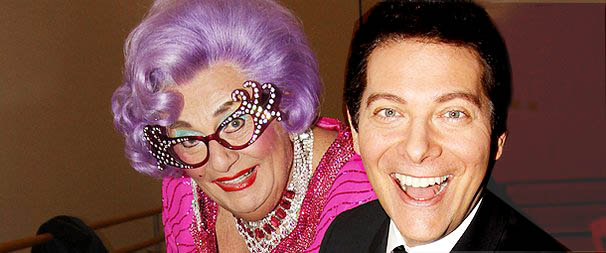
Dame Edna Everage and Michael Feinstein make a fine couple, if you enjoy a visual oxymoron: the former is the alter ego of the Australian Barry Humphries, known for his large outsized glamour. The latter is the charming song man of The Regency, diminutive, understated, elegant. Each a consummate performer, together they make for an entertaining evening combining highlights of the American songbook with Dame Edna's signature comedy, and somehow, by the end you find yourself happily in a sing along waving priapic gladioli and intoning, “Thrust, thrust, thrust.”
How did you get here? The show is based on the conceit that each has booked this space, and now, egos flair, the two vie for dominance. The brainchild of the stars plus playwright Christopher Durang and Lizzie Spender, the daughter of Stephen Spender and Barry Humphries' wife, All About Me, utilizes these talents for what amounts to a glorified high school sing, and yet, it is deliciously engaging, hilarious.
Dame Edna's wardrobe is a study in what to wear if you are insecure enough to have to prod the audience, you do miss me? She needn't worry, a man in the front row had on identical glasses with rhinestoned wings. Feathers, bling, one creation is more monumentally bedazzling than the last, as the lilac haired comic shows off her gams in red high heels. Backing her up are two buff bouncers who double in dance (Gregory Butler and Jon-Paul Mateo). Even the stage manager (Jodi Capeless) gets into the act. Exclaiming this a Sondheim-free zone, just as it's been announced, the Henry Miller Theater will be named for this Broadway great, Dame Edna does a fine “Here's to the Ladies Who Lunch.”
Michael Feinstein pays homage to comedian Paul Lind's turn on Hollywood Squares, recalled a seminal moment when the host posed this question, “Men reach their sexual peek as teens. At what age for women?” Lind replied, “Who cares?” You get that he's gay. But prepare yourself for this image, when Dame Edna offers to straddle his instrument.
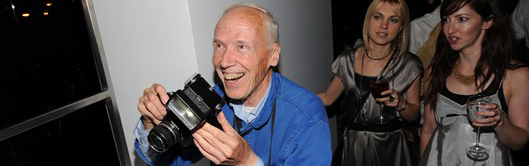
On Wednesday, a posh crowd filed into MoMA for the opening night of the 39th New Directors/New Films series, a collaboration of the museum and the Film Society of Lincoln Center. As he would for any such opening, the New York Times society and style photographer Bill Cunningham in blue jacket snapped away, capturing the well-turned out and a la mode.
Eschewing the red carpet where another type of party photographer had the likes of Anna Wintour and Carmen dell' Orefice posing, Cunningham waited at the entrance for a lady in a tiered hat, a brocade coat, some elegant, eccentric froufrou the merits of which only he could discern. New Yorkers are used to his trend spotting preoccupation, except that on this special night, the film was a documentary about him. And not only hadn't he seen “Bill Cunningham New York,” he disappeared before he could. As the producer knowingly introduced, “He's allergic to attention.”
Less biopic, more homage, this portrait of an artist, a first feature by Richard Press, is also a history of New York. One of its great pleasures is a subplot about the artists' residences above Carnegie Hall where Bill Cunningham, now 81, has lived in a file cabinet lined cubicle –bathroom down the hall– for his entire career: as a milliner under the name William J, and fashion photographer for Details, Women's Wear Daily, New York Times, from the end of World War II till today, as those spaces are being converted to offices. We see footage shot by Andy Warhol of his neighbor Editta Sherman's private performance in tutu and feathers of “The Dying Swan,” as well as her photos of Warhol, Elvis and Dali. At 98, she will be the last to be relocated to some fine apartment elsewhere, but still.
Editta Sherman joined the MoMA celebration, carrying a 1978 publication, Facades, photography by Bill Cunningham with Sherman as model in period dress, bustled and corseted. On hand too: frequent Cunningham subjects Patrick McDonald and Kenny Kenny.
Bill Cunningham may be attention phobic but ladies who dress are not. Anna Wintour-Cunningham has been photographing the Vogue editor since she was a teen– says, “One dresses for Bill.” Naturally the challenge of dressing for this night was nerve-wracking. Alas, my vintage Moschino cocktail number with Roy Lichtenstein print failed to catch his eye, even though it had others shooting throughout the night. An aficionado of haute couture, he must have known it was only the designer's bridge line, “Cheap and Chic.”
The films of Canadian Atom Egoyan can be political and intellectual, especially when his attention is on the Armenian genocide, but in his new movie Chloe, opening this week, he returns to the themes of an early work, Exotica (1994), in a Freudian teaming of mind and sex.
Viewers may want to see Chloe for the unusually sensitive attention to feminine detail: shapely ankles in strappy stilettos seen from underneath adjacent toilet stalls, lacy lingerie as the mature Julianne Moore as Dr. Catherine Stewart, a gynecologist, makes her toilette, juxtaposed with the young Amanda Seyfried as Chloe, a call girl, readying for a client, or just the voyeuristic thrill of seeing these two women in bed.Liam Neeson is Professor David Stewart, the role interrupted by Natasha Richardson's death. He's involved with Chloe too, but in this suspenseful story, not the way you think.
Chloe is the first of Egoyan's films to be made from someone else's script, in this case the writer has a resume of controversial and kinky screenplays to her name: Secretary (2002) and Fur: An Imaginary Portrait of Diane Arbus (2006), both directed by Steven Shainberg. So I was curious to talk to Erin Cressida Wilson. The following takes place in a Thai restaurant on 8th Avenue and 23rd street, just before the film's New York debut.
RW: One thread uniting your work is the sexual freedom and expression of the women. How and when did you know that sexuality for women was such a frontier?
ECW: It was a process. I grew up in San Francisco, a very sexual and expressive environment. Then I went to Smith College, an all-woman college, as you know, and they have a tee-shirt, “A Century of Women on Top.” I started to ask this question: do I have to be an aggressive on top woman to be a feminist? I was a feminist by the fact of my upbringing. My mother is a very independent woman who did what she wanted to do.
In the '80's there was political correctness about women, so when I went into the theater at that time, I was suddenly being told, you're a woman, you can work with this female director, and then I would write about something and she would say, but that's abuse. I don't know if that's abuse. I am writing about complex feelings between people that don't fall into a category. I struggled in the 80's: doesn't anybody agree with me that I can write about the complexities of human desire without being political? My political agenda is, let's not be political about this. At one point I just said, I give up. I'm just going to write dirty books.
I'm going to write what I want to write. I met Lillian Anna Slugocki who had just started producing a radio show of erotica on WBAI. You could say anything you wanted except for the swear words. These radio performances were eventually picked up by the Public Theater, becoming one of the first shows at Joe's Pub and a total success. We made a book of this material called The Erotica Project. At the same time I started to do Secretary and people at Sundance said, I'm not sure what I think about it. That was the moment when what I had been saying and praying for, for over a decade, suddenly landed. Steve [Shainberg] and I created a way to make sexual politics topical, Okay, women have desires and they may not be what's on the political agenda for feminists, and it doesn't mean she's not a feminist, but this is what we want to say. And since then, it's been infinitely easier.
RW: Of course, your characters would be championed as feminists now by intellectuals like Camille Paglia.
ECW: Yes, I didn't have those people to look to in my young 20's. Of course when I was a young child none of this mattered: It was free love, do what you want. My mother was an extremely free woman with her self, intellect and body. I knew people at Smith who said you can't be a feminist unless you are a lesbian–radical statement, perhaps important for people to move forward, but it didn't jive with my psyche.
RW: How did you get to Fur?
ECW: Secretary had just come out. And Steve said, how'd you like to look at Diane Arbus? I spent a lot of time alone looking at her photographs, and Patricia Bosworth's biography. We didn't want to do the usual thing. I wanted to write a fantasy about the birth of an artist. I took images from her work and facts from the book and created a fantasy of the birth of an artist, to create my portrait of Diane Arbus.
At the same time as I was writing I was pregnant and I had an upstairs neighbor whose noises I fell in love with. I loved my Manhattan apartment, and its sounds. I lived next door to Jeremy Steig for 20 years; his flute would basically make love to me day and night. In my fantasy about her, Arbus found her higher self, psyche and artist's mind in the man in the beast upstairs.
RW: Who is Chloe?
ECW: She's me. It took 4 years to write because I made Fur and Chloe producer Ivan Reitman-a wonderful, sensitive and great guy–was making another film. He worked very closely on the script with me. My joke is, I started out as Chloe and I ended up as Catherine. I related to Chloe, the young woman who loved to seduce people; I felt incredible empathy for her, and in the first draft she was totally fleshed out, but Catherine was middle aged and I didn't know if I could write a woman of that age. Wait, I thought, remembering a boyfriend sleeping with a 21 year old. I re-birthed myself into a woman who is no longer a little “flibbertygibbet.” I started to feel for Catherine and knew her.
RW: As Catherine develops, Chloe becomes less of a character and more emblematic.
ECW: Yes, she's a fantasy. She's a woman who makes herself a fantasy and she is a fantasy. She re-eroticizes the family and makes them fall back in love, but they have a strange incestuous secret now; in a way it is an incest story of mother and son. A mother brings in a nightmare situation to her son.
RW: How did this project come to Atom Egoyan?
ECW: I met him at a party when we did Secretary. I gave him my Book of Erotica. He said, how can we make this? And then Ivan brought up his name-they're both Canadian.
RW: You run the Dramatic Writing Program at University of California, Santa Barbara. What advice do you give your students?
ECW: Be yourself. Keep mistakes. That mistake can be the key to telling the story. If I had told the story of Fur to a normal executive they would have said no to everything. A guy upstairs covered in fur! In a way it's all a mistake. Pay attention to what falls into your life. Let it be more than an intellectual experience. I don't understand writers who don't like to write. Why do they do it? Writing is like having the greatest lover in the world. It will do exactly what you want.
RW: What's next for you?
ECW: Untitled Woman Walks Out, a pilot for HBO. Growing up, I saw a lot of women walk out on their families with devastating results. I want to follow the devastation and that woman. I am also adapting Lisa See's book, Peony in Love, for Tony and Ridley Scott at Fox 2000. Taking place in 16th century China, it's about a girl who falls in love but can't have the man she wants. She starves to death and comes back to him as a ghost.
RW: Are you happy with Amanda Seyfried's performance as Chloe?
ECW: Joyous. I saw Mamma Mia! after shooting Chloe. I used to be an actress and I know that playing the happy, simple, girl-next-door can be incredibly difficult. It takes guts to run around and sing those songs, and I know her now and she's not that giddy girl. Her acting chops in Mamma Mia! are equal to that in Chloe.
*************
A few days later at the Chloe premiere party, Thompson Hotel on the Lower East Side, Erin Cressida Wilson wanted me to meet Amanda, surely the picture of an open, free new woman. Seyfried was toying with the top of her electric blue cocktail dress, grousing that she could not wear a bra, and had to be reminded that Chloe in various stages of dress and undress, didn't wear one either.
Today Tallulah is synonymous with drama queen. In “Looped” on Broadway, you learn why: the first glimpse of Valerie Harper, television's soft, Mary Tyler Moore sidekick Rhoda, as screen legend Tallulah Bankhead, wearing a full length mink, blue satin dress, diamond brooch, and crocodile bag screams it, as she enters a recording studio late for a looping session– indeed loopy, bellowing “Fuck Los Angeles!” Her Bentley minus GPS as this is 1965 got lost in the canyons.
Referring to one advantage of the East coast: New York is built for idiots, she presses on, referring to numbered streets, and then brings the joke home: “If you get lost in Manhattan, you don't deserve to be found.”
Deploying one zinger after another-“Bisexual: Buy me something and I'll be sexual”– Harper's Tallulah tosses her head coquettishly, bats her false lashes, vamps and grimaces, kicks back some scotch, snorts cocaine, and befriends the film editor named Danny, a character invented by the playwright Matthew Lombardo, shaping a drama out of her drama. Just getting this uber-diva to deliver a single line of garbled dialogue from “Die! Die! My Darling!,” her last film, a flop that is now a cult classic, Danny verges on a nervous breakdown.
Delineating two kinds of men, “those who want to fuck me and those who want to be me,” she asks Danny, “Which one are you?” Neither, he replies, losing it. Brian Hutchison as Danny does exasperated very well. In his limited role as foil for what is essentially a one-woman show, he prods, remembering her in “Streetcar,” and she delivers. Bankhead may be remembered as a monster of bad behavior in real life, but under the direction of Rob Ruggiero, this weirdly affecting caricature gets a lot of laughs.
Valerie Harper's stand-out performance is the reason to see “Looped.” The iconic screen legend, she epitomizes a Tallulah.
As the key players were introduced at the premiere screening of “The Runaways” on Wednesday night at the Sunshine Theater, my heart leapt up: wow! Look at that girl power: Joan Jett, Cherie Currie, the young actors who portray them onscreen Kristen Stewart and Dakota Fanning, and Floria Sigismondi, the writer/director, a young woman with her front lock teased high, a boyish pompadour over an evening gown. And then the movie had me by the throat: evoking the menace and creepy dark side of the 'seventies, the drugs and sex and lack of guidance for independent minded talented girls as it limned the rise and demise of the all-girl rock band, The Runaways.
Agreeing that the '70's were scary, Joan Jett, an executive producer on this project, noted, they were also fun, and while she is having fun now, it's different, more controlled. Drummer Thommy Price who has worked with Jett on her band Blackhearts loved the movie and said, “I kind of wonder what might have been,” had Cherie not burnt out. “Runaways” is based on her memoir.
For her debut feature film, Floria Sigismondi, a director of music videos for 15 years was sure that shooting in Detroit was a bad idea. Her attention to period detail is so exact, California was key, finding there, as is, she said, those seedy bathrooms and kitchens, places that usually are the first to be renovated surprisingly intact. Yes, Dakota Fanning was really singing “Cherry Bomb” with Kristen Stewart really playing electric guitar: “She is so natural; she really knows how to put her self there,” Sigismondi lauded Stewart's work.
Remarkably a near Joan Jett look alike, Noomi Rapace stars in a Swedish movie based upon the best-selling first book of Steig Larsson's Milennium Trilogy, “The Girl With the Dragon Tattoo.” At a special screening at Scandinavia House, director Niels Arden Oplev, introduced his movie modestly, noting that it would be just your normal everyday family story of decades old deep dark secrets that come to the surface-eh, serial murders-Nazi affiliation-except for the character Lisbeth Salander played by Rapace, who joins a journalist in an investigation about the case of a missing niece long ago. The rogue Goth girl rises up as she's having sex; on her back the title dragon curls up, lifting the material and making it fascinate.
Rosie O'Donnell tells pals she has deal to return to daytime TV in 2011. Roger friedman reports that Rosie Will replace Oprah as talk show queen.
Rosie was overheard at Bway watering hole Joe Allens telling friends her return deal is almost signed for syndicated show. Would be biggest deal ever. More to come
Lincoln Center's Alice Tully Hall was packed for the opening night of the Rendez-Vous with French Cinema; in 2008, you may recall, the opening night featured Marion Cotillard's Oscar winning turn as Edith Piaf in “La Vie en Rose.” This year's opener, a Cold War espionage thriller, Christian Carion's “Farewell” stars the actor/ directors Emir Kusturica and Guilllaume Canet, with cameos by the Americans Fred Ward and Willem Dafoe, illustrating something of the synergy of world cinema.
Antoine de Clermont Tonnerre, President of French Unifrance introduced the elegant evening recounting a scene from Woody Allen's “Happy Ending,” where the film within the film was trashed by American critics for its incoherence, and loved as genius by the French. His punch line: Thank goodness for the French.
With Rendez-vous, Americans may agree, but in reverse, observing the special qualities of these French offerings: Francois Ozon's “The Refuge,” for example, is the story of a pregnant ex drug addict and the gay brother of the baby's father, suggesting open possibilities for parenting. Christophe Honore's “Making Plans for Lena” stars an excellent Chiara Mastroianni as a divorced mother of two who unravels emotionally during a summer holiday in Brittany.
A James Bond spoof, Michel Hazanavicius's “OSS 117-Lost in Rio” may challenge many Americans' sense of humor about the Holocaust, anti-Semitism, racism, and sexism. As my child observed about “The Producers,” “it offends everyone.” Hazanavicius, in town to introduce his film had no problem with possible rancor. What's next for him? The director said he is scripting a silent movie.
One powerful message of the play Next Fall is contained in its title. Simply, don't put things off: life may not wait till next fall. Or, as one character Holly (Maddie Corman) says, “One minute you are doing the crossword puzzle, and the next you are here.”
Here is a hospital waiting room where Luke, a friend and employee at her flower shop, languishes in a coma after a hideous accident. As hope for Luke remains uncertain, we see him in flashback played energetically by Patrick Heusinger in this multilayered play by Geoffrey Nauffts and directed by Sheryl Kaller that had its world premiere in a sold-out Naked Angels production last summer. Extended several times, Next Fall –with its original ensemble cast –is now on Broadway in the intimate Helen Hays Theater. In the spirit of the title, see it now.
Waiting with Holly are several others: Luke's divorced parents, the racy Arlene (Connie Ray) and fundamentalist Butch (Cotter Smith), his agnostic Jewish boyfriend Adam (Patrick Breen), and another friend, Brandon (Sean Dugan), whose relationship with Luke is rather mysterious. The play deftly moves into scenes of Luke's life with these characters revealing his conflicts with his homosexuality (he prays after sex); his need to keep his life hidden from the aptly named Butch.
Especially poignant is Luke's relationship with Adam, a seeming mismatch, whose most immediate problem is, as non-family, his inability to see Luke at this critical time. The scenes that play out how they met, how Luke keeps the truth about Adam from Butch, are funny in the manner of Seinfeld episodes. Your laugh is bittersweet: these wonderfully drawn characters keep you painfully aware that the vibrant young man at center is in trouble.
As it prepares its ninth season, it is noteworthy that several movies opening theatrically in the next few weeks premiered at last year's Tribeca Film Festival, among them Conor McPherson's “The Eclipse' and Bette Gordon's “Handsome Harry.” Another is a sweet-hearted gem named for its primary location, City Island.
“City Island” is set in the small fishing community, a part of the Bronx that feels remote from New York City, providing a backdrop for a family story where each member has something to hide. Andy Garcia leads a cast that includes Alan Arkin, Julianna Margulies, Emily Mortimer. His own daughter Dominik Garcia-Lorido plays his film daughter, a college student who has a secret vocation as a stripper in a Bada Bing type bar.
Dominik said she refused to have her father on set for some of her scenes. Yes, there's one that any parent would find difficult: clad in a sequined bikini, the shapely Dominik pole dances upside down.
Julianna Margulies, this year's Golden Globe winner for her work in the CBS series, “The Good Wife” was having a good year indeed. Accolade after accolade, the actress perched on sky-high heels said, she promised her husband, it won't always be this exciting. Let me enjoy this now. You could say that “City Island” provides her a comic variation on the wronged spouse she plays on television, when she thinks her husband is cheating on her with a “Holly Golightly-” esque character played by Emily Mortimer.
New York may be the place to reinvent oneself, but on City Island people stay close to their roots. At the party, Andy Garcia shook hands vigorously with fellow Cuban American Narcisco Rodriguez and said, “I am so proud of you.”
Actor, writer, director Bob Balaban paced about the cavernous Cipriani 42nd Street, a wad of papers clenched in his hands, as only an accomplished professional with a speech to make could. One of the artists to receive Guild Hall's annual award for Lifetime Achievement, the bespectacled Balaban, who as a teen appeared in the classic “Midnight Cowboy,” flies off to Minnesota this week to act in a new film, “The Convincer” with Billy Crudup; the Bridgehampton part-timer also has a children's book series coming out, “The Creature from the 7th Grade.”
But now he worried that the philanthropic crowd including Michael Lynne and his wife Ninah, Patti Kenner and her 99 year old dad, previous recipient Sheldon Harnick, and many other East Enders would not be amply entertained by his words, so he had a secret. Shhhh, said his wife Lynn Grossman, pulling me aside: Balaban enlisted The Flying Karamazov Brothers to perform their juggling act, first with a fish, then with a ukulele, and finally with the award itself.
Wow. With the very funny Angela LaGreca as the evening's M.C., the benefit for this first-rate organization looked promising indeed. Previewing the summer season, Arts Director Josh Gladstone mentioned a new play directed by Tony Walton and starring Alec Baldwin.
Another award recipient for the evening, playwright Marsha Norman said she was working on a musical with Sheryl Crow. A Pulitzer Prize winner, Norman said she really wanted this Guild Hall award: “I always wanted to be in.” The third arts recipient, Richard Prince, never made it to cocktails.
Awards fatigue was almost forgotten at the splendid Oscar festivities at Gilt at the Palace Hotel on Madison Avenue. Members of the American Academy of Motion Pictures who were not walking the red carpet at the Kodak Theater partied perfectly at home in New York, begowned and bejeweled, and if not surprised by the unfolding of honors for colleagues, sipped fine champagne and dined in celebration of the accolades their votes produced.
Movie legends Celeste Holm, Arlene Dahl, Shirley Knight, and Sylvia Miles escorted by painter Hunt Slonem, posed for photos and other film world notables: Mitchell Lichtenstein, Celia Weston, Courtney Hunt enjoyed specially created canapes: Mississippi style corn fritters a la The Blind Side, citrus-marinated yellowtail and blood orange ceviche for Inglourius Basterds-“served cold like revenge,” and matzo balls with chicken consommé for A Serious Man.
While the long telecast was a ceremonious end to the especially protracted award season, the results were remarkably predictable with wins for The Hurt Locker, Sandra Bullock, and so on. Actors Mo'Nique, Jeff Bridges, and Christoph Waltz won just about every important honor leading up to Oscars. So, no surprise there.
The sheer poetry of Barbra Streisand's presenting to Kathryn Bigelow cannot be overlooked. Streisand's direction for Yentl (1963) and perhaps Prince of Tides (1991) should certainly have earned her Oscar distinction.
As to the one true surprise of the evening: Best Foreign Language Film was thought to be a battle between the Austrian The White Ribbon and French The Prophet. The Argentinian The Secret in their Eyes took home the statue. My spies, travelers in Argentina, emailed me that they were watching the ceremony at a modest Buenos Aires hotel, and there the locals partied proud.
“No one expects you to perform miracles,” says the head of the Perkins Institute for the Blind sending his prized pupil Anne Sullivan south from Boston to Tuscumbia, Alabama, to a family where she is to become governess to an unruly blind and deaf girl named Helen Keller. The line gets a big laugh at the Circle in the Square Theater because, in this cherished, inspiring story of true events from 1880-well-known from the original 1959 play by William Gibson and a first-rate 1962 movie-of course work a miracle is exactly what she does.
This revival of Gibson's play features a wonderful supporting cast of seasoned actors: Elizabeth Franzplays Helen's aunt, Jennifer Morrison, Helen's mother, and Matthew Modine in his Broadway debut rises to skeptical, curmudgeonly fervor as Helen's father. In a quasi-developed subplot with his son James (Tobias Segal), one wishes for more for these fine actors to do.
The play, however, is really a pas de deux with the untamed, unruly wild child, Helen (a gifted Abigail Breslin, the bright light in the “Little Miss Sunshine” ensemble), making mischief and Anne (Alison Pillseen among other roles, in HBO's “In Treatment”) trusting that language will set the girl free. The key moment, when Helen at the water pump vocalizes the syllables, wah-wah, brings the house to tears. This straight-ahead period drama takes us through that miraculous leap of discipline and discovery, and, for that moment, it is thrilling.
A note: the Film Society at Lincoln Center will screen “The Miracle Worker” in their “Fierce & FabulousAnne Bancroft” Tribute on March 8, with special guest Patty Duke, the original Helen Keller to Bancroft's Anne Sullivan.
The Golden Globe winning actress for her role in the CBS series The Good Wife, Julianna Marguiles, was honored at the MCC gala on Monday night. M.C. Mo Rocca quipped, she was playing Silda Spitzer, Elizabeth Edwards, and other political wives scandalized by their husband's bad behavior. By the time I got to the Hammerstein Ballroom, her tv husband in question, Chris Noth, was getting a drink at the bar while a crowd pondered the silent action.
Dinner may have been great, but the best was yet to come, an annual revue featuring Broadway stars performing roles they would never ever get to play. So, Sutton Foster (Thoroughly Modern Millie, Drowsy Chaperone, and Shrek) sang “Maria” from West Side Story, Marin Mazzie belted “Where is the Life That Late I Led,” and opera singer Dennis Miller vamped “Memories” as Cats' Grizabella. You get the picture.
But here was one act calculated to be hard to fathom: Montego Glover who is currently starring as a Memphis soul singer in the hit show Memphis put on a tallis (she says she got it at Barney's) and diddle-diddle-dummed as Tevya in Fiddler: “If I Were a Rich Man.” Zero Mostel may have been dancing on that roof. This powerhouse performance went through it.
Non-fiction features, however entertaining, are traditionally not high on viewers’ radar, certainly not the most controversially debated at Oscar time as say “Avatar” vs. “The Hurt Locker,” even though what makes them strong may be controversial. This year “Food, Inc.” and “The Cove,” both Academy Award nominated, drove a heated debate on the ethics of what we eat. As one observer put it, sex used to fuel that kind of moral fervor. Today it is food But are we still talking about movies? Or good movie-making? So often documentaries are considered for the issues they raise, even by Oscar committees, rather than their art.
This year for non-fiction film honors, these fine works are joined by “Which Way Home,” a heart-wrenching view of Latin American boys hopping freight trains through Mexico to make it to the United States, “The Most Dangerous Man in America: Daniel Ellsberg and the Pentagon Papers,” on a politically volatile piece of US history, and “Burma VJ: Reporting from a Closed Country,” a Danish film by Anders Ostergaard about the 2007 uprising in Myanmar.
What makes this last unusual in a field that can be a frontier for innovation is that it is shot through the cameras of the independent journalist group, Democratic Voice of Burma. In fact, the very act of documenting the oppression of citizens and Buddhist monks protesting the country’s oppressive regime that had held them hostage for 40 years, suppressing foreign news crews and even the internet, was a subversive act. The act of smuggling the devastating footage of 30 anonymous and underground video journalists risked torture and life imprisonment. The art of putting all this material together involved not only assembling the footage, but showing how the footage was acquired.
An audience including documentarians Albert Maysles and Robert Richter, and Julie Taymor, Jane Alexander, and Gay Talese joined director Anders Ostergaard for a special screening hosted by HBO Documentary Films and Oscilloscope at MoMA recently. At dinner at Osteria del Circo, many marveled at the ingenuity of the filmmaking. When asked whether he thought he would win the Oscar, Anders Ostergaard smiled and said, “Dead monks vs. dead dolphins,” referring to the subject of The Cove. “No, I don’t think so.”
The distressed walls at BAM's Harvey Theater form a perfect backdrop for the deconstructed world of this excellent production of “The Tempest,” performed in a well-paced, intermission-less two hours and 15 minutes, in repertoire with “As You Like It.”
According to the BAM notes, director Sam Mendes paired these plays for the Bridge Project's second season, conceiving of them as “a single journey.” If in the earlier play, characters retreat from unsettling politics to the forest, here they land shipwrecked on a distant shore.
As we first see Prospero (the ever intelligent Stephen Dillane), he dons a torn waistcoat and feather belt, an outfit befitting a homeless man as well as an exiled king, and struts and frets about a circle of sand, the center of the play's action.
The slave Caliban (Ron Cephas Jones with long curled claws) emerges from that brilliantly conceived sand pit, as the ethereal Ariel (Christian Camargo) comes forth through the light, the first a man-animal, the latter a man-spirit, each subject to Prospero's command. In some of his incarnations-in a suit, evening gown, and wearing steel wings worthy of creatures in “Avatar”-Ariel carries the play's spectacle allowing Prospero's sorcery, the storm that forces others to this mini-kingdom: a fine ensemble including Prospero's usurping brother Antonio (Michael Thomas) and his posse, the comic pair Trinculo and Stephano (Anthony O'Donnell channeling W.C. Fields and Thomas Sadoski), and Ferdinand, son of the King of Naples (Edward Bennett), a proper suitor for Prospero's daughter Miranda (Juliet Rylance).
As one of Shakespeare's “problem” plays, “The Tempest” challenges the usual categories: it is not really funny, although one bit where Caliban hides under a tarp already occupied by the suited Trinculo making a two-backed, four-legged beast–all sexual innuendo invited–is hilarious. Yet it does end happily as “As You Like It” does, with those who would wed together, and a ruler in place, more wise than vengeful.
That sexy gap-toothed self-help guru of the Middle Ages, Chaucer's Wife of Bath, in her own quest discovered that what women want most is self-rule. Now in the Age of Autonomy for women, a new book The Nine Rooms of Happiness suggests desire has shifted.
As written by Self Magazine editor-in-chief Lucy Danziger informed by the clinical expertise of Dr. Catherine Birndorf, what women want most is more than the slimmest waistline, the hunkiest lover, the highest paycheck and other perks of a fabulous career! More than the big picture, it's the little things that count.
Using the conceit of a house, the authors move from room to room, from the basement clutter to attic heirlooms suggesting that cleaning up the mess is really inner housekeeping. And, anyway, the journey is a matter of recognition: you are probably happier than you think.
Perched on the stairs overlooking the dining area of the Monkey Bar, Danziger proclaimed, if she were ever bat mitzvahed, this was it. Celebrants including Charlie Rose, Dylan Lauren, Hoda Kotb, and Evelyn Lauder sipped sparkling wine and munched on shrimp and sliders and red velvet cupcakes looking happy indeed.
In town for an AFTRA Lifetime Achievement Award, the legendary Sam
Moore performed at the Highline Ballroom on Sunday night. The
consummate showman began his set from a booth in the back, teasing the
crowd with “Hold on, I'm Coming,” till the boyish 74 year old made his
way to the stage.
A perfect concert followed, featuring a first-rate band, backup singers
including a rocking Chrissy Poland, and his trademark tunes, “Knock on
Wood,” “What I Want,” “I Can't Stand the Rain,” and “Blame it on the
Rain,” until he sang “When Something is Wrong With My Baby” and someone
shouted out: “Not here tonight.”
And then the unexpected: Sam called Ryan Shaw to the stage. Shaw had
performed an opening set, remarking that he was honored that The Sam
Moore even knew who he was. The music child of Ashford and Simpson, who
just happened to be listening in, as was Steve Van Zandt, Shaw then
performed with Moore and Valerie Simpson. “Soul Man,” “Dance to the
Music.” The music from Shaft paid homage to Isaac Hayes and then Moore,
Shaw and Simpson performed “You are so Beautiful” in tribute to Billy
Preston. The show ended with Sam's “A Rainy Night in Georgia.”
As you congratulate Sam Moore on a great show and the award he so well
deserves, he comes back, serious: “how about those fish 'n' chips you
were munching on? I didn't get any.” I went home and played his CD,
Overnight Sensation. I just didn't want the music to end.
The oxymoron of “Happy Tears,” a title from a signature Roy Lichtenstein painting, can refer to the comfort of living with the dysfunction one has known all one's life. In Mitchell Lichtenstein's funny and weird fictional tale of two sisters, an LA socialite Jayne (Parker Posey) and her hippyish sister Laura (Demi Moore), coping with their father's Alzheimer's, Jayne wears a pair of $2800 boots as she wipes the shit off her father's rump. That's the least of his senescence, which also involves taking up with a drug-addled floozy (Ellen Barkin) with big tits, wild hair, and bad teeth.
The father, played by the scene chewing Rip Torn who in real life recently made headlines brandishing a gun in a bank. The character was based on a father in the filmmaker's extended family: a bit where he has a buried treasure of coins in the backyard comes from real life, said Lichtenstein in a recent interview.
When asked how he worked with Torn, Lichtenstein said, “He says he has more working credits than any other actor. He really understood the character so it was really about making sure he was happy and comfortable. He is a great actor and a great comedian.” As to the scandal: “No one was hurt. I was pretty much only happy about it when I heard for that reason. Good publicity.”
Cindy Kleine's documentary, “Phyllis and Harold,” illustrates that she is no stranger to “happy tears” herself. At first her parents seem to come out of central casting for an upscale Long Island couple of a certain age. Kleine said she realized she had a movie seeing the treasure trove of slides her father Harold had made of their family. Then at 18 she discovered her mother's secret life, a boyfriend in the early years of the marriage, who reappears later for a late-life tryst.
Much of this documentation fascinates in the way the unremarkable can resonate, reminiscent of the documentaries Alan Berliner made of his parents. But here is a coincidence: During much of their marriage, Phyllis and Harold traveled. After his death, Phyllis said appreciatively, surprising as she kvetched a lot, “he showed me the world.” Turned out, Kleine said in an interview, Alan Berliner's mother was their travel agent. That world was indeed small!
“He's the best young actor around,” said Julie Taymor of Ben Whishaw at the Lucille Lortel Theater opening of a new play, Alexi Kaye Campbell's The Pride, a recent hit in London. Taymor knows, having directed the young actor as Ariel in The Tempest, to be released by Disney in December. “That's why I'm here tonight,” she added. In The Pride, Ben Whishaw gets a fresh fifties' haircut, a handsome change from his longer coif as John Keats in Bright Star. With agility and grace he plays Oliver, a writer who in the first scene recounts an epiphany experienced at the Oracle at Delphi to a couple upon first meeting the husband, Philip, the equally fetching Hugh Dancy and wife, Sylvia, a one-time actress, now an illustrator with the lovely Andrea Riseborough in the role: “Everything will be all right.”
The “everything” is sexually transgressive for 1958, as the air in the living room becomes palpably man-to-man heavy. Segue to 2008, where Oliver, same actor, same sexual proclivities in the permissive present must face the consequences of his promiscuity. His lover, Philip, (Dancy) has moved out. An actress, Sylvia (Riseborough), is an attentive friend. Adam James, in a variety of parts provides humorous and touching moments-for example, impersonating a Nazi in a fizzled kinky interlude.
As ably directed by Joe Mantello, The Pride is especially resonant in a violent scene where Oliver speaks of his love for Philip who responds in shame. The idea of pride in one's desires might be taken as a plea for openness; as Oliver says to the closeted Philip, you have an opportunity to find out who you are. The Pride may be about sexual identity, but the subtext is loneliness, and in that regard no one suffers more than the emotionally generous Sylvia, in both her incarnations.
You will scream, “Highway robbery!” as it hits you that the villains in the provocative documentary, The Art of the Steal, to open this week–about the untoward fate of a very special painting and sculpture collection–are some of the most respected arts institutions in America.
Albert C. Barnes' rise from the poorest slums of Philadelphia to developing an antiseptic drug and buying up with his fortune what is considered the best collection of post-impressionist-early modernist art is on the one hand the American Dream enacted, and on the other, in terms of how his will has been thwarted, a cynical view of how a man's legacy can be manipulated by the greedy and powerful.
The film ably limns this history, most interestingly as it shows how Barnes' collection grew, defining what was “Barnes worthy”-any old Van Gogh would not do. This man had an extraordinary eye, amassing what is now deemed the work of great masters; moreover, in 1922, he displayed the collection in unusual arrangements in the rooms of a house in suburban Merion, Pa, not far enough away from Philadelphia arts society. Matisse is said to have thought the Barnes Foundation the best place to see art.
Barnes was as deliberate about his wishes for the collection after his death and planned his estate stipulating that the foundation remain open for educational purposes only, that the collection not tour, and most important, remain intact as is.
Trouble arises soon after Barnes died in a car accident; various factions vie for control of the prestigious and rich collection. The film thrillingly shows how key personnel disregard Barnes' intentions. Through a court system as addled as Jarndyce vs. Jarndyce, Barnes' advocates attempt to keep the collection where it is, as institutions like the Pew Charitable Trust seek to administer this art cache now worth an estimated $25 billion.
You wish to hear how respected museums justify their appropriation, but few agreed to be interviewed. You wish for justice, that somehow this documentary might have the Errol Morris effect, changing its future: that somehow the dismantling and moving of this valuable collection will not occur, even as construction of a new building on Philadelphia's Benjamin Franklin Parkway is now underway.
The film's premiere last week, appropriately at MoMA and with an afterparty at the midtown Haunch of Venison gallery, with its views overlooking Manhattan was attended by arts and film mavens: Lola Schnabel, Stella Schnabel, Michael Stuhlbarg , Barbara Kopple, Albert Maysles and John McEnroe. Some frustration set in as the filmmakers, director Don Argott, producer Sheena Joyce, and executive producer Lenny Feinberg fielded criticism for not having interviewed the right people.
Arts journalist David D'Arcy who appears in the film predicts the worst is yet to come for the Barnes collection: some paintings will have to be sold, enacting Albert C. Barnes' worst nightmare.
When I was a little girl, my mother used to make my clothes; all I wanted was store-bought dresses. Today, I am convinced I can do anything, as long as I am wearing the right outfit. When my daughter was a little girl, I shopped for her at Bendel's. Today, no matter what occasion, she wears Casual Friday. This welter of memories came up at the Westside Theatre, after seeing a production of “Love, Loss, and What I Wore” last month, and so I wanted to see it again, this time with my daughter.
As the five actresses of “Love Loss and What I Wore” meticulously lay out every meaningful bit of wardrobe-the Brownie uniform, the prom frock, the two dresses daddy bought before he left for good, the push up bra, the purse, the bathrobe-the words exert the power of Proust's madeleine for me. My daughter thinks, fascinating, but that's so yesterday, but then as this play sneakily offers a trip down memory lane for all, some lines resonate: “No I can't return it because I bought it on sale.” She wonders, are the younger actors as obsessed with clothes as her mom's generation?
And so as the play's new cast, formidable and funny, comprised of Carol Kane, Janeane Garofalo, Joanna Gleason, Caroline Rhea, and June Diane Raphael, a requisite mix of young and old and different body types, took off their black and joined the celebration at Marseilles, she could see that Janeane Girafola had removed her sequins in favor of a dark cotton tee shirt and jeans, and still looked somewhat subversive.
For me Caroline Rhea is a hilarious stand up comic on Comedy Central; my daughter knows her as one of the aunts from Sabrina, The Teen Aged Witch, and could pick out the television show's star Melissa Joan Hart at the party, a reassuring piece of her childhood.
“Love, Loss”'s Gingy is based upon the true-life character created by Ilene Beckerman who, in a style I'll call gypsy chic-bandanna, long skirt– told me she has seen the play with its rotating cast fifteen times. Loving the way each actress brings something new to her role, she pointed out, “This is not real life. Real life is home in New Jersey, with the house, the problems, the grandkids.”
Delia Ephron, who co wrote the clever script with her sister Nora Ephron, has recently completed a book, titled "The Girl with the Mermaid Hair," about daughters dealing with their mother's plastic surgery. They are struggling with self-image in a way that “Love, Loss, and What I Wore” only begins to define. This Pandora's box may require more than “Love, Loss”'s cathartic laughs.
Members of the Motion Picture Academy assure me, financial success, even the overwhelming Avatar billions, is no criteria for Best Picture Oscar. We have seen the Avatar story in many incarnations in various genres, and The Hurt Locker has a fresh narrative strategy. Awesome as Avatar is, I don't see it as Best Picture over the tighter, more thrilling achievement of The Hurt Locker.
This is not to limit the race to these contenders, but as discussed on Charlie Rose's excellent panel on Tuesday night: Annette Insdorf, Stephanie Zacharek, Dana Stevens, and A.O. Scott, a dark horse may exist in one of the other eight fine nominees, but really, these two movies define the award season race.
And ditto for Best Director. The well deserving Kathryn Bigelow should get the statue on the merit of the work, and, if history is made, so be it.
Precious based on Sapphire's Push may also present an opportunity for historic moment. As Dana Stevens put it, she felt “bludgeoned” by this movie. And yes, the performances are so good, you could feel for Precious, and surprisingly, her abusive mother too.
Without selecting one to knock off the list, I liked C more than most critics. I never understood the negative take on this highly entertaining movie. Compare it to 8 1/2. Remember Marcello, a colleague pointed out, look at the humor he brought to the Fellini film on which the show Nine and now the movie was based. True, Daniel Day Lewis as Guido is strong in suffering, a bold brooder, sexy in suits, yet short on comedy. Still. His work block seems especially real.
Inglourious Basterds deserves a category all its own for subversive humor and Tarantino's passionate, outsized, wicked and witty imagination. Best Live Action Cartoon.
The Blind Side and personal faves: A Serious Man and An Education. The animated Up may be one of the best movies I've ever seen on an airplane, and speaking of airplanes, Up in the Air is the kind of smart movie that is superbly attuned to the Zeitgeist. Best Picture for any of these? Hmm.
But one member of the academy cautioned me to avoid assumptions: “The Academy doesn't think like anyone else. You may be surprised.”
Opening his 1955 novel Lolita, Nabokov's narrator Humbert Humbert describes himself as “a salad of racial genes.” In hindsight, and based upon Harvard professor Henry Louis Gates, Jr.'s new PBS series, Faces in America–to air on Wednesdays, February 10 through March 3–perhaps the novelist was being less metaphoric and more real than he imagined.
At Jazz at Lincoln Center's Rose Room, with city views stretching east along Central Park South, one episode of the four-part series called “Know Thyself” was screened on Monday for a crowd that included Brian Williams, Lynn Nesbit, S. Epatha Merkerson, David Remnick, McGee Hickey, and Henry Louis Gates, Sr.
Harry Evans asked before Tina Brown could stop him, had I spit into a cup? Was my DNA tested? The night proceeded like something of a parlor trick with Gates a charming host. Guess who is related to whom.
Believing that the triumph of American democracy is its melting pot, its immigrants, diversity, and genetic ancestry, Gates has been busy tracing the genes of some prominent Americans, among them Mario Batali, Eva Longoria and Yo-Yo Ma.
Here is what we found out both onscreen and off: Poet Elizabeth Alexander is descended from Charlemagne. With his Russian Jewish ancestry film director Mike Nichols is related to the heart surgeon/ tv host, Dr. Mehmet Oz, a Muslim Turk.
Upon discovering that he and Gates had genetic material in common, Regis Philbin said gamely, “I am honored. There is no one in my family who even went to Harvard.” And, how in the world do I explain this to Kelly Ripa? Lots of luck, Reeg.
Despite scientific experts participating in this captivating study, the significance of this material will bemuse skeptics. Meryl Streep illustrated her diabolical sense of irony when asked how the discovery of her ancestors going back several centuries made her feel: more important than I already am, she quipped rolling her eyes.
Gates pointed out that the results prove no matter what was going on throughout human history as regards race, class, ethnicity, once the lights were down, everyone was sleeping with everyone else. That said, here is no surprise: Hollywood Reporter's celebrity columnist Roger Friedman is genetically joined, an “autosomal” cousin, to gossip doyenne Cindy Adams.









 gossipcentral.com