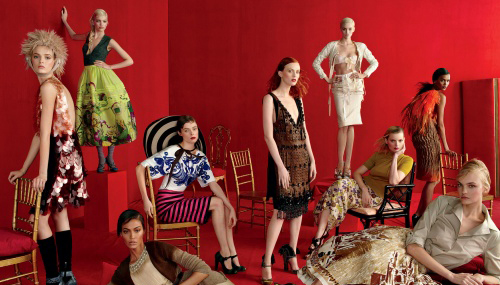
The Costume Institute’s new exhibition is a happy collision of fashion titans. Decades apart, Elsa Schiaparelli and Miuccia Prada are joined in a conceit devised by Met curators, Andrew Bolton and Harold Koda: a filmed dialogue, directed by Baz Luhrman, inspired by Louis Malle’s two-hander, Dinner With Andre–only this is two women talking, both Italian and interested in clothes. Hence “Impossible Conversations:” Judy Davis is cast as Schiaparelli and Prada is, well, her self. Their discourse is projected, heard over the mannequins sporting their shoes, dresses, ensembles, and hats. Provocative pairings make for exhibition as theater.

recent posts
- Marisa Tomei and Matthew Broderick at Guild Hall: The Plight of an Upper West Side Arts Space Gives A-List Actors The Big Chill
- Raul Esparza and Lily Rabe in The Winter’s Tale: Wet in Central Park
- Authors Night in East Hampton: If it’s Not One Thing It’s Your Mother
- Documentaries: Jocelyn Wildenstein The Lion Queen/ Tovah: How Jewish is It?
- Hamptons Journal: John Waters at Guild Hall: “Gay is not Enough” / “Cagney” at Bay Street/ “Signs” at the Bridgehampton Museum Tractor Barn
-
-
Of the atrocities of the Nazi period in Europe, the theft of art may be the least of the horrors, but as the new documentary Portrait of Wally shows, the provenance of art can be infinitely fascinating. “Who owns art?” you might say is the center of the debate concerning art stolen from Jews. But as my mother, an Auschwitz survivor used to say, there is a right and a wrong. Directed by Andrew Shea, this provocative film tells the gripping tale of an Egon Schiele painting, seized from a Vienna art collector’s home, and the drama of restitution. A world premiere screening at the Tribeca Film Festival seemed particularly apt, as part of this painting’s story took place in New York.
-
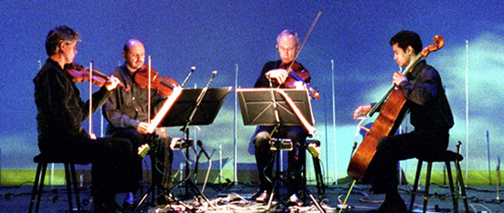
Wednesday evening at the Metropolitan Museum was meant to be a correspondence, an exploration of words and music featuring the Kronos Quartet and the writers Rula Jebreal, Marjane Satrapi, and Tony Kushner, but to most ears there was a friendly cacophony. Salman Rushdie, president of PEN introduced the much anticipated event noting that the World Voices Festival began in the midst of President Bush’s second administration when the dialogue between this country and others was breaking down. As the world has changed, a new U.S. president seemed to brighten attitudes toward America from all over the world. Still repression prevails: Satrapi’s film which had been shown on Tunisian television is now banned, the station’s head on trial for programming it. Echoing Kushner’s epic Angels in America, so prescient of current events, a Mormon presidential candidate’s gay aide is fired. -
 If you are going to chat with New York based artist Audrey Flack, she might ask you about the color of your lipstick, particularly if it is a shade of classic red as worn by iconic women, say Marilyn Monroe. In her early photorealist phase, this very girly prop shows up in likely and unlikely places, atop a dresser, near a mirror, revealing something of an obsession with the ill-fated movie star; but in the 1978 oil, “World War II (Vanitas),“ going up at auction at Christie’s next week, that very red is the color of a candle as well as a rose. Speaking about this work and its impending resale over lunch at the midtown restaurant Rare, Flack said, because of its historic reference, the painting is a work for a museum. Indeed, with its Holocaust reference, Flack juxtaposes a bright cherry on a petit four on an ornate silver dish, lustrous pearls, a butterfly, a teacup, a sumptuous gathering of life affirming objects with the grays and blacks of a row of Buchenwald inmates from a photograph by Margaret Bourke-White taken upon the concentration camp’s liberation. At an art history class at Baruch College that morning, Flack told students, back in the day, she was criticized for this odd, possibly insensitive assembling of images. But to her surprise, Holocaust survivors got it, asking her, how did you know the dream of pastries kept us alive during those dire times when all we ate were crumbs.
 -

Greeted by a standing ovation, Wayne Shorter and the band he’s been playing with since 2000 took the stage on Friday night for the first of two sold out concerts at the Rose Theater at Jazz at Lincoln Center: Brian Blade on drums, John Patitucci on bass, Danilo Perez on piano, with Shorter on tenor and soprano saxophone. For the next hour and forty minutes the quartet performed a set evocative of familiar material from this legendary composer, some phrases from Footprints, but not quite. Accumulated and contextualized by what went before, the music was intellectually rigorous. At first the listener had to grasp the abstraction of the composition, how an element of surprise is found in this structure. I actually had the feeling that the music had no center, just fanciful engaging riffs. As John Patitucci performed, draped over his bass, he became the center, and so on. Then Blade on his snare and Perez on piano would pick up a thread. Not until an encore when the group played a variation of Joy Ryder, did each instrument talk tightly to the next. -
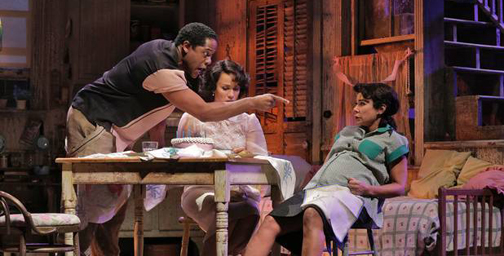
Rumor has it, Tennessee Williams used to sit in the back of the theater for performances of his Streetcar Named Desire, and laugh hysterically when in the end, Blanche would be escorted out on the arm of a doctor en route to the insane asylum. Following his lead, two Tennessee Williams plays in town, the revival of Streetcar at the Broadhurst on Broadway, and the world premiere of his last experimental work, In Masks Outrageous and Austere at Culture Project, may cause a laugh riot. -
Now on Broadway at the Walter Kerr Theater after a stunning debut two years ago, Bruce Norris biting Pulitzer Prize winning drama Clybourne Park begins in 1959 with a couple leaving their Chicago home after many years. Under Pam MacKinnon’s expert direction, Russ (Frank Wood) sits in a lounger eating Neapolitan; his wife Bev (Christina Kirk) debates the geographic origin of this ice cream’s name, an agreeable three-tier assemblage of vanilla, chocolate and strawberry. The colors, while distinct white, brown, and pink, work well together. This savvy play, about race and our unease with the matter, suggests we might do the same, live side by side, and illustrates how we don’t, neither in the midcentury nor today. -
Well, The Daily Show funnyman John Oliver did not exactly recommend stealing the six rather heavy looking, grand crystal chandeliers at the St. Regis Hotel, but he did refer to them a few times, as emblematic of the posh surroundings at the same time that he advised the gown and tuxedo clad crowd to follow the British’s lead when it comes to stocking their museums. “Steal as much as you can. It works for us,” he joked. “Then you won’t have to have a benefit dinner.” Honoring Philippe Dauman, Chief Executive Officer of Viacom, Randy Falco, President and Chief Executive Officer of Univision Communications, and George Kaufman, Chairman of Kaufman Astoria Studios, Mayor Michael Bloomberg included this Museum of the Moving Image event in his rounds, pointing out that the city had 50 ½ million tourists last year: “We are the media capital of the world.” Perhaps keyed to the Queens-based museum’s recent exhibition of Jim Henson’s legacy, he said: I took Kermit to a Yankee game and offered to buy him popcorn. He’s a cheap date. The frog said, I’ll just go out in the field and catch some flies. -

Perhaps the most inventively preposterous play ever to hit Broadway is the prequel to the Peter Pan story, Peter and the Starcatcher, at the Brooks Atkinson Theater. Opening on the anniversary of the sinking of the Titanic, this fanciful lark features two ships at sea, two trunks, one filled with sand, the other, eh, you must believe, stardust. Animated by pirates, lost boys, sea captains, a mermaid chorus, a nanny, and a girl, the play adopts clever uses for kitchen gadgets: you will see your veggie steamer in a new light, not to mention your hand juicer. That is if you have a hand, which as you may recall is a problem for a certain pirate. Here, an accident becomes an opportunity for a gag. Says the pirate to Pan, “You have singlehandedly singlehanded me,” and so on for groan-and-guffaw-worthy one-liners. -

Grounded in a current day realism about sex, friendship, and work for recent college grads, HBO’s much touted series Girls, airs this weekend. To focus on one aspect of its satire, in Girls, sex is free and freely given, an unsatisfying service by the girls, done with bewildered cads, happy to get what they can. Is this hooking up the logical extension of what Erica Jong extolled in her landmark 1973 novel Fear of Flying: “the zipless fuck?” Freed, women should pull down their pants at whim the way men do, right? For women who grew up with these “joys of sex,” watching Hannah (Lena Dunham of Tiny Furniture fame who also writes and directs) and her twenty-something pals is an untoward vision of what many suspected back in the day, that liberation did not necessarily bring enlightenment. Viewers can watch Hannah’s guy (Adam Driver) enter her from behind, with not much going on for her. -
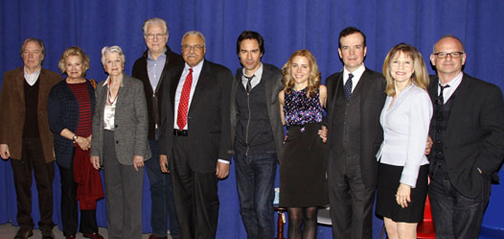
While Republicans evaluate the electability of Mitt Romney vs. Rick Santorum, the revival of Gore Vidal’s witty 1960 play, The Best Man, comes to Broadway. At the Gerald Shoenfeld Theatre, dressed up as convention headquarters, this Cold War era take on how Americans nominate our presidential candidates, the man in gray, a mere shape behind a scrim gets the prize, but he does not necessarily win. Observers of the political discourse will be amused, and reminded that the platitudes, empty promises, manufactured scandals, and colorful personalities even in dismaying blandness have been with us for a long time. Only now, media has brought them to us faster. -
Do not miss Tracie Bennett as Judy Garland. The petite frame, boyish chestnut do, twitchy gesture, agile thrashing, lusty bravado, pouting tantrums, and powerhouse voice, Tracie Bennett has the “Over the Rainbow” girl down.End of the Rainbow, coming to Broadway’s Belasco Theater upon the heels of Whitney Houston’s sad demise, illustrates with great verve and great music: the untoward journey of the famous can be glamorous and grim. Focused on Judy Garland’s last comeback in 1968, Peter Quilter’s play under Terry Johnson’s expert direction, features the star in a triangle with her fifth husband, a much younger Mickey Deans (Tom Pelphrey), and her adoring piano accompanist, Anthony (Michael Cumpsty), in many ways a stand-in for her legions of gay worshippers. This cast—with Jay Russell in a variety of roles– is exceptional, as are the band and William Dudey’s sets, a suite at the London Ritz, and the Talk of the Town nightclub where at times Ritalin, liquor-feuled performances hit notes high and low. You would not be unhappy just listening to Bennett’s Garland on the American songbook: “I Can’t Give You Anything But Love,” “Just in Time,” “Smile,” “For Me and My Gal,” “The Man That Got Away.” She brings the house down with a heartbreaking “Come Rain or Come Shine,” and that’s aside from the Harold Arlen/ Yip Harburg classic by which all remember her most.
-
“I’m the only presenter who slept with Catherine Deneuve,” said Susan Sarandon in a tribute speech at Alice Tully Hall on Monday night when the French actress was honored with the Film Society of Lincoln Center’s 2012 Chaplin Award. The ensuing clip from The Hunger (1983) shows the iconic Deneuve kissing her co-star’s hardened nipples. That was one of the movies I had to be a certain age to see, said Chiara Mastroianni about her feted mom; in a moment of public sharing, she begged The Umbrellas of Cherbourg star never to sing; when Chiara was little, her mother’s importance grew when she saw her in a photo with Miss Piggy. The picture now hangs in Deneuve’s bathroom. -
Introducing a private screening of his new movie, We Have a Pope, this week, director Nanni Moretti stopped mid-sentence and walked up the aisle to kiss kiss his pal John Turturro. Of course he was speaking in Italian and the gesture seemed so European, the audience including Tony LoBianco, Gay Talese, John Ventimiglia, Michael Musto, and a few non-Italians, Paul Schrader, Tovah Feldshuh, Alex Gibney, Lois Smith, Josh Mostel, Terry George, and Neil Simon, seemed to take the friendly gesture as a matter of course. Through his translator, Moretti, who is now celebrated at the IFC Center with a retrospective of his work, went on to tell a story about the making of this film about the inner doubts of a newly elected pope starring Michel Piccoli. -
In Eugene O’Neill’s 1943 play, A Moon for the Misbegotten, faithfully revived at The Pearl Theatre, the mores of the time seem antiquated but the performances by Kim Martin-Cotten as farm woman Josie Hogan, and Andrew May as her well educated yet drunken landlord Jim Tyrone, Jr. are pitch perfect. She, ungainly and with a rough tongue, he finely groomed, his language elegant if slurred from drink, make for as unlikely a pair as befits drama or life. In a ruse concocted by her father Phil Hogan (the Pearl’s ribald Dan Daily) to catch them in bed so that he will be forced to marry her—a plot point that seems refreshingly silly in today’s world, it is soon revealed just which of these characters is the most to be admired, and what slim pickin’s rural life has for her. The men, especially the tortured Tyrone, have the mobility to leave the farm, as Josie’s brother, Mike (the Pearl’s fine Sean McNall) does early on. Under J. R. Sullivan’s expert direction, the play offers a beautifully wrought glimpse of O’Neill’s characters’ inner worlds. -
Teenhood is not for sissies. Lee Hirsch and Cynthia Lowen’s documentary Bully opens with the dead-eyed gaze of a man, a father, talking about the suicide of his son, a victim of bullying. As if ripped from the proverbial front pages, the movie resonates with public awareness of this mean-spirited practice akin to the Rutgers webcam privacy violation that resulted in one young man’s suicide and another’s conviction for a crime. Bully comes with its own baggage: the M.P.A.A. “R” rating for six instances of the “f” word that will result in a censoring of the film from the population that most needs to see it, school-agers. No matter that the offense as heard in some footage aboard a school bus is the voice of a nasty, potty-mouthed boy deploying a threat to a girl that he will “f” her in the most vicious, unconscionable way. Did the board actually watch the movie? This rating is a lame, knee jerk response. And it is not just for kids. Grownups, parents and school officials need extra doses of this movie which features one of the most obtuse vice principals ever witnessed, claiming the school bus riders are “angels.” Harvey Weinstein pointed out an irony: the country’s top movie, the fantasy world survival story, Hunger Games, has a PG-13 rating while showing teens killing teens. In any case, as of this writing, Harvey Weinstein has decided to release the film with no rating.
-
 My favorite Sara Driver story involves her 1981 film of Paul Bowles’s short story, “You Are Not I.” Long thought lost, a print of the 48-minute film was discovered in 2008 among Bowles’ possessions in Tangier, Morocco in his driver’s insecticide-laden basement. Now restored, the film was featured at several conferences and festivals celebrating the author’s centennial last year. In its own right, Sara Driver’s work has been feted in Buenos Aires, Reykjavik, and Thessalonika, among other places.
This weekend You Are Not I screens in a retrospective at Anthology Film Archives, “Sleepwalking: The Films of Sara Driver,” along with her films Sleepwalk (1986), When Pigs Fly (1994), and Bowery—Spring, an 11-minute documentary from 1994. Also marking the occasion of a newly minted boxed DVD set of Driver’s work, the series will feature films Driver found inspiring, among them Jacques Tourneur’s Cat People and Charlotte Zwerin and Bruce Ricker’s Thelonius Monk: Straight No Chaser.
-
Admiring the television series Roots as a boy, Yale educated and Harvard professor Henry Louis Gates, Jr. explores a passion for genetics and genealogies in a new PBS series, Finding Your Roots, to start this Sunday. Featuring Mayor Cory Booker and Congressman John Lewis in the season premiere, a private screening wowed audiences at Lincoln Center’s Rose Hall on Monday. The episode intertwines the history of these two prominent Americans to reveal a poignant story of slavery, the struggle for civil rights, and a proud new generation of leaders. The backstories, developed through copious research of public records, an oral tradition of family lore, and DNA testing, are remarkable–so amazing, in fact, you wonder, what if these findings are wrong? No matter, the discovery makes for great television. -

Our winter may be mild but the cold breeze off Lincoln Center last week for the premiere of Frozen Planet was distinct, in the teeth-chattering presence of cool sculptures of an ice waterfall and ice penguins. And inside Alice Tully Hall, the temperature was brisk too. The Discovery Channel’s documentary series Frozen Planet, “The Ends of the Earth” to air on March 18, proves that good storytelling features sex and violence, even if it is family entertainment. As Alec Baldwin narrates, giant polar bears can sniff the scent of a female seven miles away, and stepping through the snow in her footsteps, they stalk her, often mounting her bloodied, having successfully fought off a contender. -
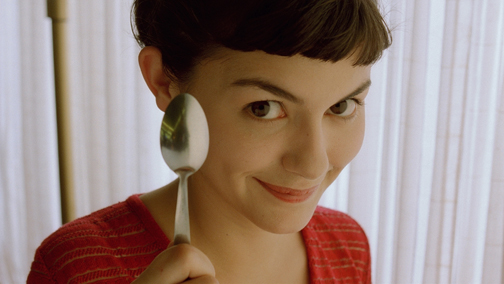
Petite and utterly adorable, the French movie star Audrey Tautou will always be known as the “Amelie” girl for her delightful performance in the 2001 film. On closing night of this year’s Rendez-vous with French Cinema, she was the guest of honor at a soiree at the upper East side Cultural Services of the French Embassy, attending with a posse that included her hairdresser. Her new movie Delicacy, opening in New York this week, has an office romance at its core. In a far corner of the elegant Fifth Avenue townhouse, Tautou, dark curls bobbing, spoke about why her character would enter into an inexplicable love affair with a dull witted co-worker. “You don’t know where love comes from. He touched her in a deep place,” said Tautou her hands gesticulating wildly. Next up for her is a movie with Cedric Klapisch, Casse Tete Chinoise, an expression that translates loosely to “head crushing anxiety,” to be shot soon in Chinatown. When asked if there is an American director with whom she’d like to work, she did not hesitate: “Alexander Payne. I adored his About Schmidt.” The French do love what they love. -

Meet the family at the core of Nina Raine’s smartly wise, well acted and subtle drama Tribes at the Barrow Street Theater: three grown kids and parents all living under the same roof. Opening on what might be a typical dinner for these upper class, articulate intellectuals, cacophony reigns as speakers clamor for attention; for clarity, Christopher (Jeff Perry), the dad of this unruly clan, whips out the Lacan. Or maybe the act is to belittle as this retired academic’s specialty is language, and the uses and abuses thereof. As barbs fly, soon you see that one son sits in eye bulging silence craning to look fully at his siblings’ faces attempting to read their lips. Deaf, Billy was not brought up signing. In denial about his “disability,” it turns out, the family has, so to speak, turned a deaf ear. -
Lasse Hallstrom’s new movie, Salmon Fishing in the Yemen, is a romance with an improbable premise. A liberal minded sheik wants to bring salmon to his native Yemen, not the kind you eat, but those that need a waterway for jumping and swimming upstream to spawn. This feat involves more than irrigating the Negev. Being rather wealthy, the sheik (Amr Waked) has the means to bulldoze, build a dam, whatever is necessary. But Harriet (Emily Blunt), his energetic and perky facilitator, needs to enlist an expert fly fisher Fred (Ewan MacGregor) to make the improbable happen. Kristen Scott Thomas plays the heavy, press secretary for the British prime minister who milks every photo op. And then, there’s a plot to kill the sheik, far too progressive to get away with his vision. -
For the same reasons that Sarah Palin is a riveting figure in American politics, the HBO movie Game Change is an astonishingly smart look at her and the world that put her in the position of John McCain’s running mate in the 2008 presidential election. Even when played by Julianne Moore, you cannot take your eyes off Sarah Palin. -
If you want to ensure a successful awards dinner, have Marshall Brickman as your M.C. A creator of the musical Jersey Boys, he has a wealth of mob related anecdotes, and with the aplomb of a seasoned comic, he delivers. At Guild Hall’s annual gala, rooftop at the St. Regis on Monday night, he told a story about an inmate who wanted him to do a sequel called, “Has Anybody Seen Frankie?” Declining, he now fears for his life.
Given the decidedly downtown edge to the awardees, the speeches were rather formal. Lou Reed presented to Laurie Anderson for Performing Arts. A “woman who can do anything,” Anderson thanked two people, one who taught her how to say no, the other yes. When she asked the famously reclusive Thomas Pynchon for the rights to make an opera of his Gravity’s Rainbow, he wrote back, fine, with one restriction, it must be for one instrument, the banjo. The other was Buddhist Trungpa Rinpoche advising, “You need to learn the skill of feeling sad without being sad. We all have to find the way ourselves.”
-
It’s a great year for Harvey Weinstein. The Weinstein Company co-chairman is the 2012 recipient of the Legion d’ Honneur awarded by France’s President Nicolas Sarkozy. The distinction was conferred last July but Weinstein wisely requested, according to a press release, “to keep the honor private to avoid a conflict of interest with Academy Award Best Picture winner The Artist.”
 gossipcentral.com