 Woody Allen may have won this year’s Oscar for Best Original Screenplay for his whimsical movie, Midnight in Paris, with its time tripping to the 1920’s when Gertrude Stein held court in her salon. But Paris had another literary heyday in the mid-century when another round of Americans, among them George Plimpton, James Baldwin, Peter Stone, Irwin Shaw, Barney Rosset, Richard Seaver, and the beats hung out. Rosset died last week at age 89, and for those who valued his contribution to upholding first amendment rights in this country, his championing the works of artists, transgressive in subject and language (Beckett, Burroughs, Miller, Lawrence, Genet, Ionesco) the event truly marks the end of an era. People said the same when Dick Seaver died in 2009, but this time we really, really mean it.

recent posts
- Marisa Tomei and Matthew Broderick at Guild Hall: The Plight of an Upper West Side Arts Space Gives A-List Actors The Big Chill
- Raul Esparza and Lily Rabe in The Winter’s Tale: Wet in Central Park
- Authors Night in East Hampton: If it’s Not One Thing It’s Your Mother
- Documentaries: Jocelyn Wildenstein The Lion Queen/ Tovah: How Jewish is It?
- Hamptons Journal: John Waters at Guild Hall: “Gay is not Enough” / “Cagney” at Bay Street/ “Signs” at the Bridgehampton Museum Tractor Barn
-
A sublime vocalist, Dianne Reeves took the stage at the Rose Theater of Jazz at Lincoln Center, glamorous in blue and aware that this was Oscar weekend. Having performed her era evoking music for George Clooney’s 2005 Good Night, and Good Luck, his film about Edward R. Murrow, the only other black and white film to be nominated for a Best Picture Academy Award before The Artist, she has seen the handsome Clooney up close; she offered “and he’s real nice.” Wishing she could be there in L.A. to support him now, she went on to perform a repertoire of standards that included “One for my Baby (and One for the Road),” “Stormy Weather,” “Our Love is Here to Stay,” “Twelfth of Never,” and backed up by a superb ensemble featuring Peter Martin on piano, Reginald Veal on bass, Terreon Gully on drums, and the guitars of Romero Lubambo and Peter Sprague, she scatted a tune inspired by a jet lagged night in Barcelona watching CNN on television. She heard a singer and “this is how she sounded to me,” recounted Reeves as she launched into her tune imitating Spanish. -
On the 6th floor of the Museum of Modern Art, Cindy Sherman is just where you want her, everywhere. In a retrospective of her work opening Sunday, in every portrait, her image –made up, masked, reconfigured –shocks, satirizes, surprises with its smart take on contemporary looks, fashion, and ideas of what it means to be visible: portraits from every period in her career, from black and white film stills evoking no particular picture specifically, to the clown series, to the more recent grand portraits of be-pearled and head-banded Park Avenue matrons with enigmatic and sad Mona Lisa smiles or smirks suggesting dubious delight, dismay and possible disgust. Ladies locked in luxury. -
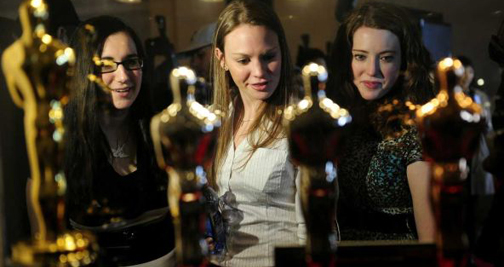
Vanderbilt Hall, a cavernous space at the entrance of historic Grand Central Station, was fitted with Oscar statuettes, for an exhibition to bring the yearly awards events to everyone, commuters and those, like me, who love to pass through this cherished landmark, en route to Broadway, Barney’s and Bergdorf’s. Just before ribbon cutting, I had a chance to chat with Melissa Leo. The Academy Award winner for Supporting Actress in last year’s The Fighter made this stop en route to L.A. to present the Best Supporting Actor award on Sunday night. “I wouldn’t mind sharing a stage with any one of those guys,” she ventured gamely about Jonah Hill, Kenneth Branagh, Nick Nolte, Max von Sydow, and front-runner Christopher Plummer. -

Getting to her parents’ house, a posh Palm Springs place in sand tones of bland and blander, Brooke Wyeth has to navigate past a sign that directs to “other desert cities,” but I don’t think the cities out west are the ones to keep an eye on in Jon Robin Baitz’s outstanding play, Other Desert Cities, now moved to Broadway’s Booth Theater. Retaining Stockard Channing and Stacy Keach in the parental roles of Polly and Lyman Wyeth from the Lincoln Center production, the play now features Justin Kirk as their son Trip, Judith Light as Polly’s sister and one-time writing partner Silda, and Rachel Griffiths as Brooke who has come from Sag Harbor for the holidays armed with her new, soon-to-be-published memoir. To borrow an idea from a known adage, if you see a lethal manuscript, the pages are going to fly. -
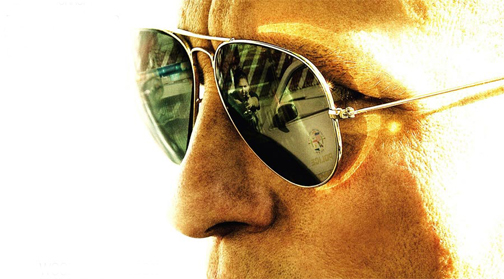
On the morning the Golden Globe nominations were announced, Woody Harrelson broke decorum, plugging his new film Rampart in which he plays an out of control cop. Not nominated, his testosterone-fueled performance nevertheless illustrates this Maui-based actor’s ferocity, playing a character very little like his green (he grows his own produce), peace loving, pot-smoking self. Just before opening, I caught up with Oren Moverman at the Gramercy Park Hotel restaurant where the Israeli born Rampart writer/director filled in Woody’s missing link. -

They are not called Loving for nothing. Loving is simply their name. You could not find a true tale more tailor-made for Valentine’s Day than the story that ended laws against interracial marriage in America in the mid-‘60’s. A documentary featuring archival footage and period photography, The Loving Story airs on HBO on February 14. The line you will remember is, “Tell the judge, I love my wife and I will not leave her.” -
In this its second year featuring a lively weekend of films focused on women and leadership, the Athena Awards, founded by Kathryn Kolbert and Melissa Silverstein and held at Barnard College, honored The Tempest director Julie Taymor, Moneyball’s producer Rachael Horovitz, Pariah’s director Dee Rees and producer Nekisa Cooper, and the Fempire: Young Adult writer Diablo Cody, , Liz Meriwether, and Lorene Scafaria. A Laura Ziskind Lifetime Achievement Award was inaugurated in memory of this noted film producer and activist in cancer research. Recipients are asked to adhere to only one caveat: they must speak about a woman who has influenced or inspired them, not their mother. An act of rebellion, this rule was immediately violated.
-
“It’s harsh,” said Polish director Agnieszka Holland introducing her new movie, In Darkness at a special screening at the Museum of the Moving Image in Queens last month. Literally dark, In Darkness, to open this week in New York, takes place under ground in the sewers of Lvov, Poland in Holocaust era Europe. Based on Robert Marshall’s book, In the Sewers of Lvov, about the story of Jews hiding in the wet, stinky sludge and the Polish thief and sewer worker, Leopold Socha (Robert Wieckiewicz), who helps them survive, at times, the rats—seen and unseen, the soundtrack of their scurrying and little squeals is terrifically powerful–seem more menacing than the Nazis hunting for Jews above ground. -

On a balmy New York evening with snow a distant memory, the corners of the Crosby Hotel were fitted with white stuff, the waiters sported big ski lodge sweaters and snow boots, and the décor, usually warm, was even cozier. The occasion was a screening of an episode of Lilyhammer, the first of five original series planned for Netflix. Harvey Weinstein and Netflix's chief content officer Ted Sarandos hosted the evening, with help from uber party planner Peggy Siegal. Starring E Street Band guitarist and The Sopranos veteran Steven Van Zandt, Lillyhammer begs the question, where can mob fugitives go to hide? Even ex-Sopranos? Well, how about Lillehammer, the remote town in Norway that famously hosted the Olympics in 1984? It looked pristine, beautiful, Frankie ("The Fixer") Tagliano explains even as he brings his ways of getting things done (i.e. bribes, blackmail) to cut through the country’s bureaucracy. Talk about a clash of cultures! -

A controversy over whether or not the original 1935 opera Porgy & Bess can work, pared down, cut in music and story, clouds over what should be a celebration. Filled with perhaps the most well known lyrics in the American songbook, Porgy & Bess in any variation is welcome.The current version at the Richard Rodgers Theatre, with book redone by Suzan-Lori Parks and Diedre L. Murray, and directed by Diane Paulus is a crowd pleasing musical. Having seen much of what Paulus has done in recent years, with her interest in bringing high brow art to a place in popular culture: Shakespeare’ Midsummer Night’s Dream as The Donkey Show, Turandot as a wrestling competition, and Hair both in Central Park and on Broadway with audience participation, the variations in this Porgy & Bess seem tame by comparison.
-
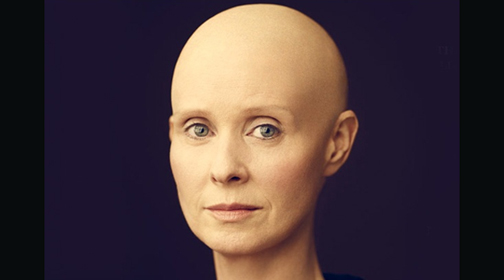
A conceit, an ironic barb, wit can be searing and funny. In the case of Margaret Edson’s Wit, the Tony winning play now in a Manhattan Theatre Club revival at the Samuel J. Friedman Theatre under the fine direction of Lynne Meadow, Wit follows the journey of Vivian Bearing, a name that loosely translates to “enduring life,” a college professor specializing in 17th century metaphysical poetry, in the verse of John Donne to be specific, author of “Death Be Not Proud.” As performed by Sex & the City’s Cynthia Nixon, she is a brainy Everyman/woman, precious in what she knows and does, vital in knowledge, commitment, and contribution to life, devastating to lose. And lose her we do. Sorry for the spoiler: she dies at Wit’s end. -
“Fame is fleeting,” said Harvey Weinstein introducing Coriolanus last week at the film’s Paris Theater premiere. Juxtaposing the all night Golden Globe parties with his turn on television with Uggie, the canine star of his movie The Artist, Weinstein noted, one minute I’m accepting awards (The Artist, My Week with Marilyn, The Iron Lady, were among Weinstein films honored with top prizes), the next I’m on the Today show with a dog. But what a dog!Anticipating the Best Picture Oscar nod, Uggie’s P.R. people called for a photo op at the Empire State Building, on the 86th floor deck. With his trainer and owner Omar von Muller, the Jack Russell terrier played dead and eh, manned a skateboard. Ever since Cannes, this “rescued” dog has been a secret darling of the film: at the New York Film Festival opening, The Artist director Michel Hazanavicius was asked how he worked with the dog. Sausages. The reply seems to have gone viral.
-
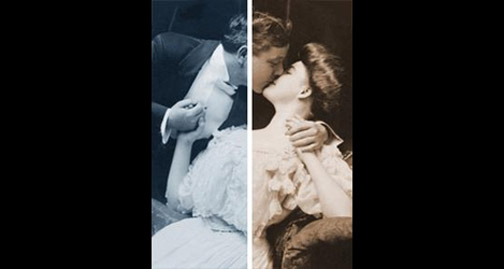
The Pearl Theatre Company revival of George Bernard Shaw’s The Philanderer had many in the audience wondering why this delightful and deliciously scandalous play is not produced more often. Of course the sex implied and on view between corseted women and waist-coated men is nothing to raise a contemporary eyebrow, but in its day, 1893, it was banned for fifteen years. -
The picture on the Richard III poster shows the actor Kevin Spacey, mangled like a piece of John Chamberlain’s chrome sculptures, his left leg in a brace turned inward, his epaulets woefully off kilter, his dark glasses barely grazing his nose, his crown cocked like a smartass cartoon. At BAM where the Bridge Project’s stunning production of Shakespeare’s play is thus advertised, the image only begins to tell you what’s in his heart. Having just murdered Lady Anne’s father and husband, he woos her, Shakespeare’s language suggesting everything you can possibly do with a cane. Its noise announces Richard’s writhing gestures, producing dread and glee. You don’t know where he will thrust it, including a gratuitous jab at a severed head in a bloody box. Ooooh! -
Freshly returned, triumphant at the Golden Globes, Harvey Weinstein exhibited no jet lag introducing a new film, Coriolanus at the Paris Theater: There are three great Shakespeare films, he exulted, Olivier’s Hamlet, Olivier’s Henry V, and this one. The film’s star and director Ralph Fiennes then introduced cast members Jessica Chastain and Vanessa Redgrave to a crowd that included Patti Smith, Judd Hirsch, Gina Gershon, Fisher Stevens, Dan Abrams, Michael Stuhlbarg, Liam Neeson, James Earl Jones, Paul Haggis, Terry George, Thomas Langmann, and hosts Bob Balaban and Susan Sarandon. -

Running up to the Golden Globes weekend, a plateau in the awards season, one category I had my eye on was Best Actress in a Drama. The nominations left two formidable actresses vying for the honor, that is, Viola Davis in The Help and the winner Meryl Streep for The Iron Lady. Even as Streep left the stage she said, Viola, you’re my girl. -
At the elegant National Board of Review’s Awards Gala at Cipriani 42nd Street this week, fine films were respectfully feted, with Hugo winning Best Picture, its director Martin Scorsese honored. Christopher Plummer, Best Supporting Actor for Beginners, and Will Reiser for his 50/50 original screenplay were among those honored. But, those speeches! On this occasion coming up on the Golden Globes weekend, a subtext emerged. Were they thinking about Oscars? -
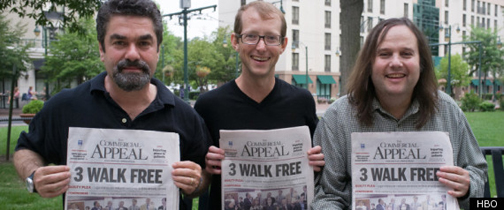
Last October when the documentary Paradise Lost 3: Purgatory premiered at the New York Film Festival, filmmakers Joe Berlinger and Bruce Sinofsky celebrated an unanticipated event: the release from prison of the West Memphis 3. For documentary filmmakers, it doesn’t get better than this: having your work bring about change.In 1993, a newspaper item about the murder of three 8-year olds in West Memphis and the three teenaged boys arrested for the crime piqued the interest of HBO’s Sheila Nevins. She called the filmmaking team of Joe Berlinger and Bruce Sinofsky, sending them south to document the case. The filmmakers thought they were going to tell a tale about guilty teens and Satanic rituals in the heartland. Finding the evidence overwhelming that the men were innocent, instead they made a movie that pointed toward a miscarriage of justice. Two earlier versions of the documentary, shown at the Film Society of Lincoln Center’s New Directions/ New Films festival and HBO galvanized support for the convicted young men. After 18 years in prison, the men were released this past August.
-
The crowds outside Crimson, the club where the New York Film Critics Circle held their awards, were six deep, calm in the cold behind velvet ropes, hoping to get a glimpse. Brad Pitt would receive a Best Actor award for his work in Moneyball and The Tree of Life, and, Angelina was by his side. He had been at hers a few weeks ago, a quiet presence at the In the Land of Blood and Honey premiere. Inside Crimson, critics and colleagues heard his story about first coming to New York at age 25, staying with a friend on Christopher Street, noting there were an awful lot of men, and they were all so nice. As to the New York critics, he was happy to meet this group led this year by John Anderson, surprised they weren’t taller, and even happier that the event would not be televised. -
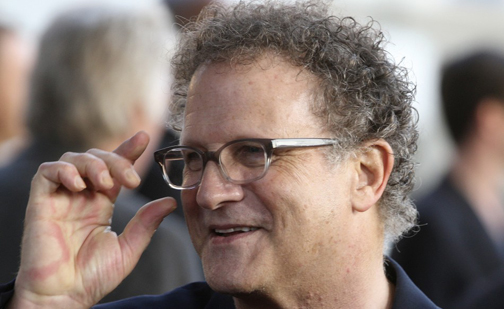
As the guy who doesn’t get the pretty girl, Albert Brooks does get the laughs. Which, as he indicated at a special tribute focused on his acting on Sunday night at the Walter Reade Theater, has made some directors hesitate to cast him in dramatic roles. In such American classics as Taxi Driver and Broadcast News, romance with Cybill Shepherd and Holly Hunter eludes him, while in Private Benjamin, sex with Goldie Hawn on their wedding night does him in. Filmmakers may be wary of his “funny,” but not Nicolas Winding Refn, the Danish director of Drive, a Ryan Gosling vehicle (ha!) in which Albert Brooks plays an articulate thug, a performance touted for major awards, such as Best Supporting Actor from the New York Film Critics Circle.Before the Film Society’s tribute and a special screening of Drive, I had the opportunity to ask Albert Brooks about this role.
-
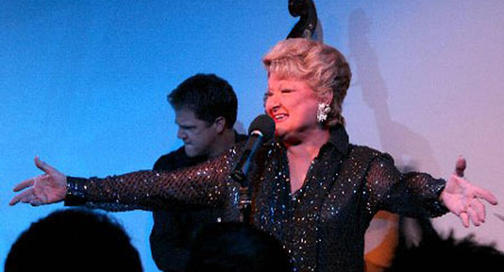
Marilyn Maye’s return to the Metropolitan Room was like a camp reunion for the saloon set. Saloons, she informed the crowd already familiar with her patter, are otherwise called “upholstered sewers.” This chanteuse, elegant in her mid-80’s in a blond bouffant, sang tunes suggested by her “regulars,” many of whom she addressed from the stage by first name: “Who requested this?” she asked amiably on the night I caught her act. “You? Okay, now you’re hearing it.” -

Languishing on a beach chair in my winter outpost by a turquoise sea, I have only books on my mind, for me the most portable item from before the age of kindle or even a recent dinosaur, the ipod nano. So here are a few that have pleased and provoked: -
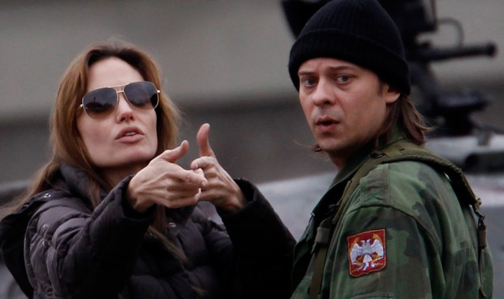
With a Golden Globe nomination for Best Foreign Language Film and a ban called by a Serbian leader, it is hard to tell which is better publicity for Angelina Jolie’s directorial debut, In the Land of Blood and Honey. Set in Sarajevo in the early ‘90’s, the drama illustrates neighbors murdering neighbors, barbaric behavior of all sorts, rape, and an official policy of ethnic cleansing. This bloodbath makes the Serbians look bad, the Muslims look like victims. The Croatians are mostly missing in the movie’s action. But last week, at the premiere and press conference, surrounded by regional actors on all sides of that conflict, Jolie made her equal-opportunity indictment clear: war damages the human psyche. -
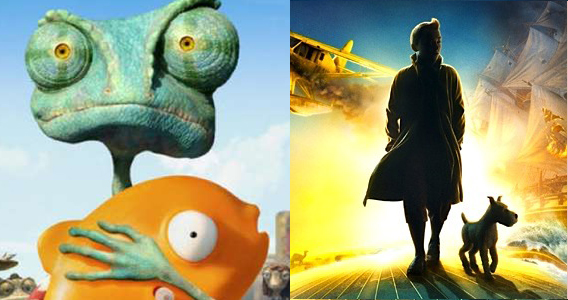
In the category of Best Animated Feature, the Foreign Press Association has just nominated both Rango and The Adventures of Tintin for Golden Globes. This awards nod comes as no surprise—expect Oscar nominations as well– each is state of the animation art, but so different. In Rango, director Gore Verbinski used the quirky story telling techniques that made his Pirates of the Caribbean franchise so special—well, at least the first two. The plots are frankly forgettable, but the characters remain fresh, a product of brilliant casting. In Rango, Johnny Depp’s voice animates the central character, a chameleon, of all creatures, and it’s like he’s retained a residual high from his Rum Diary persona in this sheriff who must solve the mystery (a la Polanski’s Chinatown) of the disappearing water supply for the desert town of Dirt
 gossipcentral.com