• Sheryl-Crow-006
    Last Thursday evening at the Park Avenue Armory, after the consumption of an elegant dinner and the auctioning of many fine items including the most adorable black and white spaniel, Sheryl Crow rocked the cavernous house. In sequins over jeans, she sang her signature songs: “If it Makes You Happy” and “Soak Up the Sun.” More important, she, a cancer survivor, sang the praises of Dr. Samuel Waxman. This was the 13th annual Collaborating for the Cure Benefit for the Samuel Waxman Cancer Research Foundation and from the looks of this crowd, young and enterprising, money appeared to have no limit. The live auction alone garnered nearly $1 million. 

    According to a press release, the foundation has awarded $75 million to researchers worldwide since its inception in 1976. When I first attended such a benefit, in 2009, I was pondering an irony: my mother, the late Pola Weinreich died in the care of this world-renowned oncologist at Mount Sinai in 1996. When I spoke to him, reminding him of an event commonplace to him and devastating to me, he spoke to me for several minutes while others tried to get his attention. Did I give her the best care I could? he sincerely wanted to know. A sign of a good doctor, he very much wanted to talk about her demise and the deadly disease that he was hoping to cure in his lifetime with the foundation he created 34 years ago.

    Regina Weinreich

    Graphic Design: Salpeter Ventura


  • Fran_Lebowitz Fran Lebowitz is a motormouth, so all you really have to do is press “ON.” That makes television a perfect medium for this unusual talker, who, part James Thurber, part Dorothy Parker, part Oscar Levant, thrives at public speaking. With her signature man tailored white shirt, Savile Row suit jacket over jeans and cowboy boots, she makes for a handsome and distinctive subject for the wonderfully entertaining documentary portrait directed by Martin Scorcese to air tonight on HBO.

     
    For those who find this film remarkably unlike others in the famed director's oeuvre, you can see his back as Ellen Kuras's excellent camera work grazes his shoulder. Set against Edward Sorel's tableau of literary types at The Waverly Inn, the downtown eatery part-owned by the film's producer Graydon Carter, the interview with Lebowitz features her opinions and bon bots on everything: how Andy made fame famous telling Candy Darling that she was more than Marilyn, she was a superstar; this was a joke that came to define the Zeitgeist, but ironically, it also comes to explain Fran Lebowitz.

    Like the twin towers looming behind the set in an old Conan clip, Lebowitz, the author of the essay collections, Metropolitan Life (1978) and Social Studies (1981) a writer who has not published a book in thirty or so years, is an endangered species, a living reminder of how far we have come from a time when smart people are prized. Perhaps the most revealing aspect of the film is her self deprecation about what she calls her “writer's blockade.” For a documentary portrait, Public Speaking is withholding. You find out Lebowitz is Jewish, gay, an only child. But where exactly does she live? What is her domestic scene? How does she support herself? She seems sui generis, an original. How do you pull that off in our consumer culture?

    Lebowitz tells a funny story about going to Sweden with her good pal Toni Morrison, as she was awarded the Nobel Prize for literature, how at the dinner Lebowitz was seated at the kids' table where the next in age was 12. She also does a rant about strollers. So you might come away thinking that she doesn't like children. Au contraire! At the premiere at The Four Seasons last week, a lavish gathering of literary types like Morrison, Lynn Nesbit and Lynne Tillman, I chatted with Wilford Hemans, a middle school principal for whom Fran Lebowitz sits in at a yearly event. Rather than go off to a reception, he recounted, Lebowitz remains in the classroom with students helping them write. Who knew this famous curmudgeon could also be lovable?

    Regina Weinreich

    Graphic Design: Salpeter Ventura


  • Tiny_Furniture
    A fresher, smarter movie you are not likely to see this season than “Tiny Furniture,” written, directed by, and starring Lena Dunham, a sweet-faced young woman festooned with tasteful tattoos. A film within the film shows her in a bikini, not a perfect ten, but you've got to give her snaps for this vanity defying display. Shot in her family's downtown loft, the film features her mother, the artist Laurie Simmons, as well as her sister, Grace Dunham, as her mother and sister respectively. You could logically assume that much of the material is autobiographical, and as such, a Zeitgeist marking moment.     

    On Wednesday, after the premiere at MoMA, one ecstatic viewer asked Simmons, would she please raise his children, a remark that took her off guard. She responded gamely, that parenting was not a job she was particularly prepared to do. Listening to this, a mother of girls with one as my date, both of whom like Lena Dunham attended a NYC private school, I wondered what was bothering me.  From the look of it, Simmons as a parent seemed loving, yet self-involved, indulging her kids, perhaps to make up for not entirely focusing on them. She teaches her daughter a few good lessons about entitlement, un-hypocritically permits a boyfriend to sleep in her bed (sex at 20 is simply taken for granted), and generally allows her girls to learn as they go. The results are tough and funny.     

    I laughed. I cried. My daughter observed that some of the dialogue sounded eerily familiar as if Dunham had secretly mic-ed our place. What disturbed me was where this film went as a record of a girl's post-college sexual evolution. Aura as a character is not adept at self-protection, alarmingly generous to strangers, allowing her self to be used.  She makes it with one guy in a metal tube, a found, if claustrophobic, shelter. Aside from the sight gag and any metaphoric implications, it looks fine for him, painful for her. A rude awakening: those rumors about all the blowjobs status-seeking girls were giving classmates INSTEAD of sex-(Clinton, are you listening?)– are true. Young men seem as immature and insensitive as they were decades ago. Dunham's fictive mother, like most, is spared the realities of where her child's sexual liberation has led, but as film viewer like me, Simmons must now know. Maybe moms have been teaching the wrong lessons and should, along with our lack of guidance in such matters, be handing out copies of  “The Joy of Sex.” Is my complaint just a throw back to the “Satisfaction”-seeking 'seventies?  Free to enjoy sex, our girls-with a nod to Cyndi Lauper– should be wanting more fun

    Regina Weinreich

    Graphic Design: Salpeter Ventura


  • Amram(1)(2) No one can believe David Amram is now 80. Yes, you can do the math. But, to see him cavorting about the ample stage in front of a packed Symphony Space on Thursday for his birthday celebration was surely to see a man in mid-life: Hence the title, “The First 80 Years.” 

    In typical Amram style, performances of this quintessential American composer and ethnomusicologist's “greatest hits” were not self-reflexive, but rather homages to the greats he performed with, learned from, those who inspired him: Odetta, Joe Papp, Woody Guthrie, Frank McCourt, Max Roach, Dizzy, and Kerouac. In memory of Floyd Red Crow Westerman, he played with Tokasin Ghosthorse on Lakota Courting Flutes. The Queens College Orchestra conducted by Maurice Peress played “This Land is Your Land,” and I could feel his Whitmanesque expansive juxtapositions. Similarly his “Home on the Range” was bebop Americana.

    Perhaps my favorite part of the evening was the medley of his music for movies: “Splendor in the Grass,” the original “Manchurian Candidate” where John Frankenheimer just directed him, Take it where it takes you. And of course, “Pull My Daisy,” Working with Robert Frank and Alfred Leslie and also a version created for a documentary I worked on in the 1980's, “The Beat Generation: An American Dream.” Scatting his signature “senior” spontaneous bop, he sounds good, a hip guy in a suit with pipes and pennywhistles hanging off his neck making it up as it suits him. The actor John Ventimiglia brought this sequence home with his reading of the last paragraph of Kerouac's “On the Road:” And don't you know that god is Pooh Bear.    

    Surrounded by family, his kids, Adira, Alana, Adam, his ex wife Laura Lee, and many fans and friends including Jacques D'Amboise, Barbara Kopple, Ira Gittler, Malachy McCourt, Ray Mantilla and John McEwan of the Nitty Gritty Dirt Band, David Amram hosted the evening without sentimentality, without excess, eschewing the typical testimonials for such a grand occasion. After all, we've got the next 80 to anticipate and cherish.

    Regina Weinreich

    Graphic Design: Salpeter Ventura


  • Bottle D2 At “21” last Tuesday, it was a case of multiple events. Newt Gingrich graciously held the door for me as Joan Didion stood in the foyer of the legendary restaurant. I wondered was this Grande Dame of Letters going to his book party on the second floor? No, she went straight to the third, to a princely luncheon for “The King's Speech.” Director Tom Hooper stood, clinked his glass embossed with a big D for DeLeon Tequila, host of this grand occasion, his new film already touted as a sure Oscar contender if not win for Best Feature and Director. Noting how pleased he was to be greeting us, he reminded everyone that the Duke of York before he became King George VI, the subject of his movie, could not get out the words of a simple two-word toast. All he had to say was, “The King.” Holding up his royal quaff, Hooper added two more: “Colin Firth.”     

    Indeed, Firth, the handsome actor who played Mr. Darcy, wooed Bridget Jones, and starred in last year's Tom Ford movie debut, “A Single Man,” commanded court over a table that included Christine Baranski, Harvey Weinstein, Stephen Daldry, and Candice Bergen. The buzz: he will win for Best Actor, and should have for last year's film about a gay man's grief over the death of his lover. In “The King's Speech,” he reddens as if to explode stammering through his words. He has the audience in tears. 

    The night before, his co-star in the role of Queen Mother, Helena Bonham Carter held court at another soiree sponsored by DeLeon at the refurbished swank 44 at the Royalton Hotel. Introducing her at the Ziegfeld screening, Hooper had called her a genius, and truly in this role she grounds the volatile relationship between the king and Lionel Logue, his speech coach, a commoner who becomes his friend (a deeply-affecting  Geoffrey Rush). Eve Best, who plays the movie's scandal-ridden Wallis Simpson chatted with Stella Powell Jones, granddaughter of Harold Pinter. Director Amir Bar-Lev talked about casting his next film, a biopic about Jerry Garcia. Many eyed the elegant DeLeon bottles with their heavy intricately crafted silver stoppers hoping to spirit the smooth liquor into the night.

    Regina Weinreich

    Graphic Design: Salpeter Ventura


  • Asyoulikeit_pdp
    Director Danny Boyle is a master cineaste of potty detail. Who can forget the toilet swim in “Trainspotting”? Or the latrines of “Slumdog Millionaire”? In “127 Hours,” the most revolting is Aron Ralston (James Franco) drinking his own urine in a life saving moment when he is pinned under a boulder in Blue John Canyon in Utah. Unless you want to count the anatomical detail of his cutting through his own arm, already turning gray/green under the rock's weight. This sequence would be grim as it sounds except that the fine script Boyle penned with Simon Beaufoy based on Ralston's book, “Between a Rock and a Hard Place,” includes Ralston's interviewing himself on the folly of his having taken this adventure without telling anyone, including-eh, especially his mother–where he was going. Oops! There's a whole bit about his not taking her phone calls, which, under the circumstances, he regrets. The director also delights in illustrating his hallucinations as Ralson sees his life flash before him with a buzzard circling overhead. 

    At the premiere screening on Tuesday, you could hear the proverbial pin drop in the audience that included Susan Sarandon, Zoe Lister-Jones, Daryl Wein, Padma Lakshmi, and Mario Cantone. James Franco moved through the crowd at The Bunker Club, seeming to avoid the beautiful models circling about him at the Gucci-sponsored after party. It must be good to be James Franco these days, with several movies out, including Howl, his evocation of the poet Allen Ginsberg. 

    The real Aron Ralston sat on a banquette surrounded by close friends; he let me feel his hook hand. Picture a metal lobster claw.  Assuring me his life was going fine, he is now a family man, teaching his son all about the outdoors. He still climbs and enjoys the wild as a matter of habit, pride, and identity. And how is his mother? She's having a great time, he told me. They were just back from the London premiere parties. And now he tells her his every move.

    Practice_of_the_wild
    Yes, nature can be menacing, ominous, life threatening, indifferent but it can also be the source of great poetry. Opening this week at Quad Cinema is a documentary, Practice of the Wild featuring a conversation between writers who celebrate Nature: Pulitzer Prize-winning poet Gary Snyder and novelist Jim Harrison. Having lived in Japan and with his interest in the monastic life, Snyder was a catalyst in bringing eastern culture to the US in the mid-century. His journey mountain climbing with Jack Kerouac is immortalized in the novel “The Dharma Bums,” where, as the character Japhy Ryder, he teaches the discipline of haiku composition to the beat writer. The great pleasures of this documentary are the extraordinary views of the central California coast, and the poetry readings. The interview with poet Michael McClure is especially resonant. The film's transcript is part of a new poetry-packed book, “The Etiquette of Freedom.” Snyder recounts his experience climbing the Matterhorn on the Northern Sierra boundary line. There, a huge boulder did not trap them; instead, the rock reflected heat. Ahhhh!

    Regina Weinreich

    Graphic Design: Salpeter Ventura


  • WeWantSex2
     
    The subject of equal pay for skilled workers is of course a serious subject, but in “Made in Dagenham,” a little known but true story about a strike at a Ford plant in mid-century England is told with such heart and humor, many will call it a comedy. On Monday Rouge Tomate was bustling for a luncheon hosted by ReVive and Laura Mercier celebrating the film and its actors Sally Hawkins, the feisty Rita who leads the women seamstresses in a work strike, and Miranda  Richardson, formidable and funny as Secretary of State for Employment and Productivity. 

    Of the casting, director Nigel Cole said, never believe a director who says he always wanted so and so for the part. They always have a string of actors and they keep going down the list. In this case, he got everyone he wanted including Rosamund Pike who plays an upper class wife stuck in stifling domesticity. Cole made another crowd-pleaser featuring feisty women, Calendar Girls. That's the one where all these women over 40 take their clothes off for a calendar to raise money. There I was with all of them, laughed Cole. We didn't know but the actors wanted to rehearse with the actual women and they made a pact, insisting on being entirely naked, even when they did not have to be. We found out: nudity on the set is a good way to get people to work hard. As no one wants to actually look, so they suddenly get eye-averting busy. With Helen Mirren, he quipped, the trouble is to get her to keep her clothes on. 

      Driving Miss Daisy 2

    The director continued with hilarious on-the-set tales, concluding with his time directing Christopher Walken having sex with Sharon Stone in “$5 a Day,” a movie so fraught with legal troubles, it went straight to video. How do you direct a sex scene? You have to be specific. You have to say where to put your hands, and so on, because everyone is embarrassed: maybe others don't do what I do at home. With Walken and Stone, all you had to do was call action. We wanted to hose them down.


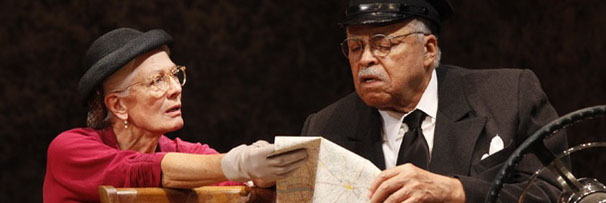
    Dana Ivey brought playwright Alfred Uhry to the lunch. His 1987 Pulitzer Prize winning play, Driving Miss Daisy opened last week on Broadway. Even the critics who ponder the slight story line of the spry 72 year old white Jewish matron in Atlanta whose son Boolie hires a black man to chauffeur her around are enchanted with the acting. To age to somewhere in her 90's, all Vanessa Redgrave has to do is water her eyes dim and go gummy, drawing her lips over her perfect set of teeth. And James Earl Jones as Hoke Coleburn, shuffling about, bearing the weight of racism, does more than drive her to temple. A hotter couple you are not going to see on Broadway for tender banter. 

    The play's riches come across in a scene where Daisy is to attend a Martin Luther King benefit and her son (the excellent Boyd Gaines) decides it is not to his advantage to go. You recognize with pain how many decisions are made this way.

    Uhry has acknowledged his joy in having had wonderful actors performing in the play and movie versions of his work, including Jessica Tandy, Morgan Freeman, and Dana Ivey, present company his favorite Daisy.

    Regina Weinreich

    Graphic Design: Salpeter Ventura


  • SpitzerEven as a CNN political talk show host, the specter of scandal haunts Eliot Spitzer. Oscar winning Alex Gibney seized the moment to document the fallen governor who many believe might have been president. At the movie’s premier last week, the filmmaker addressed a screening room at the Tribeca Grand Hotel packed with a who’s who of documentary filmmakers, Barbara Kopple, Chris Hegedus, D. A. Pennebaker, Albert Maysles, Kate Davis, as well as writers Erica Jong and others mesmerized by the epic dimension of the Spitzer story. Mostly people wanted to know how Gibney got his interview subjects to talk, and were surprised to learn how very eager they were to do so, especially such enemies as Joe Bruno and AIG’s Hank Greenberg. When Gibney unspooled this work-in-progress at the Tribeca Film Festival last spring, Client 9 was a working title. He was just releasing Casino Jack, about Jack Abramoff. I caught up with him in the offices of Magnolia Pictures.

    Weinreich: You are showing an untitled Spitzer documentary. Is there a connection between questions raised about government, politics, and money in Jack’s story with Eliot Spitzer?

    Gibney: The Spitzer story is more complicated. Unlike Casino Jack, there’s no easy prescriptive answer to Eliot Spitzer, but I was interested in him as a character, in his rise and his fall. He is one of the few who understands the political economy, the wicked games that are played in the financial community, and he knew how to get tough. The SEC wasn’t doing it. I admire him.

    After the scandal happened, everybody was talking about it; still is, because it cuts very deep. How do we choose our public officials? What do we need them for? What about relations between men and women? How do we parse that? Spitzer is not the only powerful man who was unfaithful to his wife, but it was a spectacular moment because the way he presented himself he was so unlikely a character a candidate for using prostitutes. He prosecuted people for having done the same.

    There’s no doubt that his enemies were gleeful. That’s part of the film, the political blood sport. And a lot of the people who went after him, as with Clinton, were guilty of the same or similar crimes. Eliot Spitzer didn’t corner the market on hypocrisy.

    At last week’s after event at Kastel at Trump Soho, partiers munched on lamb chops and fois gras canapés, and mused on another unlikely star of the movie: the now 26 year old Cecile (CeCe) Suwal, former Madam of the Emporers Club, an active if unaware participant in bringing the former governor down. Giggling, rolling her eyes through her interview, she becomes the movie’s unlikely co-star-and comic relief. You simply cannot make a character like this up!

    Regina Weinreich

    Graphic Design: Salpeter Ventura


  • Hamptons&NYFilmFestavil The great pleasures of the fall film season, the venerable NYFF in its 48th year and HIFF, 18 and growing, leave me reeling (no pun), reflecting upon the awards season ahead. To make a comparison over many years of immersion, the NYFF offers the more daring and experimental in world cinema-I am thinking now of two American films, Julie Taymor's “The Tempest” and Kelly Reichardt's “Meek's Cutoff,” both visually stunning, risk taking entertainments, the first being Shakespeare Taymor style, with Helen Mirren as Prospera and an all-star cast: Alfred Molina, Chris Cooper, Ben Whishaw, to name a few, The Tempest is a gorgeous visual treat. NYFF's “Meek's Cutoff” stars Michelle Williams in an intensely beautiful film that moves at the pace of buzzards circling their prey. 

    This must be Williams' year. One of the treats of the Hamptons: she stars with Ryan Gosling in “Blue Valentine,” a movie that reveals a relationship so raw it feels like you are seeing it with its guts hanging out. The truth of these performances is memorable, and illustrates a fundamental characteristic of the Hamptons festival: the films have heart, starting with the opening night's “Barney's Version.” 

    While the Hamptons was always a fun festival, its focus was not always clear. That perception has changed. Moving the dates to the holiday weekend has made a difference even if the Hamptons now overlaps with the NYFF. Silvercup Studio head Stuart Suna, Board Chair since the beginning, took credit for the fine weather, but much is owed to the leadership of Karen Arikian and her team, including Programming Director David Nugent. The choices were simply excellent. 

    Tom Hooper'sThe King's Speech” features award worthy performances by Colin Firth, Geoffrey Rush, and Helena Bonham Carter in a supporting role. This film with the unlikely subject of King George getting over his stammering has won several audience awards at various festivals and will surely bring award nods to everyone involved: at a dinner at 75 Main in Southampton to honor the film, screenwriter David Seidler said he will bring the play version to Broadway. 

    But it is “Black Swan” that haunts me most. Darren Aronofsky follows his trend of taking extreme characters on a fatal flying leap-see “The Wrestler”-with Natalie Portman as a young ballerina to star in a variation of Swan Lake directed by Vincent Cassell. You are never sure whether the untoward events are all inside Portman's head but nobody plays sexy and perverse as well as Cassell. Rodarte's costumes add to the spectacular in this film, influenced by Polanski's “Repulsion” and Haneke's “The Piano Teacher.” At the Hamptons Q&A, Aronofsky told a crowd that included Madonna and James Franco: Portman, a trained dancer as a teen, did most of her own work. 

    Also at the Hamptons: producer, distributor, all around film impresario Ben Barenholtz was toasted at an industry tribute at Montauk's Second House Tavern by the Coen Brothers and many others. Marcia Gay Harden was M.C. The next day, the Coen's “Miller's Crossing” starring Harden in her film debut was screened, reminding everyone that the Coen Brothers, so good now, were so good then. Barenholtz was an executive producer of the film. So how does it feel to be toasted like a marshmallow in the Hamptons? “It felt good.”

    Regina Weinreich

    Graphic Design: Salpeter Ventura


  • Sallyhawkins
    The crowd-pleasing “Made in Dagenham,” about a strike for equal pay for women workers at a Ford plant in mid-'60's England, will remind many viewers of “Norma Rae.” With a winning performance by Sally Hawkins in the lead as Rita, this labor world variation of “the little engine that could” has a charm all its own. 

    “Made in Dagenham”'s overt feminist message will resonate for everyone in the current economics of layoffs and fair wages; yet, an aspect of women's sensibility is played for irresistible comedy. No matter how heavy the problems of their world, style is part of the discourse–beyond the period detail of Rita's co-worker Brenda's beehive (Angela Riseborough who was so good in last spring's off Broadway play The Pride), or Sandra's (Jamie Winstone) hot pants. Unexpectedly championed by an upper class fellow mom, Lisa Hopkins (the elegant Rosamund Pike), a well-educated housewife stifled in domesticity, Rita admires her red dress and learns the designer is Byblos. Clearly a moment of recognition, many women at the screening chuckled. Later, when Rita meets the Secretary of State for Employment and Productivity (Miranda Richardson), the gravitas of an impending strike is punctuated with a light-hearted fashion tip. 

    The star of Mike Leigh's “Happy-Go-Lucky,” Sally Hawkins is now performing in Roundabout Theater's production of Mrs. Warren's Profession. Leigh, with whom she remains friends, attended a performance when he was in town presenting his new movie “Another Year,” one of my favorites from this past New York Film Festival. In East Hampton on Sunday for a special screening of “Made in Dagenham” and dinner at Della Femina hosted by Judy Licht, Hawkins in a smart black suit and multi-tiered crystal necklace and earrings chatted about her work, reviews good and bad. Yes, in real life, the work concerns of a talented actress –whose career is most definitely assured– seem gender free. But another conversation was just as real: a mutual admiration for jewelry. 

    Regina Weinreich

    Graphic Design: Salpeter Ventura


  • Barneys-version
    One of the great pleasures of Barney’s Version, the opening night feature of the Hamptons International Film Festival, was the parade of Canadian filmmakers in cameo roles: David Cronenberg, Atom Egoyan, among them. It’s as if this funny, sad, smart film set in Montreal andbased on Mordechai Richler’s last novel, had its own inside jokes. 

    Producer Robert Lantos told a packed audience on Thursday night in East Hampton, he shepherded this film into creation after Richler’s death. The two had formed a friendship and realizing that this was probably Richler’s finest work, Lantos persevered through severalscreenplays and a number of key changes.  One was moving the locationof the protagonist’s early years and first marriage to Rome instead of Paris. While giving readings in Italy, Richler had been surprised thathis book had become a huge hit there. Here in Canada, I am a novelist, he told Lantos, but in Italy, I am arockstar. And so this change had the author’s blessing. The moviepremiered in Venice and made front-page news for days.

    Paul Giamatti plays the protagonist of the title, a Jewish producer of shlock television; his shlemiel persona rivals that of Larry David. Ironically lucky and luckless in love, he is married first to a painter who commits suicide, then a Jewish Canadian Princess (Minnie Driver), and then to the elegant Miriam Grant. British actress Rosamund Pike who ages miraculously through this story, based herrestrained performance on Richler’s widow Florence who at 80, said Lantos, still has the stately demeanor of her youth. Pike’sperformance anchors a cast that also includes Dustin Hoffman as Barney’s father, a Jewish cop. Hoffman will surely be nominated for a Best Supporting Oscar. Even dead in a tawdry brothel, he steals theshow.

    Regina Weinreich

    Graphic Design: Salpeter Ventura


  • Tempest_helen_mirren
    The centerpiece of the New York Film Festival, "The Tempest" is state of the art Julie Taymor, that is, a study in the spectacular. The ashen spirit Ariel darts behind trees in the barren terrain of the Shakespearean island forest in multiples, to say nothing of the heavens conjured and riled by the tap of Prospero's crooked stick. But here is Taymor's twist: Prospero, long the private plum of aging actors much as he was created in the playwright's senior years, is now Prospera. Introducing her in the grandeur of Alice Tully Hall on Saturday, Taymor announced, here is our sorceress. And Helen Mirren, always the queen, resplendent in sequins, glimmered onto the stage. 

    What does this gender bending do for Shakespeare's late-life tale of shipwreck and betrayal? Taymor had directed an off-Broadway version early on, for Classic Stage Company, with a male lead. But a woman makes so much sense. Mirren supplies the requisite maturity: dozens of close-ups show her age unadorned with the magic of makeup, and she is above all else a mother, to Miranda, metaphorically to Ariel (the wiry Ben Whishaw), and to his earthly counterpart Caliban (Djimon Hounsou). 

    Composer Elliot Goldenthal said that the final coda over the credits was set to music –sung to haunting perfection by the band Portishead's Beth Gibbons— after the film was put to bed. It will be amazing to see what Taymor does for the “Spider Man: Turn Off the Dark” musical, premiering on Broadway in November.

    As viewers queued up for the long line leading to the Empire Hotel's rooftop for the afterparty, it was hard to speak, hard to get over the return to contemporary English after the exquisite immersion of The Tempest.

    Regina Weinreich

    Graphic Design: Salpeter Ventura

  • Freakonomics-2 It takes a wild leap of the imagination to think Freakonomics, the best selling book by Steven D. Levitt and Stephen J. Dubner could be made into a film. Incredibly, several offers were made and finally the right concept presented itself: a dream team of documentary filmmakers Morgan Spurlock, Alex Gibney, Eugene Jarecki, Rachel Grady and Heidi Ewing, among them, creating what amounts to a very clever, entertaining, seemingly random fact-loaded commentary on the workings of our world. At a special screening on Wednesday, author Stephen Dubner presented one tidbit not found in his book, but it could have been: after giving the predictable alarming statistics about drunk drivers, he asked had we ever thought about the risks of drunk walkers. Huh? And then he provided the alarming statistics. Let's just say, it is neither safe nor prudent to drive or walk home after cocktails.

    Over cocktails at the afterparty in the Garden Room of Michael's, another set of documentarians including Barbara Kopple and Robert Richter chatted about the inventiveness of their colleagues. Morgan Spurlock, creator of the popular “Supersize Me” directed the “Freakonomics” segment that explores the idea of how people's names determine their destiny, following the fate a baby who had been given the unfortunate name of “Temptress.”  You can guess how her life turned out. 

    “Which part of the film was your favorite,” he asked me, and then ventured his own: I loved Eugene's elaborate conceit on how the crime rate dropped after Roe v. Wade. Not actually taking a stand on the right to abortion/ right to life issue, the segment was more an illustration of how the elimination of unwanted children is a boon to civilization. Fewer neglected individuals exert their pathology on society. That's the kind of witty logic exhibited throughout. To answer Morgan's question though, I had to admit, my favorite was his because I'd often contemplated the fate of a particular supermarket checkout woman who sported the nametag “Kleshea.” Is your name Klee-shia, I had asked trying to figure it out. No, it's “Cliché.”

    Regina Weinreich

    Graphic Design: Salpeter Ventura

  • Face Book
    Five minutes into David Fincher's movie about the birth and gnarled development of Facebook, “The Social Network,” you get the picture of founder Mark Zuckerberg trying to impress his girlfriend by putting her down. Clueless, he doesn't get why she picks up and leaves calling him an Asshole.  We get it though, and ponder how this ill-adjusted kid got into Harvard in the first place. Said to have studied people with Asperger's Syndrome in order to play this part, Jesse Eisenberg frowns his way through a movie that many hail as the “Network” of the new media. 

    Surely there must be some joy in grimacing all the way to the bank!

    “The Social Network” was a brilliant choice for the opening of the New York Film Festival, a sign that something is going right with the festival's direction under the new executive director, Rose Kuo. In due course, filing past fans lining the sidewalk at Lincoln Center hoping for a glimpse of Justin Timberlake who plays Napster founder Sean Parker, a thousand or so guests made their way to The Harvard Club for a lavish party. Abuzz on 3 floors, this venerable wood-lined institution returned the gloss and glamour to this special festival's opening night. I for one was grateful to see the words Black Tie Optional on the invite: no matter that fashion went from tux to tattered jeans. 

    As to Facebook and its founder, let the lawsuits take their course. That guests included the real Winklevoss twins still in court with Zuckerberg even after receiving a $65 million settlement was a reminder, there is a larger story out there waiting for a good documentary, about a phenomenon bigger than the attention-grabbing scandals. Where is all this money coming from? What will become of personal privacy? Who are the Facebook users: are they as lonely as Zuckerberg appears to be, truly connected to millions of friends, happy that others know their relationship status? I started out agreeing with Betty White on SNL when she quipped, “What a waste of time,” even as the social network revived her career.  I end up wondering how long I can hang out hopelessly old school

    Regina Weinreich

    Graphic Design: Salpeter Ventura

  • Woody Allen
    A long time has passed since the sound “d'jew” could be heard in a conversation between characters played by Tony Roberts and Woody Allen in a Woody Allen movie. In his latest romantic tragedy, “You Will Meet a Tall Dark Stranger,” Allen's Judaism is so distant, it is a presence in absence. In a string of films, magic, chance, the playful machinations of the Greek gods supplant conventional religion, and in Tall Dark Stranger, a character's fate is in the hands of a fortuneteller. The auteur may be through with God, but suffering, now that's another story. At a recent press conference, he explained that he'd had a debate with Billy Graham about believing in God and Graham insisted that he would have a better life, even if Graham's belief were wrong. Allen said, he preferred work as a distraction to morbidity. “I can control work problems like what should I do if Josh Brolin can't do my movie?” Brolin, seated nearby chuckled loudly.

    Ruth Gruber At ninety-nine, photojournalist Ruth Gruber is sharp as the proverbial tack. At a special screening of a new documentary about her life, Ahead of Time she told a rapt audience about going below on the Exodus and shooting the squalid conditions of the refugees huddled in the famed embargoed boat hoping to make their way to Israel. At a delicious dinner hosted by the film's co-producer Patti Kenner at her Park Avenue home, and prepared under the auspices of another producer, Doris Schechter whose cookbook, “My Most Favorite Dessert Company Cookbook” is like a Bible to me, Dr.Ruth Westheimer, Tovah Feldshuh, Marie Brenner, and many others celebrated with Gruber and director Bob Richman. Among the most “heimish” of women in New York, Kenner and Schecter can invite me anytime.

    Gertrude Berg

    Another heimish woman, Gertrude Berg a pioneer in the world of television sit-coms, is back. After a thrilling year in theatrical release, Aviva Kempner's excellent documentary, “Yoo Hoo, Mrs. Goldberg” is now on DVD with extras: Berg's guest appearances with Edward R. Murrow and on Ed Sullivan, her recipe for chicken in the pot with kneidlach. Yum!

    Gershon David Hundert editor in chief of the indispensable Yivo Encyclopedia of Jews in Eastern Europe has now succeeded in creating a superb all-inclusive website: see http://www.yivoencyclopedia.org.

    Shana tova!

    Regina Weinreich

    Graphic Design: Salpeter Ventura

  • Ginsberg_orlovsky-1
    A scheduling glitch created the following conundrum: Best Generation poet and Allen Ginsberg's longtime mate, Peter Orlovsky, who died in June, was remembered on Wednesday at St. Mark's Church. Meanwhile the New York premiere of “Howl,” the new movie starring James Franco with Peter (Aaron Tveit) in a small role took place a few blocks across town at the IFC Center. Having filled the prestigious slot of opening night film at this year's Sundance Film Festival, the anticipation was high for this movie: part animation, part courtroom drama, part period piece about the creation of the iconic beat poem and the censorship trial for obscenity that followed its 1956 City Lights publication.

    An event in beat style, the memorial featured performances by Patti Smith, Philip Glass, Gordon Ball, Bob Rosenthal, Hal Willner, Simon Pettet, Rosebud Pettet, Ed Sanders and anecdotes remembering Peter's generosity of spirit and obsession with cleanliness by Juanita Lieberman Plimpton who as a teen fell in love with this much older poet. Anne Waldman accompanied by her son Ambrose Bye brought down the house with readings of Orlovsky's poems. Peter Orlovsky penned the poetry volume, Clean Asshole Poems and Smiling Vegetable Songs, encouraged by Ginsberg to write. Bill Morgan, Ginsberg scholar, author of the recently released “The Typewriter is Holy: The Complete, Uncensored History of the Beat Generation” (Free Press), and co-editor with David Stanford of “Jack Kerouac and Allen Ginsberg: The Letters” (Viking) also spoke. The correspondence reveals the sweet and sometimes belligerent Orlovsky on every page-he's called Petey– in his role as muse and significant other.

    Robert Frank and others, poets and beat luminaries looked on. Frank was co-director of the iconic “Pull My Daisy,” that black and white gem epitomizing the aesthetics of spontaneity that so defined the beat movement. Jack Kerouac was narrator, exercising his bebop prosody while Ginsberg took on the movements of a cockroach and intoned Holy Holy Holy before a bewildered bishop and his family played by Milo O'Shea and the painter Alice Neel. Another painter, the horn playing Larry Rivers also starred in the beat classic along with David Amram, Gregory Corso and Orlovsky. Many at the memorial mentioned “the ghosts” that lingered in the church best known as a performance space for them all.

    The new movie “Howl” to its credit and poetic beauty maintains much of the downtown fervor of the beat post war urgency to create its own American language. Enacting the time when the use of such words as “cocksucker” could get you censored, “Howl,” the movie, illustrates how “Howl” was a landmark poem in its resistance to that violation of the First Amendment. The actual trial transcripts supply the dialogue, comic in today's world. Actor James Franco channels poet Allen Ginsberg in “Howl,” perhaps because the role reflects this Yale literature student's own passion for poetry. 

    Many at the Peter Orlovsky memorial scrambled for cabs to attend the “Howl” premiere after-celebration at Kastel at the elegant steel and chrome Trump Soho newly built on Spring and Varick, sponsored by Maestro Dobel Tequila and Woolrich Woolen Mills. You have to wonder what Allen and Peter would have thought of the uptown feel. Some poets simply boycotted the party in protest of this sleek edifice: there goes the neighborhood. For his part, Peter might have appreciated the establishment's cleanliness.

    Regina Weinreich

    Graphic Design: Salpeter Ventura

  • Mytriptoalqaeda
    Lawrence Wright, New Yorker staff writer and Pulitzer Prize winning author of  “The Looming Tower: Al-Qaeda and the Road to 9/11” is also a performer/ playwright. Wanting to tell the backstory of writing his book, he created “My Trip to Al-Qaeda,” a one man stage play performed at The Culture Project. The film version directed by the Academy Award winning documentarian Alex Gibney premiered at the Tribeca Film Festival and is now airing on HBO-timely programming for the anniversary of 9/11. 

    Speaking about his attraction to this interesting and provocative story, Gibney noted that Lawrence Wright's journey into the Middle East shows the threat that we face: how dangerous it is in facing that threat that we are becoming more like the terrorists than we imagine. 

    My Trip to Al-Qaeda” begins with Wright's travels to Cairo, and with a history of violence involving a movie Wright scripted, “The Siege,” starring Denzel Washington and Bruce Willis. In early September, I had the opportunity to talk to Lawrence Wright about his work.

    Q: You have a strange destiny to have to tell this story from “The Siege” to “My Trip to Al-Qaeda.” Do you see the provocation in these films as relevant today?

    The current mosque controversy echoes the controversy about “The Siege.” I was proud of the movie, which was, by the way, a box office failure. Just as there was a campaign against “The Siege,” now there is a controversy with more heat around it. Poor Muslims. I find myself in an oddly neutral spot. As in the case of the cartoons in Holland depicting Mohammed like pig having intercourse with a dog, the character of the people involved is distorted by the right wing.

    [Wright's makes this comparison in the “Talk of the Town” section of the current New Yorker.]

    Islam is religion of peace, and both sides on the mosque controversy are reprehensible because they have created a self-defeating strife where there should be a bridge for understanding. There is room for flexibility. The Muslim  center has a perfect right to be there.

    Q: What about the Wikileaks?

    As a reporter aware that documents have been hidden, I am glad that the information is coming out. I am concerned that the information is inadequately vetted and people may die or go to prison. Afghan lives are in danger.

    Q: Can you tell me how the film evolved from the stage play to film to television?

    I was performing the play at the Kennedy Center. Alex Gibney had an idea about how the play could become more cinematic, could go out into the world. HBO is the best possible place for this film. They have courage.

    Q: So, are you more writer or actor?

    When Matt Damon and Robert DiNiro came to see me in the play, I felt that I was blessed by the tribe. I know I am not an actor in the way that they are. I was working in a novel form, non-fiction theater, communicating what I learned and experienced as a journalist. 

    Q: Is your new play in the same genre?

    Yes, I'm doing it again. I am writer and performer of “The Human Scale,” part of the New Yorker Festival on October 2. A co-production with The Public Theater, the work is interesting and gratifying. Print. Stage. Film. Each has a unique domain. This play derives from my New Yorker story on Gaza and the capture of an Israeli soldier Gilad Shalit, and how that event has led to war and a blockade. It would be a great thing for Israel and Hamas to be pressured to make a deal. Of course Hamas wants 1400 prisoners, some of them murderers, to be released in exchange for the one Israeli soldier.

    Q: Are you working on anything else?

    My band Whodo played in Washington on Sept. 11 at a club called Madame's Organ. It's a rockabilly and blues band. I am on keyboard. The fiddler is 15 year old and tours with Willy Nelson. Daunting.

    Q: Would you call yourself a Renaissance man?

    Restless, I guess.

    Regina Weinreich

    Graphic Design: Salpeter Ventura

  • Jack-Goes-Boating
    If you are a cook, there is a nail-biting sequence in the new movie, Jack Goes Boating, starring Philip Seymour Hoffman under his own direction, adapted from the stage play by Bob Glaudini that was such a hit at the Public Theater last year. In this astonishingly tender movie, wanting to impress Connie (Amy Ryan) Jack learns to prepare an elegant dinner. Timing the pork chops to their perfection, he puffs on a hookah with friends Clyde and Lucy (John Ortiz and Daphne Rubin-Vega), and well, let's just say, much violence is done to a smoke alarm. 

    At the premiere on Thursday, Hoffman greeted friends at the Paris Theater, among them, Susan Sarandon, Julian Schnabel, Cindy Adams, Robert Klein, Patricia Clarkson, Ben Shenkman,  John Patrick Shanley, Barbara Kopple, Kate Davis, Amir Bar-Lev, Tamara Jenkins, Mad Men's Cara Buono, Cynthia Rowley, saying of his film: “Open up your hearts.” In fact, if I learned anything at this opening and swank after party at the New York Yacht Club, everybody loves Philip Seymour Hoffman. Just as so many of the New York film and theater community came out in support of this film, a glamorous Amy Ryan-as unlike the mousy Connie as you could imagine– hoped his appeal would draw audiences. Her character blossoms as she falls under his unlikely spell: Even in a bathing cap and goggles, flabby, walrus like with matted rasta hair, this sissy turns sexy.

    PasteryIn the documentary Kings of Pastry now featured at Film Forum, D.A. Pennebaker and Chris Hegedus follow a competition as rigorous and compelling as the U.S. Open. Pastry chefs contend for the Meilleurs Ouviers de France, that country's highest honor in the art of patisserie. Accomplished and passionate chefs gather in Lyon for three intense days of mixing, blowing, sculpting vast amounts of sugar, butter and eggs to create works of art. Pennebaker and Hegedus with cinematographer Nick Doob were allowed unprecedented access to this event. One wrong move and they could have destroyed a contestant's arduous efforts in winning the coveted three-color MOF collar.

    This week's premiere party at Jacques Torres Chocolate was like an excursion to Candy Land. Jacquy Pfeiffer, one of the film's stars created a special pastry sculpture to mark the occasion. Looking closely you could see the intricacy of construction, ribbons of sprocketed film in thinly sliced chocolate. As this riveting documentary illustrates, making confectionary castles in the air is fraught with peril. One misstep carrying spun sugar out of the kitchen! Talk about drama!

    Regina Weinreich

    Graphic Design: Salpeter Ventura

  • John LennonYoung As a teen, Harvey Weinstein worked at Apple Records with the responsibility to shepherd about a young band, The Beatles, he told the well-heeled guests at Lincoln Center’s Allen Room Sunday night. He introduced a new movie The Weinstein Company will release in time for John Lennon’s 70th birthday on October 8: Nowhere Boy

    In a case of corporate synergy, the stunning evening hosted by Montblanc was the global launch of the Montblanc John Lennon donation pen, and connected with similar launches in Berlin, Tokyo, Hong Kong, and Mexico City. “Tonight we will make the world feel as one,” announced Montblanc CEO Lutz Bethge with Susan Sarandon by his side. He also affirmed a commitment by Montblanc to support education all over the world. Yoko Ono appeared on a large screen, live from Berlin’s Peace Tower to emphasize the message. In an important gesture, she spoke about allowing the Nowhere Boy filmmakers the rights to use the song, “Mother.” She mentioned yet another movie to open at the upcoming New York Film Festival limning his life in New York: Michael Epstein’s LennonNYC

    The launch’s invitation promised a special music guest. It was indeed a pleasure to hear Christina Aguilera’s cover of “Imagine,” accompanied by Linda Perry at the piano. Later, as the Allen Room’s scrim was lifted, the word was emblazoned across Central Park’s entrance on Columbus Circle, where Strawberry Fields remains nearby, a memorial to the dead Beatle. You could see the machinery in motion, celebrating, yet also creating a myth of this man. You could see Yoko Ono’s interest in sanctifying John. At the same time that one can be a tad cynical and wary of exploitation, the Montblanc John Lennon pens are truly magnificent art objects gorgeously designed, gem encrusted, — they’d be a thrill for anyone to own. 

    The movie Nowhere Boy brought matters down to earth. Given that it is about an icon, large enough to be murdered by a madman and remembered in the way that everyone remembers those extraordinary moments: where you were when you heard, etc. this movie is small in the best sense. It tells the story of John’s youth, his highly confused parentage, dramatizing his brutish behavior and also revealing the sources of his most tender songs. A family story, Nowhere Boy features wonderful performances by the two women, his spirited birth mother Julia (a dynamic Anne-Marie Duff) and the aunt who raised him (the splendid Kristin Scott Thomas). This is the story of a young man whose life is a rage against an adverse, sad childhood full of loss and identity issues. As the teen John Lennon, the actor Aaron Johnson sports a pompadour appropriate to a Liverpool lad seeking to become a rocker in the manner of Elvis, but in real life he wears Rimbaud-like waves. He and director Sam Taylor-Wood, a noted photographer who was wearing an Alexander McQueen cocktail dress at the posh opening are recent parents and in between speaking to reporters and greeting Christian Siriano and  Alan Cummings, they worried how their six-week old daughter fared in her hotel room. Already out in England, the movie has had only modest success, Johnson said, because it opened the same day as Sherlock Holmes and Avatar. Harvey Weinstein recounted an early Nowhere Boy review: Sir Paul McCartney said he loved the movie, finding fault only with the casting of Paul: He was much more handsome.

    Regina Weinreich

    Graphic Design: Salpeter Ventura


  • BillyJoelLast
    Did I detect a note of jealousy at Guild Hall where the Q&A following the screening of Last Play at Shea? The documentary traces the demolition of the famed ball park and home of the Mets through the history of rock performed there, from a legendary Beatles concert back in the day to Paul McCartney's joining Billy Joel for Shea's last play.

    Alec-baldwin Alec Baldwin, board member of the Hamptons International Film Festival and Hamptons resident at large lauded Billy Joel to the skies for his artistry, musicianship, and with a little help from the audience, for his menschlechkeit. Lorraine Bracco wanted to know how Joel survived Hicksville High, and the piano man talked about his interest in boosting the arts and music programs in public education. 
    But then the true source of Baldwin's envy came out-the gorgeous blond sitting in the back wearing a black fedora. 

    I saw you at a concert, said the 30 Rock star to the rock star. Your ex-wife Christie Brinkley was cheering you on. You would ask, hey Christie, where were we when I wrote this song? I don't have that kind of relationship with my ex, where she would buy a ticket to see me. In fact, I have something like the Empire State Building shoved up my ass. To which Billy shouted out, hey Christie, did you really buy a ticket? 

    And it was not just a show of humility: it is safe to say that the evening proved there is always someone perceived as better, someone, in fact, to envy, and he lives nearby. Boasting about the invitation, the stars were off to Amagansett, to a party chez Sir Paul.

    *****

    In Kenny Solms's play, “It Must Be Him,” that opened this week at the Peter Jay Sharp Theater, an L.A.-based writer Louie (Peter Scolari) with at least one Emmy under his belt, hasn't had a hit in twenty years. A nebbish with the soul of a rock star, Louie's psychic underpinnings get played out in this very funny revue: His dead mom (Alice Playten) and dad (Bob Ari) haunt–er, visit-regularly. Patrick Cummings provides eye candy in the standout role as Louie's “roommate” and the campy Edward Staudenmayer is hilariously well-hung (prosthetics, he said). At the afterparty at 48 Lounge, Anjelica Huston swiveled on a barstool, to chat with Phyllis Newman and Joan Rivers. A fan told Huston how she loved Prizzi's Honor to wit she replied gamely, “You just like bad girls.”

    Regina Weinreich

    Graphic Design: Salpeter Ventura

  • Secretariat A handsome Rare Prince posed for photographers on the lawn of Goose Creek last Monday, for what might have been an advertisement for the coming Hampton Classic. The occasion was instead a special screening of Disney's thrilling biopic about the legendary Secretariat. Among his many distinctions, this stud sired some six hundred foals, and Rare Prince, the evening's guest of honor, is his great grandson. In the grand tradition of epic, state of the arts entertainments so perfected at Disney, Secretariat features superb performances by Diane Lane as the racehorse's owner, Penny Chenery, and John Malkovich as the eccentric trainer Lucien Laurin sporting an array of hats worthy of Fashion Week.
    Dick Cavett and the lovely Martha Rogers, painter Henry Koehler who was at the racetrack when Secretariat won the Triple Crown in 1973, Toni Ross, Candice Bergen and daughter Chloe Malle were among those munching on popcorn, crackers and cheese, which at a fun family movie like this–if you will pardon me–ain't hay. Argentinian Nacho Figueras was a natural for pictures with Rare Prince. The star polo player told me that Secretariat's story was popular lore in his home country as he was growing up, and he dreamed that he might one day ride such an exceptional racehorse.

    Superman Another highlight of the busy Hamptons weekend: Davis Guggenheim's Waiting for Superman screened in Southampton. This riveting documentary examines education in America, specifically a lottery for admission to charter schools that was also the subject of another fine non-fiction film, The Lottery, earlier this year. Waiting for Superman traces the lives of several families in a nail-biting bid for the special, excellent education offered at key charter schools. Of course the question arises as to how to provide quality education for everyone, not just those kids lucky to have their numbers picked out of a bingo bowl. One comes away knowing: stepping up education is an imperative for our survival. The title's source comes at the end with a clip from the television series featuring George Reeves as the Man of Steel to the rescue with a runaway school bus. Of course that dates from the 1950's when our public education was the finest in the world. Waiting for Superman limns this bleak story of education's devolution, and spotlights the heroic tale of teachers who rise above it.

    Regina Weinreich

    Graphic Design: Salpeter
    Ventura

  • Blythe-danner
    The actress Blythe Danner can do anything, and in the one-woman play, My Brilliant Divorce by Geraldine Aron, she does: pirouetting, leaping, laughing, singing, sashaying across a bare stage fitted with one large stuffed chair in which she is engulfed like Eloise. Accompanied only by a stuffed dog in a wheeling cart, she recounts the tale of marital loss in a staged reading directed by the playwright and Jim Lawson. This being a comedy, she finds love. The evening of husbands and wives was sponsored by Dina Merrill and Ted Hartley who cheered Danner on along with Bob Balaban and Lynn Grossman, Danner’s children Jake Paltrow with Taryn Simon, and daughter Gwyneth with husband Chris Martin of Coldplay. This was one of Guild Hall’s stellar summer evenings.

    The week prior, the shy Barbara Kruger greeted guests at her one-woman show (till October 11) featuring her trademark slogan photographs and collages. One of her satiric one-liners taking over an entire gallery ceiling reads: everyone laughs at a rich man’s jokes. This humor is particularly relevant in the Hamptons. Still, its irony could not have been more acute as partiers gathered at Julie Taubman’s beachfront estate for Guild Hall’s annual summer gala sponsored by Van Cleef & Arpels. Models strolled about wearing gowns and dime-sized gems, while Kruger, humbly attired –looking like, um, a working artist– avoided photographers. The bejeweled women clustered aroundAlec Baldwin who seemed worried that he wasn’t wearing a tie.

    Alec-baldwin The infinitely affable 30 Rock actor/comedian could not be more appealing or available. Attending every event, he is a significant Hamptons presence. At the annual Authors Night at the East Hampton Library, crowds flocked for autographs of his memoir, A Promise to Ourselves, on divorce, alienation, and the joys of parenting, now out in paperback. Other popular authors at the fundraiser that raised $200,000 for the library included Dani Shapiro, Candace Bushnell, Bonnie Jacobson, and Robert Caro.

    A board member of the Hamptons International Film Festival, Baldwin has served as M.C. and interviewer on a series of documentaries hosted by the festival at Guild Hall including The Art of the Steal, about the fate of the Barnes Collection, and The Most Dangerous Man in America, about the Pentagon Papers and Daniel Ellsberg. Preceding a final screening at Guild Hall on September 4 of Last Play at Shea with Billy Joel attending for a Q&A, Montblanc and the Wall Street Journal hosted a breakfast at the Maidstone Hotel last Saturday. In conversation with the HIFF’s Karen Arakian and the Journal’s Christopher Farley, Baldwin extolled the virtues of documentaries, citing the excitement of seeing The Cove and Food, Inc. among last year’s most popular movies. And in truth, the HIFF has since its inception in 1993, championed the art of non-fiction films. I for one am looking forward to October.

    Regina Weinreich

    Graphic Design: Salpeter Ventura

  • Tillman Josh Brolin introduced a special screening of The Tillman Story at MoMA last week. The documentary's “voice,” the Oscar-winning actor explained that he took on this project as narrator after seeing a bit of footage: “I wanted the Tillman family to adopt me,” he said clearly moved by their dedication to their famous son's legacy.

    By the time director Amir Bar-Lev and producer John Battsek were chosen to make this film among many filmmakers who approached the family, everyone knew the story of Pat Tillman, the charismatic football star with superhero good looks who put aside a multi-million dollar contract in 2002 to enlist in the U. S. army to fight the war against the terrorists who attacked our country. Killed in his second tour of duty, in Afghanistan in 2004, Tillman became a poster boy for a Hollywood scenario of heroism, of death by Taliban ambush; he also became our military's worst nightmare as his family, led by his remarkable mother, continued to press for further details, demanding the truth about Tillman's death.

    The film is a riveting quest for this truth, and it is also heartbreaking, in that whatever emotions we harbor about this war, the injustice done to this family speaks in larger ways to the culture of cover-ups that passes for patriotism in post-9/11 America. 

    At center is Mary Tillman, like any grieving mom, but who, in memory of her son, won't let the matter go; in 2008 she published, Boots on the Ground by Dusk: Searching for Answers in the Death of Pat Tillman. The film crew began with perhaps the most damning scene: At a Congressional hearing, top military officials are seen to be dumb and dumber around this family's aching questions about what the military knew, when they found out, who sanctioned the cover-up, leading finally to Rumsfeld, and probably beyond. At the end of this scene, these men glad hand one another in the highest court as accountability slides off them. The betrayal is devastating.

    After the screening, hosted by The Weinstein Company, A&E Indie Films, and Michael's the audience including Brolin and the filmmakers, Army Ranger Specialist Russell Baer, Jane Fonda, Kerry Washington, Dan Abrams, documentarians Ellen Kuras, Robert Richter, and many others filed out to Michael's for cocktails, the question on everyone's lips: What really happened? The simple answer is, a bunch of our guys who were amped up to engage in a conflict, just kept shooting at Tillman's position. This wasting of life is called by the ironic term “friendly fire,” or the more Biblical, familial “fratricide.” Either way, the shooter is known, but has not been held accountable.

    In other words, the question remains unanswered, in the official sense, of course.

    Regina Weinreich

    Graphic Design: Salpeter Ventura

  • Sam BonJovy2
    A benefit at the Creeks Saturday night raised a reported, whopping $800,000 for Harlem's Apollo Theater Foundation. Hosted by Ron Perelman at his East Hampton estate, the elegant event was also a great night for music: the all-star concert in Perelman's “barn” featured Sam Moore with Jon Bon Jovi, John Legend, Mary J. Blige, and The Roots, with special guests Paul Shaffer and Chuck Jackson

    Kissing Sam Moore's hand in a moment of adoration and noting the Soul Man's status as a true legend, Jon Bon Jovi reminded the happy crowd, Sam's the only one in the room to be inducted into the Rock & Roll Hall of Fame. The intimate setting was perfect for the duets the New Jersey native sang with Sam: “Soul Man” and “Lookin' for Love.” JBJ announced he first met his wife at a Sam & Dave concert thirty years ago-and they are still together. Sam Moore paid tribute to his recently deceased pal Billy Preston who penned “You Are So Beautiful.” Sam's rendition is so moving, a glorious fixture on his tours. A surprising piano solo by John Legend, performing “Let it Be,” I'm told for the first time ever, gave me chills. Mary J. Blige had the house up and rocking to “No More Drama.”

    Everyone, including Chuck Jackson, and with Ron Perelman on drums, finished up with a rousing “Soul Man,” everyone that is except Mary J. Blige, but the crowd-Penny Marshall, Lorraine Bracco, Richard Gere, Christie Brinkley, Russell Simmons, Kyle MacLachlan, and jazzman Randy Brecker-who will perform in Montauk on Gosman's Dock this Sunday–didn't seem to mind.

    Regina Weinreich

    Graphic Design: Salpeter Ventura

  • DavidMamet2 You know you are in David Mamet's world when the expletives fly rapid fire, one distasteful zinger after another, breaking every taboo. You laugh, and hearing the rhythms, you call it poetry. The title Romance may suggest a candlelit evening, but here that candle may be a stick of dynamite up our cultural ass. Four tight scenes performed in an hour and a half, Romance features a fine ensemble: Richard Kind, Darrell Hammond, Chris Bauer, Matt McGrath, Reg Rogers, Joey Slotnick and Joe Pallister, expertly directed by Lisa Peterson. Like the language, time zings by.

    Mamet's writing has never been this funny, or have I missed something in recent productions? Race seems more an acted out essay on that subject, Oleanna too, on the subject of sexual harassment to the point of who is manipulating whom. Romance adds slapstick and shtick to a courtroom farce. Somewhere in the neighborhood, there is a peace conference, a protest, a parade. Under consideration: how to achieve peace in the Middle East, was Abraham Lincoln a Jew (yes, just look at the photographs), was Shakespeare a Jew (inconclusive), was he a homosexual, and, what do homosexuals actually DO anyway. Then, for wardrobe: one man lounges in a leopard thong, another rips off his clothes in court revealing socks held up with garters, and boxer shorts to the loud gasps of the audience. 

    Richard Kind plays the Judge who cannot remember whether or not he's taken his medication, sneezing, confessing to some impropriety with his daughter, oy vey! Most recently seen in episodes of Curb Your Enthusiasm and in the Coen Brothers' A Serious Man, as well as Bay Street's production of Charles Busch's The Lady in Question, Kind has a featured role in the upcoming HBO series, Luck. He is a treasure, funny just standing still.

    Murphy Davis, Bay Street artistic director with Sybil Christopher, said they read the play some years ago and wanted to stage it, but perhaps they were thinking, this is genteel Sag Harbor. Then, with the success of Dinner, a British transplant by Moira Buffini last summer that starred Mercedes Ruehl serving primordial soup, a dish to die for, they realized they could now do Romance. As it is, Davis said, a woman walked out in the midst of one preview noisily announcing she'd had enough. 

    As to Mamet's “thing” with gender: This being an all male show, they deliberately decided to have a woman director. Davis quipped, they may move it to Off-Broadway with a new judge: Lady Gaga.

    Regina Weinreich

    Graphic Design: Salpeter Ventura