
Bob Dylan’s massive archive is now on view in Tulsa, at the Bob Dylan Center right next door to the Woody Guthrie Museum. Artifacts of these two music giants make a must-see stop on any American culture tour. But Tulsa? Why there, everyone asks. For his stuff to be situated next to his hero’s, Dylan would have agreed to any place. Tulsa is not particularly relevant to his biography, but, as his new book, The Philosophy of Modern Song, illustrates with great gusto, his sources and inspirations can be far-ranging, and belong to one place in particular—here, the place where democracy lives. They belong where, in a Whitmanesque sense, people of all stations in life can sit side by side—at least theoretically. An homage to a highly idiosyncratic American songbook, Dylan revels in behind-the-scenes stories of the famous as he honors the work of less well known artists.

Yes, he goes deep into how Frank Sinatra’s “Strangers in the Night” had its lyrics adjusted. Referring to The Who’s “My Generation,” he proclaims, “Every generation gets to pick and choose what they want from the generations before with the same arrogance and ego-driven self-importance that the previous generations had when they picked the bones of the ones before them.” Yes, he calls Willie Nelson’s “On the Road Again” “an update of the iconic beat generation masterpiece by Jack Kerouac.” Maybe taking a cue from Kerouac’s Mexico City Blues which in other places he calls an important influence on his writing, each entry reads like a satori, a nugget of supreme wisdom. Short and to the point, each might follow a Kerouacean writerly strategy to simply fill up the page, like a jazz riff, stopping “where the page stops.” But Dylan doesn’t let his ideas spill one to the next.
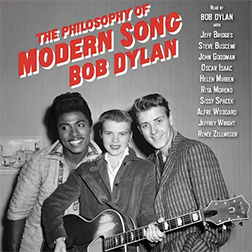 At 81, he dispenses the wisdom acquired over a life on tour, empathizing with Dean Martin, The Osborne Brothers, Stephen Foster. He celebrates Ray Charles’ “I Got a Woman” by imagining a sweet scenario attuned to the sound. Songs by The Fugs, The Grateful Dead, Bing Crosby get their due, as do some by Waylon Jennings, Little Richard; for Rosemary Clooney, along with Judy Garland and Cher, one of the few women present, he limns the great seductions of “Come on-a My House” and Nina Simone’s “Don’t Let Me Be Misunderstood,” concluding that “The thing about being misunderstood is that it diminishes
your enjoyment of life.”
Similarly, Dylan makes a strong case for Ricky Nelson being even more of an ambassador of rock and roll than Elvis, while reminding us, for “Viva Las Vegas:” “The house always wins.” A shot of Burroughs’ The Soft Machine cover, a poster featuring a Plymouth Volare, a period photo of a family at dinner saying grace. Dylan’s mind is sexy and alive in these pieces, with illustrations that rarely, as in most books, dance cheek to cheek with the subject, suggesting you make up your own steps for this sly and significant playlist.
 gossipcentral.com
Leave a comment