
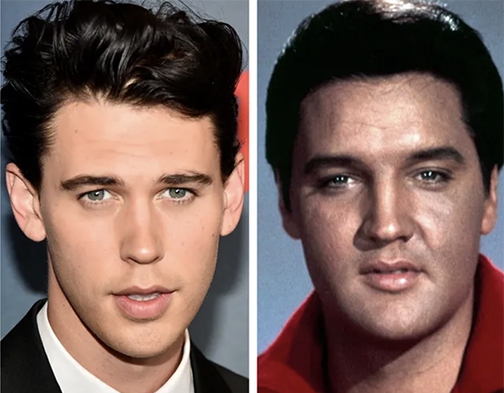
“Man cannot live by Batman alone,” said Baz Luhrmann about making his film of Elvis, and yet the film feels like a wild ride at times. Its great achievement is the casting of Austin Butler who, handsome and talented singing many of the songs we know and love, manages to humanize this historic figure. Young Elvis, grows up in the black community, learning music amidst the gospel and rhythms surrounding him, marginalized by poverty. Luhrmann traces the vital American lineage up through monstrous fame choreographed by a mysterious figure known as Colonel Parker, a citizen of no particular country, who manages Elvis’ career. Played with flair by Tom Hanks, this man has the heart of a carnival barker and fashions Elvis in the art of the con. Often feeling like a sideshow freak, Elvis is imprisoned by the colonel’s greed which leads to his drugged demise and addiction to swooning fans. He’s a Shakespearean outsized tragic hero who reflects upon the eras, the ‘50’s, ‘60’s, ‘70’s—as Luhrmann observed, “He defined all of them.”
Baz Luhrmann was made to illustrate Las Vegas. His aesthetic in every project, from Romeo & Juliet, to The Great Gatsby, and Moulin Rouge is more surface than substance, but what a surface of eye-popping gold and glitz. Elvis, trapped in a gilded cage, the excess, the women, so over-the-top, the effect is a dizzying even to us. A favorite scene is the Christmas special, when Elvis protests wearing a cheesy holiday sweater and ends up singing a memorial to the slain Martin Luther King. The music is great, but this rebellion is better, providing a portrait of the era, an idealistic picture of America’s soul in flux.
 gossipcentral.com
Leave a comment