• AUTHERS NIGHT 2023
    Famously, you cannot get near the famous authors at the yearly event of the season, Authors Night to benefit the East Hampton library. For books by Misty Copeland, Robert Caro, Neil deGrasse Tyson, Paulina Porizkova, the lines are long. No matter, writers in abundance are just happy to schmooze with one another. Susan Isaacs sat beside A. M. Homes, favorites conferring behind stacks of their most recent books. Similarly, Vanity Fair writer Marie Brenner could not say enough about Alice Carriere, seated beside her with a memoir about growing up the daughter of artist Jennifer Bartlett and French actor Mathieu Carriere, even when Katie Couric stopped by to say hello. Alafair Burke, daughter of novelist James Lee Burke, does her famous father proud. Another father, Geraldo Rivera was on hand to support his daughter Sol Rivera who has written a book of poetry. Page-turning author  Jean Hanff Korelitz spoke about book clubs she organizes in private Park Avenue homes. Allison Yarrow, passionate about women’s reproductive rights, held forth beside Amy Zerner and Monte Farber, regulars at this mega-gathering with a new book registering astrological verites for each birthday. Crazy as it may sound to some, they always get it right. Looking up mine, I did learn a “karmic lesson:” “the life and fun of a party,” I should, at overwhelming times, “change activities and cultivate more determination.” Good to know!

    (more…)

  • Barbi3Among the many Barbie international variations, Barbie in a sari, in lederhosen, in a kilt, none exist in a burka. So how would Barbie play where women, covered except for the eyes, are simply not seen? In Tangier, still an “international zone,” a thriving tourist spot, the streets are crowded with women and men in all attire, speaking the sounds of many languages. Still, it is hard to imagine a visual language as far afield as the palette of Greta Gerwig’s movie Barbie and its screaming pinks.

    Barbie is a world phenomenon making over a $billion. Could nostalgia for the ubiquitous doll draw the audience at Tangier’s Cinema Alcazar’s 5 pm screenings, as it does for millions in the U.S. and elsewhere fascinated with her extensive wardrobe—(I’m a fan of the Bob Mackie Cher dolls), preposterous physique, feminist/anti-feminist controversy? Wink-wink smart, Gerwig’s script penned with her partner Noah Baumbach, is full of a political agenda all too familiar on these shores. The professional Barbies lose all sense of self when Ken declares Kendom, and all things patriarchy. Are Moroccan women similarly inclined?

    (more…)

  • Oppenhiemer
    The Cinema Alcazar, a newly refurbished theater in the Tangier medina, was just a zigzag from my riad, one minute away if I remembered the right rights, lefts, and a staircase. Shuttered for decades, the theater now shows the latest in world fare subtitled in French. When Oppenheimer opened to acclaim in the U. S., so too did it fascinate Moroccans, judging by the crowds queuing up for the 7 pm screenings. The theater manager said most shows were sold out from first screening on. The next day I was there, seated between a German filmmaker and a Moroccan one who said as a kid he used to come to this theater with friends to take in Kung Fu action flicks. Now with no spare seat in sight, I wondered why the American story of Oppenheimer would be such a hit in North Africa.

    The development and dropping of the atom bomb were world events, true. Christopher Nolan’s visuals are worth the price of admission. Solarized, monumental, rising plume, the testing cloud alone had his fictive viewers geared up, in sunglasses and slathered against burn for the occasion. The image—movie magic for sure– seems comical, and does not play well among descendants of New Mexicans hurt by the radiation.

    A register of J. Robert Oppenheimer’s achievement, the bomb is the movie’s excuse for engaging in important themes—anti-Semitism being one, and another being betrayal. (I had just seen the sculpture of Judas kissing Christ on the façade of the Sagrada Familia in Barcelona.) Taking note of a brilliant performance by Robert Downey Jr. as the former chairman of the Atomic Energy Commission and Oppenheimer’s chief antagonist, I was struck by the egotism mixed with ambition, and the damage done by small men—as Nolan, basing his portrayal on Kai Bird and Martin J. Sherwin’s American Prometheus: The Triumph and Tragedy of J. Robert Oppenheimer, shapes the hero/ villain narrative.

    (more…)

  • RufusOn the brink of 50, legendary Rufus Wainwright’s music genre is hard to pin down. But one thing’s certain: he’s got lots of friends, family, and fans, all in full display at his birthday concert bash to benefit Montauk’s historic lighthouse, now turned 227 years old. Maintaining this edifice takes more than a village, and from the looks of the slopy grounds outside, everyone was pitching in. The same could be said of the performances, featuring Tig Notaro, Katie Couric, Jimmy Fallon, Jenni Muldaur, Laurie Anderson, Chris Stills, Chaim Tannenbaum, G. E. Smith, Rufus’ sisters Martha Wainwright and Lucy Wainwright-Roche, daughter Viva Wainwright, and more. Hosting or just hanging around for the first-rate music were Liev Schreiber, Ross Blechner, Bruce Weber and Nan Bush, Christy Brinkley and Cynthia Nixon. Many spirits hung around too: many of Rufus’ mom Kate McGarrigle’s songs were sung, Laurie Anderson performed a song by Lou Reed about how to see in the dark.

    Wainwright started off the generous three-hour concert with Irving Berlin’s “How Much Do I Love You?” Who knew that Berlin actually spent time in Montauk? Wainwright does the American songbook, folk, jazz, rock with ease. Everyone waits to hear Rufus’ cover of Leonard Cohen’s “Halleluliah,” which he dedicated to the artist Eric Freeman who recently died and who is scheduled to have an exhibition at Guild Hall in the coming year. After a duet on Neil Young’s “Harvest Moon,” Rufus congratulated Chris Stills on his marriage to Stacy. They had just flown in from the Vineyard for the occasion. I am still not over G. E. Smith’s guitar solo on “Memory Motel.” And Amber Martin led everyone in a rousing “Higher.”

    (more…)

  • Lora Linly
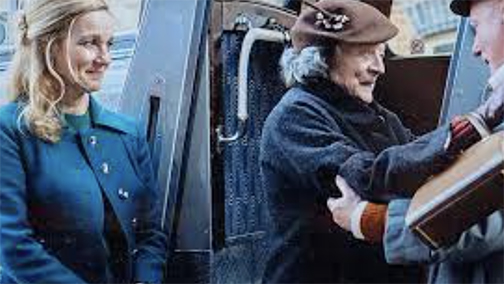
    During the pandemic, Ozark was celebrating its latest season at the Plaza Hotel’s Oak Room. Laura Linney, one of its stars, dropped by the masked but crowded party—“on her way to Ireland to make a movie with Maggie Smith,” she said. Now that film, The Miracle Club, having just had its world premiere at the recent Tribeca Festival, opens in American theaters in July.

    A road movie for ageless women, as we say, The Miracle Club is a European variation on the female travel romp made popular in this country with The Book Club, 1 & 2, 80 for Brady, etc. hugely successful entertainments featuring an older, glamorous, stellar quartet. In the Irish version, with a purposeful, religious pilgrimage that goes back to The Canterbury Tales (1400), you can add soul.

    Linney plays the estranged daughter of a beloved Irish woman recently deceased. The woman’s friends—with Kathy Bates joining in with Maggie Smith—take a bus trip to Lourdes for healing. A good part of the film’s beginning goes into the kinds of emotional and physical resuscitation needed here. In lesser hands, this could be melodramatic fodder for a soap opera. Newly arrived to mourn her mother, Linney makes the trip with them, an outsider who used to be an insider; shall we say, without divulging a rich backstory, she is the movie’s miracle.

    In Lourdes (filmed in Dublin), there’s a quiet moment that takes your breath away: Linney, helping Smith in a “bath” meant for spiritual cleansing places her hand on Smith’s shoulder in a gesture of generosity and forgiveness. If Americans are concerned with stolen Louis Vuitton suitcases in Rome, here, you might replace the laughs with tears of gratitude. At the SVA Beatrice theater, Linney and the film’s director Thaddeus O’Sullivan noted, this was the first time Linney and Smith performed together; Kathy Bates worked hard with a dialect coach for her fine accent, and the filming took a brisk 25 days.

    (more…)

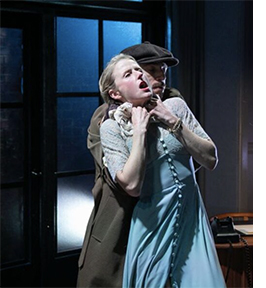
  • PhotoAt Bay Street Theater, bourbon glasses bear tell-tale fingerprints and lipstick traces. A husband and wife and her lover, in evening attire, converse in a London living room, the décor like the players, impeccably soignee. Murder scenarios foreshadow events to come. This is the opening of Dial M for Murder, adapted from Alfred Hitchcock’s 1954 movie, from Frederick Knott’s original script and play. Jeffrey Hatcher’s version raises the stakes, making the husband a would-be writer turned PR guy in publishing, promoting the lover’s new murder mystery.

    As Margot, the socialite wife, Mamie Gummer is sublime, elegantly slim, vulnerable yet capable of anything. It’s Grace Kelly’s part in Hitchcock’s masterpiece. Her husband, Tony (Erich Bergen) suspects she’s having an affair. “The other woman,” Maxine, (Rosa Gilmore) is smart, challenging to Tony. As in the classic, he’s bent on murder. Under Walter Bobbie’s superb direction, the twists keep coming: Is it jealousy or simply the money?

    Enter Lesgate (Max Gordon Moore), down on his luck. Is he a murderer for hire, or a convenient body? This being a period thriller, a black telephone with rotary dial is a character more than a prop. By Act II, Inspector Hubbard (Reg Rogers) with wind swept hair commands the stage in a trench coat, a hilarious bespectacled vision reminiscent of Groucho Marx.

    (more…)

  • Double Helix
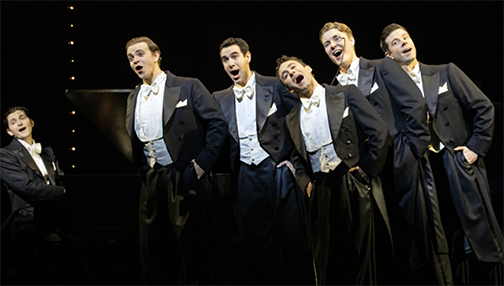
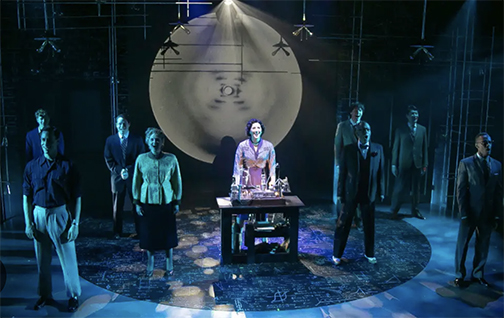
    Can science define a musical? Bay Street’s season opened with Madeline Myers’ Double Helix, starring Samantha Massell as Rosalind Franklin, one of the scientific researchers who discovered the DNA helix. As it starts out, tuxedoed men at a podium receive the Nobel Prize for their groundbreaking research. If you know the history, you know someone vital to the discovery is missing. The show seems to follow a predictable scenario: the lab as a male dominated workplace, with the women lunching in a separate cafeteria. Soon, though, because of Myers’ excellent music and book, Scott Schwartz’s fine direction of an excellent cast, the story lifts off from the feminist formula to the particularities of this woman, her dedication, love life, sacrifices, and science. Yes, the Nobel Prize should have gone to her too.

    In lieu of that, her story was so well played at Bay Street, Double Helix should be picked up for Broadway immediately.

    The Eternal Memory
    Summerdocs kicked off its season with a Chilean movie, The Eternal Memory, directed by Maite Alberdi. The story of a couple, Augusto Gongora a historian of his country, covering the horrors of Pinochet’s regime, and Paulina Urrutia, an actress and activist journalist. As we meet them onscreen, she wonders if he knows who she is. Frail, he is not so sure, and she reassures him, they’ve been married for twenty years. Flashbacks to this couple in better times juxtaposed with archival footage of Chile’s difficult political scene provide a background for this story of a marriage, the ravages of his developing dementia, set against the large canvas of Chile’s past.

    (more…)

  • Slattery and Hamm
    Among the pleasures of Tribeca this year, actors have taken the helm of movies, working well with other actors, and finding stories that reveal their strengths as directors.

    Actor John Slattery, well known for his role in Mad Men, is not just another pretty face. He premiered a film at the Tribeca Film Festival as director: Maggie Moore(s), scripted by Paul Birnbaum, could not be funnier given that two, not one, women named Maggie Moore are murdered. Slattery’s Mad Men pal Jon Hamm—let’s just say he’s not the Don Draper heart throb we knew, –leads a cast of loony characters. Hamm plays a lonely widower who works as the cop on this bizarre coincidence of a case. SNL alum Tina Fey, nutty as a peeping tom neighbor, is divorced and their relationship grounds the dramatis personae, including a pedophile, a dumb fast-food store manager, a closeted Nazi freak, and a large, scary deaf man for hire.

    Sad things happen and make you laugh but no one you really know and love gets hurt in the making of this madcap movie. Well, maybe except one.

    And, big reveal, Slattery does fine work making all the comedy and poignance land.

    (more…)

  • A2
    Invited to a party to celebrate designer/ costumer Patricia Field and the fine documentary about her life and career premiering at Tribeca, one ponders the question: what to wear? After the Tribeca screening of Happy Clothes: A Film About Patricia Field directed by Michael Selditch, a colorful romp through her decades-long career in the business of fashion: the 8th Street retail shop, her genius pattern combinations (plaids with florals that work) and accessories for the cultural icons starring in Sex & the City and The Devil Wore Prada, the better question is, is my outfit happy enough?

    We all accepted Sarah Jessica Parker’s Carrie Bradshaw in a tutu, making it New York street attire no less, awkwardly avoiding a splashing puddle; that image adorned the sides of buses for years, and the tasteful matching of Anne Hathaway’s dressy shirts with giant cuffs and mini-pleated skirts, curated by Stanley Tucci for the pleasure of a white haired Miranda Priestly—that is, Meryl Streep styled to look like the supermodel Carmen dell Orifice, not Vogue editor Anna Wintour. Even the detail-oriented Darren Star capitulated to Field’s eye, her unique combos and stylings—for the diva and Everywoman, trans or not.

    (more…)

  • A tony 2013pg
    The Writers’ strike was on everyone’s mind at the 76th annual TONY awards on Sunday night. Opening with a gorgeous dance number on the expansive United Palace Theater stage, the TONY show was its own Broadway show on upper Broadway that is, in the heights, Washington Heights. We do know that Lin-Manuel Miranda has enormous influence in the theater community, and he also has some inspiring ideas. Ubering in, guests missed Radio City Hall for a moment but took in the glamor and glitz of this spectacular venue. TONY host Ariana DeBose welcomed everyone in her own language of movement, with that exuberant dance opening, breathless as she welcomed everyone, acknowledging writers— the lack thereof, –and saluting Puerto Rican day. This was the quintessential New York night.

    Pre-televised, some awards for lighting and sound design were given out, with a wonderful tribute to John Kander whose New York, New York is now wowing audiences. Beowulf Borritt won Best Scenic Design of a Musical for that show, explaining how the sets were hand-painted, not video screened in his acceptance speech. Both Kander (96) and Joel Grey (91) were celebrated with Lifetime Achievement Awards—Grey receiving his from his daughter, Jennifer Grey. A star from the very start of his career, winning his first TONY for Cabaret (and an Oscar for the movie), Grey was the son of a Yiddish actor which goes far to explain his pre-pandemic production of Fiddler on the Roof in Yiddish. He said, you never know when something you are offered that you don’t think is right for you, is actually right, such as Anything Goes in which he starred with Sutton Foster.

    Many such legendary figures were on hand. When Leopoldstadt won for Best New Play, writer Tom Stoppard joined the cast and crew onstage; similarly, when Parade won for Best Musical Revival, writer Alfred Uhry spoke, followed by the “In Memoriam” reel accompanied by Juaquina Kalukango, last year’s winner for Paradise Square, singing “Wishing You Were Somehow Here Again” from Phantom of the Opera. Without saying so, the performance was a nod to Andrew Lloyd Weber who would not have a Broadway show in production for the first time in decades. Even though Funny Girl was not eligible this year, Lea Michele’s “Don’t Rain on my Parade,” was irresistible. And Will Swenson, starring as Neil Diamond in A Beautiful Noise, led a sing-along to “Sweet Caroline.”

    (more…)

  • Persion Lessons
    A hit at the 2020 Berlin Film Festival, Vadim Perelman’s Persian Lessons, a fiction film of a quasi-true story of Holocaust survival might have a hard time being made today. Perelman, a Ukrainian born Canadian filmmaker has been on my radar since his 2003 feature, House of Sand and Fog which starred Ben Kingsley and Jennifer Connelly who forge an unlikely friendship. Based on 14 pages of notes for a short story by the German writer, Wolfgang Kohlhaase, Perelman’s Persian Lessons is similarly grounded in an unlikely frenemy-ship between a concentration camp inmate and the German head of the camp’s kitchen. As Perelman told me on Zoom recently, a co-production among Russia, Belarus, and Germany, would be impossible today, given the war. And yet, with antisemitism a continued issue worldwide, such stories are imperative to tell.

    Persian Lessons might be considered a masterfully told fable. Gilles (Nahuel Perez Biscayart), a French-speaking Jew rounded up for execution improvises a survival strategy, guaranteed to give him one more moment of life. Claiming to be Persian just as the commandant is looking for someone who can teach him Farsi—for when the war is over, so he can open a restaurant in Teheran—this commander, Koch (Lars Eidinger) proceeds to take lessons in Farsi from Gilles, to tragicomic effect. A relationship ensues, life-saving, yes, comic at times, amidst the barbarity and random cruelty of concentration camp agenda, but mutually sustaining. The conceit of the film is how Gilles creates a language that does not exist.

    (more…)

  • Fat SamFans of William Shakespeare’s Hamlet will find James Ijames’ audacious reimagining, Fat Ham, a hoot. Set in a backyard barbeque, the play starts with a white-suited jive ass (Billy Eugene Jones) arriving in a whirl of sulphurous smoke to tell his son, a juvenile brooder called Juicy (Marquis D. Gibson in the performance I attended), about the wrong that’s been done him at the hands of his brother and wife. Well, we get every spectacle but those damned “incestuous sheets.”

    Along the way, as the characters sashay and butt butts celebrating a suspicious marriage onstage at the American Airlines Theater, we even get some soliloquies such as the one that asks, “what is this quintessence of dust?” On the way to revenge, Fat Ham delivers much existential dread in this house in North Carolina, a “liminal space between the past and the present with an aspirational relationship to the future that is contingent to your history living in the South, . . . inside the second decade of the 21st century,” according to a program note. James Ijames is clearly repurposing whatever lay “rotten in the state of Denmark!” 

    Tweaking Shakespeare, both Juicy and his “love” and childhood pal, Opal (Adrianna Mitchell) are queer; as a sort of Polonius, Rabby (Benja Kay Thomas) and “Gertrude,” now Tedra (Nikki Crawford) are excellent beefing up the female side of the story. But it isn’t until the staid, conservative Larry (Calvin Leon Smith) morphs into a dancing god that the show hits its spectacular stride, becoming an outsized Las Vegas (or Broadway) revue. What a play within a play!

    (more…)

  • Midge and manIn fact, two tits up! The stunning final season makes for a picture of life as a stand-up comic for Mrs. Maisel and her agent Susie, or Susan, depending on your history with her. Our heroine is now gainfully employed: she’s a writer on the evening’s popular celebrity television talk program, The Gordon Ford Show. The season flips through time periods, juxtaposing Midge’s rise to comedy superstardom with her rookie warm-up to fame. Both Midge (Rachel Brosnahan) and Susie (Alex Borstein) learn on the job, the hard way. Mutually dependent, they have each other’s backs—except when the mob’s involved—becoming an object lesson in female friendship. Working on television, on a popular evening talk show, Midge writes for Ford, and though there’s a taboo on actually getting on the show if you are a writer, well, you can guess that Midge gets there. And, having delivered a great speech to her boss about how if she slept with him, she would never know if she got the job by her talents or some casting couch. It’s a proto-feminist monologue that would work in our day.

    Susie becomes a famous agent, roasted at the legendary Friars’ Club. Danny Strong gives an outstanding performance as a rival agent, and fills everyone in on her backstory. Susie’s sister gushes and soaks up the air in the room, refusing to leave the podium. [An aside: Show biz being what it is, she played by Emily Bergl, the very actress who is currently on Broadway playing Sean HayesOscar Levant’s wife in Good Night, Oscar, a drama that similarly offers a glimpse of television’s salad years.] As to the Friars, the whole set up is a piece of New York history, playing out in real time; faced with financial ruin, the Friars’ Club is about to end if someone doesn’t come up with a way to save it—soon.

    (more…)

  • Fears
    In his theater production debut, Steven Soderburgh brings us Emma Sheanshang’s The Fears, performed off-Broadway at the Pershing Square Signature Theater. On trend, this ensemble work takes place in a room, with a window, and with hangings of the Buddha; this is a safe zone for the psychically injured, akin to a consciousness raising group space. A lively cast of characters is led by a neo-hippie-ish facilitator to deal with their triggers. The title The Fears made me think of the ancient Greek play, The Furies, which externalized the emotional explosions thin-skinned types experience in volatile families—think of the House of Atreus alone where sons are served up to fathers for dinner. Of course, without calling the characters trauma survivors. The personae in The Fears form something of a fiery family itself, –and that window: it faces onto a courtyard with a lot of commotion outside. Everyone has issues.

    Still, where is anyone safe from trauma? Each character, from Maia (Maddie Corman), the leader who keeps taking room tone, to Suzanne (Robyn Peterson) who offers solace in snacks of crispy seaweed, to bossy Rosa (Natalie Woolams-Torres), to exasperating Fiz  (Mehran Khaghani), and Katie (Jess Gabor), a most fragile Goth girl, gets a big sorry past, as do the new girl, Thea (Kerry Bishe) and her boyfriend. She just happens to be living with Mark (Carl Hendrick Louis). Director Dan Algrant keeps the tirades and banter flowing.

    (more…)

  • Book Club 4
    A four female post-pandemic road trip, Book Club: The Next Chapter, defies the current trends toward diversity and inclusion and yet manages to be silly enough to be just what we need: a big laugh against the backdrop of scenic Italy. One can argue that rich older white women are in a class that needs to be seen and heard.

    When first seen, in Zoom squares, wine glasses in hand, Jane Fonda, Diane Keaton, Mary Steenburgen, Candice Bergen ponder the finer points in books and quickly move on to escape (high end) lockdown as Covid restrictions allow. Jane Fonda as Vivian, recently engaged with a giant rock on her finger, will have a bachelorette bash in Italy with her besties. Candice Bergen’s Sharon, a retired judge is a pill, doing what older women do: find excuses for not embracing new adventure. Needless to say, she becomes the most outrageous of the lot in some clever plotting by writer/director Bill Holderman featuring travel mishaps: loss of luggage (we’re talking Louis Vuitton), misplaced ashes, a flat tire, and a night in jail. On the plus side: a steamy night on a boat in a Venice canal, kneading of dough, and yes, a wedding in Tuscany.

    This week’s premiere and afterparty at Tavern on the Green echoed the movie’s joyful release from the pandemic. Diane Keaton wore stripes and a signature hat. In the film, kooky as Annie Hall was, her character, Diane, favors dots and a flared silhouette. Partiers included Tovah Feldshuh, Candace Bushnell, Clive Davis, Carol Kane and Judd Hirsch (stars of iMordecai, the most adorable rom-com of the year), David Rasche (mum on Succession’s surprising series’ end), Ted Danson, Diane Sawyer, and many others toasting to all four stars!

    (more…)

  • Tony2023

    “Mazel tov.” You could hear Ben Platt in the Sofitel Hotel corridor congratulate Jessica Hecht, both nominated for Tony Awards. She was leaving the press room at the annual “Meet the Nominees” event, and he was entering. Starring in one of the two most Jewish plays on Broadway—Platt plays Leo Frank in the stunning revival of Parade—he spoke about how important this musical was to him, having grown up actively Jewish, and especially now as antisemitism in America is not simply a thing of 1913. The other most Jewish play is Leopoldstadt, a brilliant work by Tom Stoppard, examining an unexplored piece of the playwright’s history in Nazi-occupied Europe. Both plays received multiple much-deserved nominations. No one from Leopoldstadt stopped to say hello, but that’s the way with the “Meet the Nominees” day, you never know who will come by. Best to take frequent bathroom breaks. The corridor may be where you will see Sean Hayes as he’s led off to be photographed. Or glimpse Jessica Chastain.

    Or you may be lucky to get J. Harrison Ghee in blouse and midi skirt, with rhinestone-trimmed velvet slippers, looking divine as you would expect from the actor playing Daphne in Some Like It Hot. Dressed for the occasion, Ghee spoke of the joy of having the mother of a trans kid thank him for the representation. Or Beowulf Boritt, nominated for Best Scenic Design of a Musical, go into detail about how they spared no expense in the look of New York, New York: using the techniques of old school Broadway, they got a Ukrainian painter who had relocated to Amsterdam to hand paint 12 backdrops. Video would have been so much cheaper but the actors would not have looked as good. In my favorite scene, construction workers tap dance on a steel beam high above the street; the beam, he said, actually had a steel surface, so heavy it was a nightmare to get it on and off stage.

    (more…)

  • Viola Davis
    The newly minted EGOT, Viola Davis, is having a moment. More than one speaker at this week’s Film at Lincoln Center’s gala noted what distinguishes Davis in the awards world. Now she can add the Chaplin Award, presented to a film artist for film career achievement. By all measure, Viola Davis has had an astonishing career. Clip after clip, in big and small movies, she melts into character, never looking the same, whether she’s the mother Mrs. Miller looking respectable in hat and gloves in Doubt, the housewife Rose giving Denzel Washington the what for, or festooned in war gear as in The Woman King, in housemaid apron as in The Help, or the grieving wife in Widows, or gaudily made-up and hefty as Ma Rainey. When words come, she delivers every speech as if it were Shakespearean, with Oscar worthy gravitas.

    I said as much, reviewing her most recent movie, AIR. Playing Michael Jordan’s mother, a woman so fierce in her demands for her son, she elevates a business negotiation with Nike, making it a speech about knowing one’s worth. Scripted or not in Ben Affleck’s movie, this recognition of self-worth was precisely how the Chaplin Award tributes—from Jayme Lawson, Meryl Streep, Gina Prince-Bythewood, George C. Wolfe, and Jessica Chastain—might be summed up.

    My favorite speech of the night came from Meryl Streep, not only because she’s naturally funny, but because she actually went through a scene from Doubt telling precisely how Davis works—not told in Davis’ memoir, Finding Me. Playwright/ director John Patrick Shanley was putting them through their paces on the scene when Streep as a nun confronts Davis as Mrs. Miller about the priest who is taking liberties with her son. As scenes go, this one is through the roof emotional as Davis tries to explain how her abused son needs male guidance, no matter what. Take after take, Davis was giving her all and Shanley wanted to keep going. Seeing Davis go to a heart wrenching place each time, Streep asked Shanley, what are you doing? He did not like the way a leaf in the background was blowing. Davis nailed it every time she was asked.

    (more…)

  • ScreeGood Nightn Oscarn Shot 2023-04-25 at 9.33.06 AM
    Unreliable and often hospitalized and drugged, if Oscar Levant hadn’t been a musical genius, he might have been a bum. At least that’s how he’s portrayed by a terrifically transformed Sean Hayes at the Belasco Theater in Good Night, Oscar. Themes of mental illness being all the rage right now, Levant is a dynamic subject, beloved by his wife June (Emily Bergl who does a stunning turn here and on The Marvelous Mrs. Maisel) and popular talk show host Jack Paar (Ben Rappaport), despite Levant’s many issues. (Now we have names like OCD, bipolar disorder, although severe depression worked then as now.) Many who saw him as a talk show guest, or on his own television show, knew him as a brazen comic and a raconteur. Being very funny in the early years of television, he was responsible for immigrants learning the language just to get his jokes. He was a wit, when such a thing had cache.

    Glimpses of television in those golden years are a highlight of Good Night, Oscar, as they are of the series, The Marvelous Mrs. Maisel, now in its last season. Midge Maisel breaks through on The Gerald Ford Show. Hired as a writer, she finagles her way to “the couch” –not the casting couch but the couch where guests are interviewed by the host. In playwright Doug Wright’s conception of this single night when Oscar was scheduled to appear on Paar’s program and he has not yet left the hospital, Oscar Levant was all couch, cracking wise and off color as can be, unless he was seated at the piano when he would play George Gershwin’s “Rhapsody in Blue” —even his auditory hallucination of the maestro (John Zdrojeski) who died at age 38, approves. Yet what haunts Levant even more than that smoky vision is his musical writer’s block, his anxiety of Gershwin’s influence. When does he get to play his own compositions? Putting himself down constantly, he despaired he was a mere clown.

    (more…)

  • Leo FrankLooking mild-mannered, even Evan Hanson-ish, Ben Platt plays the real-life historic figure Leo Frank, a Jew who was lynched in the early 20th century in Atlanta. Lynching, a gruesome act of violence performed in the American South, illustrated by Billie Holiday’s “strange fruit,” is not the customary way of doing away with Jews as we think of it. Still, this really happened. As the musical Parade—yes musical—moves on to its climax, we see how justice works when zealous prosecutors force witness testimony serving their agenda, however racist. And, when an antsy mob takes over. Or maybe that’s the easy excuse for getting rid of “others.” Chilling, riveting entertainment, Parade, now revived at the Bernard B. Jacobs Theatre is so fiercely good, a highlight of this Tony award season, it defies you to turn away.

    Leo Frank from Brooklyn as conceived in Alfred Uhry’s excellent script and music, written with Jason Robert Brown, seemed secular enough to endure the south with its worship of confederate ideals. The play opens with a celebration of those who fought and died for this land. Anyone wondering about sources for white supremacy, see it here, in the exuberance of those who fought the war—the civil war of course. Leo Frank’s story takes place some fifty years after, with aging soldiers, soil still blood-soaked, and blacks finding their way. A proverbial fish out of water, Frank manages a factory. A little girl not yet fourteen working there, is murdered. Accused and found guilty, innocent Frank is set to die. Prodded by Frank’s wife Lucille, a stunning performance by Micaela Diamond, the governor commutes his sentence, and that’s when the mob hits, completing their blood lust, as Frank says the “Shma,” (Hear O Israel, the Lord is One) prayer to God, questioning what purpose this death serves HIM. Very Job-like—it’s a heartbreak.

    (more…)

  • Peter Marino at Gotham Hall
    “I hate it,” architect Peter Marino exclaimed surprising even himself, as he noted Gotham Hall, a cavernous former bank on Broadway, decorated for the 350 guests arriving for a tribute to him, and to art collectors Tom Roush and LaVon Kellner. This was Guild Hall’s winter gala, celebrating too the venerated East Hampton art institution’s emergence from a long renovation. Can it be that Peter Marino, clad in his hard-to-miss signature head-to-toe leathers and silver rings, all his own designs, is oddly demure? A video featured his many achievements and talents: architect, painter, sculptor, potter, gardener, collector with an impeccable eye. It finally took the Israeli artist Michal Rovner, a longtime friend, to underscore his bold innovations with a telling anecdote: In Tokyo, at the opening of a Chanel store he designed, he found the perfect use for the building’s façade, projecting her art on it.

    This was not a boast. An internationally renowned multimedia artist, Rovner will be featured at Peter Marino’s art foundation housed in Southampton, as part of a series, “Brunches with Bob,” the Bob being writer Bob Colacello who was part of Marino’s entourage, with his daughter Isabelle Trapnell Marino, who, despite her valuable input quips, she’s the “Vanna White” of the conversation series. The culture-packed room also included Michael Halsband, just back from his opening of his iconic sparring Basquiat/ Warhol photos at the Fondation Louis Vuitton, April Gornik, Blythe Danner, Lisa Perry, Iris Smyles, Alice Aycock, and many more to honor their East End neighbors, Tom Roush and LaVon Kellner. A retired doctor, he used to treat many artists when they occupied lofts in Soho, before they became big names.

    (more…)

  • Chantilly Bridge
    If The Golden Girls weren’t a sitcom, or if The Big Chill was an all-women cast, it might look like Linda Yellen’s new movie Chantilly Bridge, a bringing together of old friends for a reunion. A thirty-year jump from Yellen’s movie Chantilly Lace, “Bridge” features the same actresses, all with big careers: JoBeth Williams, Jill Eikenberry, Lindsay Crouse, Helen Slater, Talia Shire, Patricia Richardson and Ally Sheedy. We haven’t seen them in a long time because in film life as in real life, older women are simply not seen. To the point, their lives matter.

    Chantilly Bridge opens with a quote about the function of bridges to connect the living with those departed. The characters come together to hug, mourn, remember, console, and deal with the matters that death brings—disposal of ashes, dispensing of “things,” discussion of lives lived, the demands of friendship, and of aging. There’s hardly a guy in the whole film.

    (more…)

  • Curt Vonagut22
    The iconic American satirist Kurt Vonnegut might seem an unusual inspiration for a jazz suite but composer/ pianist Jason Yeager brought the Slaughterhouse Five author live in a musical homage at Birdland this week. Originally performed in tandem with Vonnegut’s centennial year at the Kurt Vonnegut Museum & Library in Indianapolis in November, the show featured Yeager’s quintet—multi-reedist Patrick Laslie, trumpeter Alphonso Horne, trombonist Mike Fahie, vibraphonist Yuhan Su, bassist Danny Weller, drummer Jay Sawyer, and two guests, Miguel Zenon on alto sax and Yeager’s partner, singer Julie Benko, currently wowing audiences as Fanny Brice on Broadway in Funny Girl.

    Entitled “Unstuck in Time: The Kurt Vonnegut Suite,” Yeager’s playlist followed his new CD by the same title, the “unstuck in time” metaphor working well to describe the medium of jazz. As Yeager aptly put it, Vonnegut loved jazz, and the American songbook in particular. Punctuating Yeager’s improvisations on his work, Benko sang the standards “I’ll Be Seeing You,” and “Bewitched, Bothered and Bewildered.” A charming presence, she helped her flustered spouse light a Kurt Vonnegut candle, with a prayer from their rabbi who was seated nearby.

    It was that kind of a night, intimate with great music. “Now It’s the Women’s Turn,” an homage to Bluebeard, “Unk’s Fate,” referencing a character in Sirens of Titan, “Kilgore’s Creed,” for the protagonist of Timequake, and “Blues for Billy Pilgrim” honoring Slaughterhouse Five. Fans will immediately see the connections to their Vonnegut favorites.

    (more…)

  • Sharon StoneThe only one of this year’s nine muses awarded by NYWIFT to actually have been in a movie as a muse, Sharon Stone played goddess to the hilt. At a packed 700-person luncheon at Cipriani 42nd Street, she spoke of growing up in a town so small there was no traffic light; watching Fred Astaire and Ginger Rogers on television and dreaming of dancing down a spiral staircase, she punctuated her story of finally achieving that, “and I did.”  “And I did” became the punchline of several more achievements including starring as an action hero. Hers is a story of many triumphs–making it in New York being one of them. Yes, she started as an Eileen Ford model and still had to look for change in telephone booths so she could take the subway home downtown to a studio she shared with another girl and a million roaches. Recently in L.A. her pal Sarah Paulson asked her why people hate her so much. “You know why,” she said.

    No other movie has followed her as Basic Instinct has. An unknown, she was paid $500,000. Michael Douglas was paid $14 million. There is of course one of the most memorable movie scenes which aside from making everyone say, did I just see what I just saw, features her speech about loving sex with a particular partner because he liked to experiment. Wow! She became the voice of female pleasure like no other woman since The Wife of Bath! Few have torn away the curtain on hypocrisy as she has. Now we have college professors fired for showing full frontal Michaelangelo’s David, she said. Prior to Basic Instinct, “I was not allowed to cross my legs, or hold my arms up. You could not show armpits. We should think about what we can do.”

    Freida Pinto made it all about her journey, how motherhood helped her transcend insecurity, perhaps the most common thread among women who achieve—until now. Sandra Lee had taken the stage before, and recounted a time Stone sat with her on an airplane. Sharon Stone gave her sage advice, she said: “Make sure your hair is not perfect.” Munching on branzino and ricotta cheese cake, guests listened intently as Lee told everyone how excited she was to be in NY.

    (more…)

  • Matt and Ben
    Who knew basketball great Michael Jordan had a secret weapon? I don’t mean the Nike Air sneaker, the subject of a compelling, smart new movie, Air, but his mom Doloris Jordan who brokered the Nike endorsement deal and championed her son, when he was a rookie, to the top. Under the superb direction of Ben Affleck, Air tells the story of the making of that famous deal starring Matt Damon as Sonny Vaccaro, the persistent Nike exec who made it happen, giving the first heart-felt Oscar speech of the new season. Equal and opposite to that is a second speech, performed by Viola Davis. Believing in her son’s potential, she takes a risk in insisting the athlete get a percentage of the sales of the shoes with his name on it. She knows his worth. Phil Knight, with Affleck playing the Nike CEO, goes for it, making history.

    Ben Affleck has his own not-so-secret weapon, his decades-long friendship with Matt Damon. They won Best Screenplay Oscars for Good Will Hunting. The shorthand between them as they fielded questions during a post-premiere Q&A this week, made the filmmaking look like a breeze to the crowd attending. Viola Davis and her husband Julius Tennon were also onstage, talking about how their marriage informed the onscreen marriage. When Sonny makes the trip to visit Michael Jordan’s parents, to say why Jordan should go with Nike over Adidas and New Balance, the other hot sneakers of the 1980’s, Doloris takes him ‘round the back of the house to talk. With a mere gesture, James Jordan, Sr. lets her know, he’s got her back.

    (more…)

  • Drinking in America
    A glass of wine with dinner, or a joint if you are so inclined, might be a good idea before meeting the array of characters who so imbibe in Eric Bogosian’s award-winning one-man tour-de-force, Drinking in America, a production of Audible at the Minetta Lane Theatre. Performed to wiry perfection by Andre Royo, the assorted men he plays hale from the 1980’s. You might want to consider this background, drinking in American culture, to understanding the male toxicity—and fragility– of our moment, decades later. And let’s face it, the drugs are different now.

    Which may explain why the jokes landed askew at the performance we attended, even though Royo could not have been more appealing—as a talent agent, for example, doing lines of coke to wake up, trying to book Lee Marvin, but Richard Chamberlain would do. Or vice versa. It would be good to know the young folk in the audience could get these references.

    Or the traveling salesman, on the road hawking industrial ceramic tile, wasted in a hotel room with an unseen “Cheryl.” The vignette starts with his paternal, fatigued request: “Cheryl, keep your rubbing to yourself,” as he passes out in an easy chair. The ending is less than happy; getting his money’s worth, he advises her, “There’s no future in the escort business.”

    (more…)