• Persion Lessons
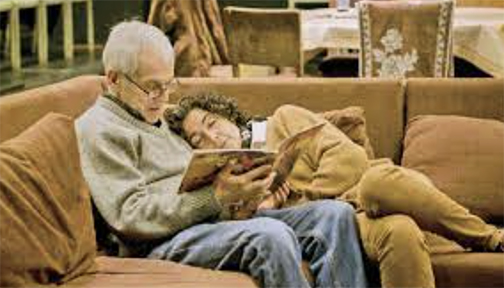
    A hit at the 2020 Berlin Film Festival, Vadim Perelman’s Persian Lessons, a fiction film of a quasi-true story of Holocaust survival might have a hard time being made today. Perelman, a Ukrainian born Canadian filmmaker has been on my radar since his 2003 feature, House of Sand and Fog which starred Ben Kingsley and Jennifer Connelly who forge an unlikely friendship. Based on 14 pages of notes for a short story by the German writer, Wolfgang Kohlhaase, Perelman’s Persian Lessons is similarly grounded in an unlikely frenemy-ship between a concentration camp inmate and the German head of the camp’s kitchen. As Perelman told me on Zoom recently, a co-production among Russia, Belarus, and Germany, would be impossible today, given the war. And yet, with antisemitism a continued issue worldwide, such stories are imperative to tell.

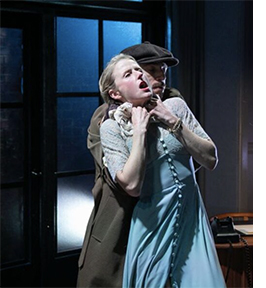
    Persian Lessons might be considered a masterfully told fable. Gilles (Nahuel Perez Biscayart), a French-speaking Jew rounded up for execution improvises a survival strategy, guaranteed to give him one more moment of life. Claiming to be Persian just as the commandant is looking for someone who can teach him Farsi—for when the war is over, so he can open a restaurant in Teheran—this commander, Koch (Lars Eidinger) proceeds to take lessons in Farsi from Gilles, to tragicomic effect. A relationship ensues, life-saving, yes, comic at times, amidst the barbarity and random cruelty of concentration camp agenda, but mutually sustaining. The conceit of the film is how Gilles creates a language that does not exist.

    (more…)

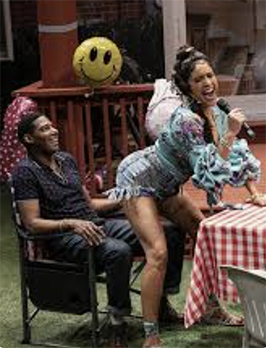
  • Fat SamFans of William Shakespeare’s Hamlet will find James Ijames’ audacious reimagining, Fat Ham, a hoot. Set in a backyard barbeque, the play starts with a white-suited jive ass (Billy Eugene Jones) arriving in a whirl of sulphurous smoke to tell his son, a juvenile brooder called Juicy (Marquis D. Gibson in the performance I attended), about the wrong that’s been done him at the hands of his brother and wife. Well, we get every spectacle but those damned “incestuous sheets.”

    Along the way, as the characters sashay and butt butts celebrating a suspicious marriage onstage at the American Airlines Theater, we even get some soliloquies such as the one that asks, “what is this quintessence of dust?” On the way to revenge, Fat Ham delivers much existential dread in this house in North Carolina, a “liminal space between the past and the present with an aspirational relationship to the future that is contingent to your history living in the South, . . . inside the second decade of the 21st century,” according to a program note. James Ijames is clearly repurposing whatever lay “rotten in the state of Denmark!” 

    Tweaking Shakespeare, both Juicy and his “love” and childhood pal, Opal (Adrianna Mitchell) are queer; as a sort of Polonius, Rabby (Benja Kay Thomas) and “Gertrude,” now Tedra (Nikki Crawford) are excellent beefing up the female side of the story. But it isn’t until the staid, conservative Larry (Calvin Leon Smith) morphs into a dancing god that the show hits its spectacular stride, becoming an outsized Las Vegas (or Broadway) revue. What a play within a play!

    (more…)

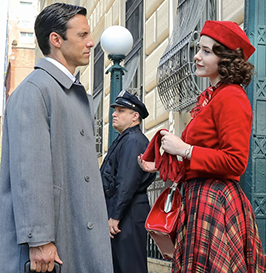
  • Midge and manIn fact, two tits up! The stunning final season makes for a picture of life as a stand-up comic for Mrs. Maisel and her agent Susie, or Susan, depending on your history with her. Our heroine is now gainfully employed: she’s a writer on the evening’s popular celebrity television talk program, The Gordon Ford Show. The season flips through time periods, juxtaposing Midge’s rise to comedy superstardom with her rookie warm-up to fame. Both Midge (Rachel Brosnahan) and Susie (Alex Borstein) learn on the job, the hard way. Mutually dependent, they have each other’s backs—except when the mob’s involved—becoming an object lesson in female friendship. Working on television, on a popular evening talk show, Midge writes for Ford, and though there’s a taboo on actually getting on the show if you are a writer, well, you can guess that Midge gets there. And, having delivered a great speech to her boss about how if she slept with him, she would never know if she got the job by her talents or some casting couch. It’s a proto-feminist monologue that would work in our day.

    Susie becomes a famous agent, roasted at the legendary Friars’ Club. Danny Strong gives an outstanding performance as a rival agent, and fills everyone in on her backstory. Susie’s sister gushes and soaks up the air in the room, refusing to leave the podium. [An aside: Show biz being what it is, she played by Emily Bergl, the very actress who is currently on Broadway playing Sean HayesOscar Levant’s wife in Good Night, Oscar, a drama that similarly offers a glimpse of television’s salad years.] As to the Friars, the whole set up is a piece of New York history, playing out in real time; faced with financial ruin, the Friars’ Club is about to end if someone doesn’t come up with a way to save it—soon.

    (more…)

  • Fears
    In his theater production debut, Steven Soderburgh brings us Emma Sheanshang’s The Fears, performed off-Broadway at the Pershing Square Signature Theater. On trend, this ensemble work takes place in a room, with a window, and with hangings of the Buddha; this is a safe zone for the psychically injured, akin to a consciousness raising group space. A lively cast of characters is led by a neo-hippie-ish facilitator to deal with their triggers. The title The Fears made me think of the ancient Greek play, The Furies, which externalized the emotional explosions thin-skinned types experience in volatile families—think of the House of Atreus alone where sons are served up to fathers for dinner. Of course, without calling the characters trauma survivors. The personae in The Fears form something of a fiery family itself, –and that window: it faces onto a courtyard with a lot of commotion outside. Everyone has issues.

    Still, where is anyone safe from trauma? Each character, from Maia (Maddie Corman), the leader who keeps taking room tone, to Suzanne (Robyn Peterson) who offers solace in snacks of crispy seaweed, to bossy Rosa (Natalie Woolams-Torres), to exasperating Fiz  (Mehran Khaghani), and Katie (Jess Gabor), a most fragile Goth girl, gets a big sorry past, as do the new girl, Thea (Kerry Bishe) and her boyfriend. She just happens to be living with Mark (Carl Hendrick Louis). Director Dan Algrant keeps the tirades and banter flowing.

    (more…)

  • Book Club 4
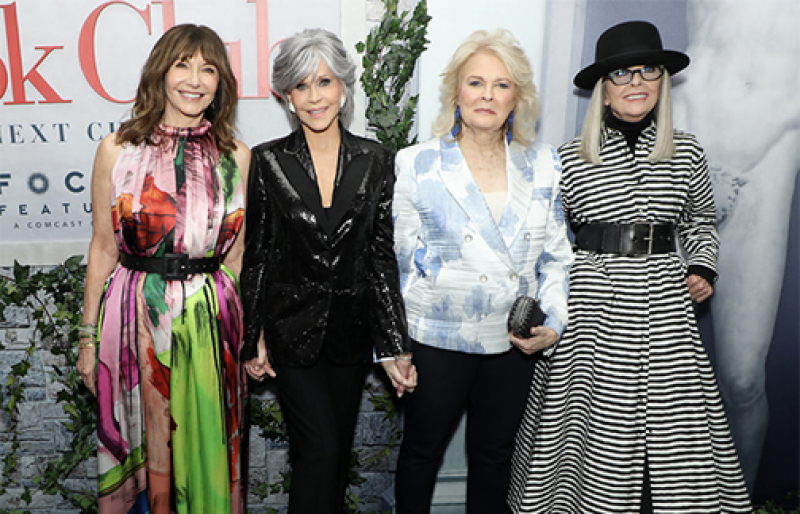
    A four female post-pandemic road trip, Book Club: The Next Chapter, defies the current trends toward diversity and inclusion and yet manages to be silly enough to be just what we need: a big laugh against the backdrop of scenic Italy. One can argue that rich older white women are in a class that needs to be seen and heard.

    When first seen, in Zoom squares, wine glasses in hand, Jane Fonda, Diane Keaton, Mary Steenburgen, Candice Bergen ponder the finer points in books and quickly move on to escape (high end) lockdown as Covid restrictions allow. Jane Fonda as Vivian, recently engaged with a giant rock on her finger, will have a bachelorette bash in Italy with her besties. Candice Bergen’s Sharon, a retired judge is a pill, doing what older women do: find excuses for not embracing new adventure. Needless to say, she becomes the most outrageous of the lot in some clever plotting by writer/director Bill Holderman featuring travel mishaps: loss of luggage (we’re talking Louis Vuitton), misplaced ashes, a flat tire, and a night in jail. On the plus side: a steamy night on a boat in a Venice canal, kneading of dough, and yes, a wedding in Tuscany.

    This week’s premiere and afterparty at Tavern on the Green echoed the movie’s joyful release from the pandemic. Diane Keaton wore stripes and a signature hat. In the film, kooky as Annie Hall was, her character, Diane, favors dots and a flared silhouette. Partiers included Tovah Feldshuh, Candace Bushnell, Clive Davis, Carol Kane and Judd Hirsch (stars of iMordecai, the most adorable rom-com of the year), David Rasche (mum on Succession’s surprising series’ end), Ted Danson, Diane Sawyer, and many others toasting to all four stars!

    (more…)

  • Tony2023

    “Mazel tov.” You could hear Ben Platt in the Sofitel Hotel corridor congratulate Jessica Hecht, both nominated for Tony Awards. She was leaving the press room at the annual “Meet the Nominees” event, and he was entering. Starring in one of the two most Jewish plays on Broadway—Platt plays Leo Frank in the stunning revival of Parade—he spoke about how important this musical was to him, having grown up actively Jewish, and especially now as antisemitism in America is not simply a thing of 1913. The other most Jewish play is Leopoldstadt, a brilliant work by Tom Stoppard, examining an unexplored piece of the playwright’s history in Nazi-occupied Europe. Both plays received multiple much-deserved nominations. No one from Leopoldstadt stopped to say hello, but that’s the way with the “Meet the Nominees” day, you never know who will come by. Best to take frequent bathroom breaks. The corridor may be where you will see Sean Hayes as he’s led off to be photographed. Or glimpse Jessica Chastain.

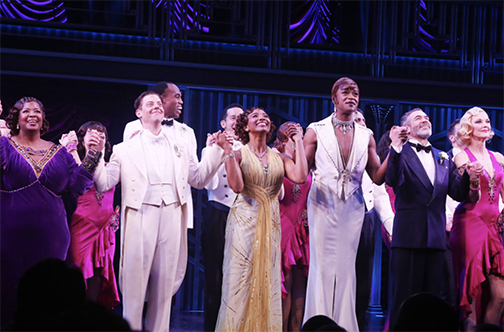
    Or you may be lucky to get J. Harrison Ghee in blouse and midi skirt, with rhinestone-trimmed velvet slippers, looking divine as you would expect from the actor playing Daphne in Some Like It Hot. Dressed for the occasion, Ghee spoke of the joy of having the mother of a trans kid thank him for the representation. Or Beowulf Boritt, nominated for Best Scenic Design of a Musical, go into detail about how they spared no expense in the look of New York, New York: using the techniques of old school Broadway, they got a Ukrainian painter who had relocated to Amsterdam to hand paint 12 backdrops. Video would have been so much cheaper but the actors would not have looked as good. In my favorite scene, construction workers tap dance on a steel beam high above the street; the beam, he said, actually had a steel surface, so heavy it was a nightmare to get it on and off stage.

    (more…)

  • Viola Davis
    The newly minted EGOT, Viola Davis, is having a moment. More than one speaker at this week’s Film at Lincoln Center’s gala noted what distinguishes Davis in the awards world. Now she can add the Chaplin Award, presented to a film artist for film career achievement. By all measure, Viola Davis has had an astonishing career. Clip after clip, in big and small movies, she melts into character, never looking the same, whether she’s the mother Mrs. Miller looking respectable in hat and gloves in Doubt, the housewife Rose giving Denzel Washington the what for, or festooned in war gear as in The Woman King, in housemaid apron as in The Help, or the grieving wife in Widows, or gaudily made-up and hefty as Ma Rainey. When words come, she delivers every speech as if it were Shakespearean, with Oscar worthy gravitas.

    I said as much, reviewing her most recent movie, AIR. Playing Michael Jordan’s mother, a woman so fierce in her demands for her son, she elevates a business negotiation with Nike, making it a speech about knowing one’s worth. Scripted or not in Ben Affleck’s movie, this recognition of self-worth was precisely how the Chaplin Award tributes—from Jayme Lawson, Meryl Streep, Gina Prince-Bythewood, George C. Wolfe, and Jessica Chastain—might be summed up.

    My favorite speech of the night came from Meryl Streep, not only because she’s naturally funny, but because she actually went through a scene from Doubt telling precisely how Davis works—not told in Davis’ memoir, Finding Me. Playwright/ director John Patrick Shanley was putting them through their paces on the scene when Streep as a nun confronts Davis as Mrs. Miller about the priest who is taking liberties with her son. As scenes go, this one is through the roof emotional as Davis tries to explain how her abused son needs male guidance, no matter what. Take after take, Davis was giving her all and Shanley wanted to keep going. Seeing Davis go to a heart wrenching place each time, Streep asked Shanley, what are you doing? He did not like the way a leaf in the background was blowing. Davis nailed it every time she was asked.

    (more…)

  • ScreeGood Nightn Oscarn Shot 2023-04-25 at 9.33.06 AM
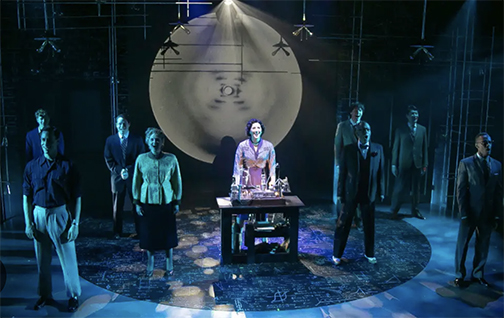
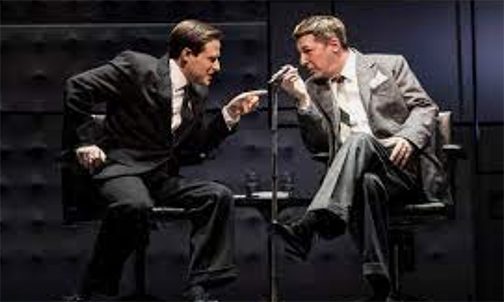
    Unreliable and often hospitalized and drugged, if Oscar Levant hadn’t been a musical genius, he might have been a bum. At least that’s how he’s portrayed by a terrifically transformed Sean Hayes at the Belasco Theater in Good Night, Oscar. Themes of mental illness being all the rage right now, Levant is a dynamic subject, beloved by his wife June (Emily Bergl who does a stunning turn here and on The Marvelous Mrs. Maisel) and popular talk show host Jack Paar (Ben Rappaport), despite Levant’s many issues. (Now we have names like OCD, bipolar disorder, although severe depression worked then as now.) Many who saw him as a talk show guest, or on his own television show, knew him as a brazen comic and a raconteur. Being very funny in the early years of television, he was responsible for immigrants learning the language just to get his jokes. He was a wit, when such a thing had cache.

    Glimpses of television in those golden years are a highlight of Good Night, Oscar, as they are of the series, The Marvelous Mrs. Maisel, now in its last season. Midge Maisel breaks through on The Gerald Ford Show. Hired as a writer, she finagles her way to “the couch” –not the casting couch but the couch where guests are interviewed by the host. In playwright Doug Wright’s conception of this single night when Oscar was scheduled to appear on Paar’s program and he has not yet left the hospital, Oscar Levant was all couch, cracking wise and off color as can be, unless he was seated at the piano when he would play George Gershwin’s “Rhapsody in Blue” —even his auditory hallucination of the maestro (John Zdrojeski) who died at age 38, approves. Yet what haunts Levant even more than that smoky vision is his musical writer’s block, his anxiety of Gershwin’s influence. When does he get to play his own compositions? Putting himself down constantly, he despaired he was a mere clown.

    (more…)

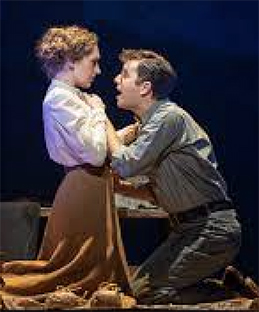
  • Leo FrankLooking mild-mannered, even Evan Hanson-ish, Ben Platt plays the real-life historic figure Leo Frank, a Jew who was lynched in the early 20th century in Atlanta. Lynching, a gruesome act of violence performed in the American South, illustrated by Billie Holiday’s “strange fruit,” is not the customary way of doing away with Jews as we think of it. Still, this really happened. As the musical Parade—yes musical—moves on to its climax, we see how justice works when zealous prosecutors force witness testimony serving their agenda, however racist. And, when an antsy mob takes over. Or maybe that’s the easy excuse for getting rid of “others.” Chilling, riveting entertainment, Parade, now revived at the Bernard B. Jacobs Theatre is so fiercely good, a highlight of this Tony award season, it defies you to turn away.

    Leo Frank from Brooklyn as conceived in Alfred Uhry’s excellent script and music, written with Jason Robert Brown, seemed secular enough to endure the south with its worship of confederate ideals. The play opens with a celebration of those who fought and died for this land. Anyone wondering about sources for white supremacy, see it here, in the exuberance of those who fought the war—the civil war of course. Leo Frank’s story takes place some fifty years after, with aging soldiers, soil still blood-soaked, and blacks finding their way. A proverbial fish out of water, Frank manages a factory. A little girl not yet fourteen working there, is murdered. Accused and found guilty, innocent Frank is set to die. Prodded by Frank’s wife Lucille, a stunning performance by Micaela Diamond, the governor commutes his sentence, and that’s when the mob hits, completing their blood lust, as Frank says the “Shma,” (Hear O Israel, the Lord is One) prayer to God, questioning what purpose this death serves HIM. Very Job-like—it’s a heartbreak.

    (more…)

  • Peter Marino at Gotham Hall
    “I hate it,” architect Peter Marino exclaimed surprising even himself, as he noted Gotham Hall, a cavernous former bank on Broadway, decorated for the 350 guests arriving for a tribute to him, and to art collectors Tom Roush and LaVon Kellner. This was Guild Hall’s winter gala, celebrating too the venerated East Hampton art institution’s emergence from a long renovation. Can it be that Peter Marino, clad in his hard-to-miss signature head-to-toe leathers and silver rings, all his own designs, is oddly demure? A video featured his many achievements and talents: architect, painter, sculptor, potter, gardener, collector with an impeccable eye. It finally took the Israeli artist Michal Rovner, a longtime friend, to underscore his bold innovations with a telling anecdote: In Tokyo, at the opening of a Chanel store he designed, he found the perfect use for the building’s façade, projecting her art on it.

    This was not a boast. An internationally renowned multimedia artist, Rovner will be featured at Peter Marino’s art foundation housed in Southampton, as part of a series, “Brunches with Bob,” the Bob being writer Bob Colacello who was part of Marino’s entourage, with his daughter Isabelle Trapnell Marino, who, despite her valuable input quips, she’s the “Vanna White” of the conversation series. The culture-packed room also included Michael Halsband, just back from his opening of his iconic sparring Basquiat/ Warhol photos at the Fondation Louis Vuitton, April Gornik, Blythe Danner, Lisa Perry, Iris Smyles, Alice Aycock, and many more to honor their East End neighbors, Tom Roush and LaVon Kellner. A retired doctor, he used to treat many artists when they occupied lofts in Soho, before they became big names.

    (more…)

  • Chantilly Bridge
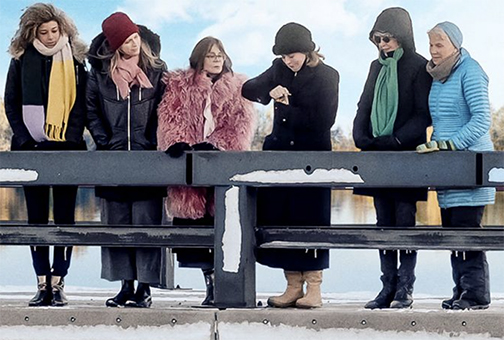
    If The Golden Girls weren’t a sitcom, or if The Big Chill was an all-women cast, it might look like Linda Yellen’s new movie Chantilly Bridge, a bringing together of old friends for a reunion. A thirty-year jump from Yellen’s movie Chantilly Lace, “Bridge” features the same actresses, all with big careers: JoBeth Williams, Jill Eikenberry, Lindsay Crouse, Helen Slater, Talia Shire, Patricia Richardson and Ally Sheedy. We haven’t seen them in a long time because in film life as in real life, older women are simply not seen. To the point, their lives matter.

    Chantilly Bridge opens with a quote about the function of bridges to connect the living with those departed. The characters come together to hug, mourn, remember, console, and deal with the matters that death brings—disposal of ashes, dispensing of “things,” discussion of lives lived, the demands of friendship, and of aging. There’s hardly a guy in the whole film.

    (more…)

  • Curt Vonagut22
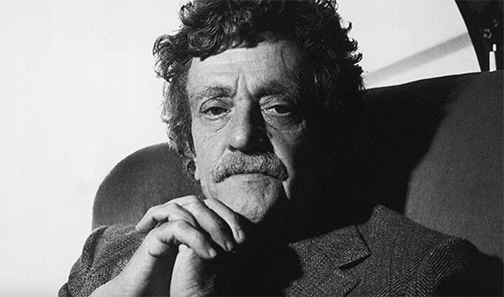
    The iconic American satirist Kurt Vonnegut might seem an unusual inspiration for a jazz suite but composer/ pianist Jason Yeager brought the Slaughterhouse Five author live in a musical homage at Birdland this week. Originally performed in tandem with Vonnegut’s centennial year at the Kurt Vonnegut Museum & Library in Indianapolis in November, the show featured Yeager’s quintet—multi-reedist Patrick Laslie, trumpeter Alphonso Horne, trombonist Mike Fahie, vibraphonist Yuhan Su, bassist Danny Weller, drummer Jay Sawyer, and two guests, Miguel Zenon on alto sax and Yeager’s partner, singer Julie Benko, currently wowing audiences as Fanny Brice on Broadway in Funny Girl.

    Entitled “Unstuck in Time: The Kurt Vonnegut Suite,” Yeager’s playlist followed his new CD by the same title, the “unstuck in time” metaphor working well to describe the medium of jazz. As Yeager aptly put it, Vonnegut loved jazz, and the American songbook in particular. Punctuating Yeager’s improvisations on his work, Benko sang the standards “I’ll Be Seeing You,” and “Bewitched, Bothered and Bewildered.” A charming presence, she helped her flustered spouse light a Kurt Vonnegut candle, with a prayer from their rabbi who was seated nearby.

    It was that kind of a night, intimate with great music. “Now It’s the Women’s Turn,” an homage to Bluebeard, “Unk’s Fate,” referencing a character in Sirens of Titan, “Kilgore’s Creed,” for the protagonist of Timequake, and “Blues for Billy Pilgrim” honoring Slaughterhouse Five. Fans will immediately see the connections to their Vonnegut favorites.

    (more…)

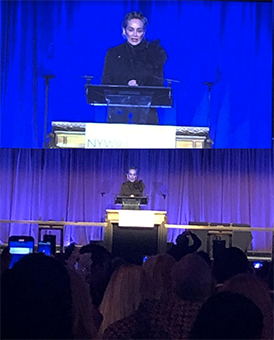
  • Sharon StoneThe only one of this year’s nine muses awarded by NYWIFT to actually have been in a movie as a muse, Sharon Stone played goddess to the hilt. At a packed 700-person luncheon at Cipriani 42nd Street, she spoke of growing up in a town so small there was no traffic light; watching Fred Astaire and Ginger Rogers on television and dreaming of dancing down a spiral staircase, she punctuated her story of finally achieving that, “and I did.”  “And I did” became the punchline of several more achievements including starring as an action hero. Hers is a story of many triumphs–making it in New York being one of them. Yes, she started as an Eileen Ford model and still had to look for change in telephone booths so she could take the subway home downtown to a studio she shared with another girl and a million roaches. Recently in L.A. her pal Sarah Paulson asked her why people hate her so much. “You know why,” she said.

    No other movie has followed her as Basic Instinct has. An unknown, she was paid $500,000. Michael Douglas was paid $14 million. There is of course one of the most memorable movie scenes which aside from making everyone say, did I just see what I just saw, features her speech about loving sex with a particular partner because he liked to experiment. Wow! She became the voice of female pleasure like no other woman since The Wife of Bath! Few have torn away the curtain on hypocrisy as she has. Now we have college professors fired for showing full frontal Michaelangelo’s David, she said. Prior to Basic Instinct, “I was not allowed to cross my legs, or hold my arms up. You could not show armpits. We should think about what we can do.”

    Freida Pinto made it all about her journey, how motherhood helped her transcend insecurity, perhaps the most common thread among women who achieve—until now. Sandra Lee had taken the stage before, and recounted a time Stone sat with her on an airplane. Sharon Stone gave her sage advice, she said: “Make sure your hair is not perfect.” Munching on branzino and ricotta cheese cake, guests listened intently as Lee told everyone how excited she was to be in NY.

    (more…)

  • Matt and Ben
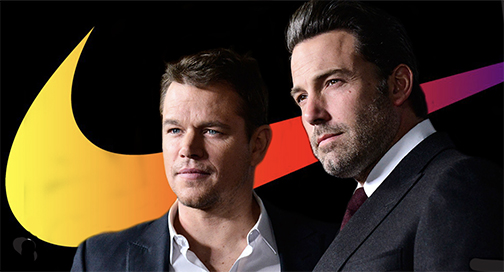
    Who knew basketball great Michael Jordan had a secret weapon? I don’t mean the Nike Air sneaker, the subject of a compelling, smart new movie, Air, but his mom Doloris Jordan who brokered the Nike endorsement deal and championed her son, when he was a rookie, to the top. Under the superb direction of Ben Affleck, Air tells the story of the making of that famous deal starring Matt Damon as Sonny Vaccaro, the persistent Nike exec who made it happen, giving the first heart-felt Oscar speech of the new season. Equal and opposite to that is a second speech, performed by Viola Davis. Believing in her son’s potential, she takes a risk in insisting the athlete get a percentage of the sales of the shoes with his name on it. She knows his worth. Phil Knight, with Affleck playing the Nike CEO, goes for it, making history.

    Ben Affleck has his own not-so-secret weapon, his decades-long friendship with Matt Damon. They won Best Screenplay Oscars for Good Will Hunting. The shorthand between them as they fielded questions during a post-premiere Q&A this week, made the filmmaking look like a breeze to the crowd attending. Viola Davis and her husband Julius Tennon were also onstage, talking about how their marriage informed the onscreen marriage. When Sonny makes the trip to visit Michael Jordan’s parents, to say why Jordan should go with Nike over Adidas and New Balance, the other hot sneakers of the 1980’s, Doloris takes him ‘round the back of the house to talk. With a mere gesture, James Jordan, Sr. lets her know, he’s got her back.

    (more…)

  • Drinking in America
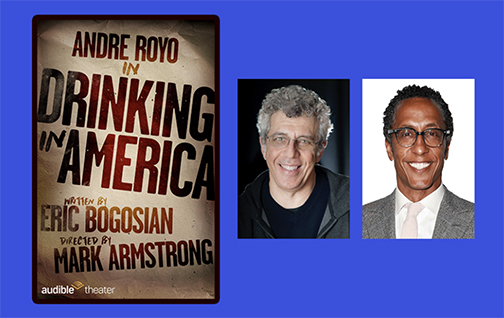
    A glass of wine with dinner, or a joint if you are so inclined, might be a good idea before meeting the array of characters who so imbibe in Eric Bogosian’s award-winning one-man tour-de-force, Drinking in America, a production of Audible at the Minetta Lane Theatre. Performed to wiry perfection by Andre Royo, the assorted men he plays hale from the 1980’s. You might want to consider this background, drinking in American culture, to understanding the male toxicity—and fragility– of our moment, decades later. And let’s face it, the drugs are different now.

    Which may explain why the jokes landed askew at the performance we attended, even though Royo could not have been more appealing—as a talent agent, for example, doing lines of coke to wake up, trying to book Lee Marvin, but Richard Chamberlain would do. Or vice versa. It would be good to know the young folk in the audience could get these references.

    Or the traveling salesman, on the road hawking industrial ceramic tile, wasted in a hotel room with an unseen “Cheryl.” The vignette starts with his paternal, fatigued request: “Cheryl, keep your rubbing to yourself,” as he passes out in an easy chair. The ending is less than happy; getting his money’s worth, he advises her, “There’s no future in the escort business.”

    (more…)

  • Acadamy Awards 2023
    Even the pre-Oscar buzz augured a return to old-school. The academy had its wits about them awarding Everything Everywhere All at Once, which, for the most part, swept the earlier awards. When that phenomenon began, the world seemed divided: some could not understand its metaverse. Others said, it spoke to them. Because the latter group included some younger film enthusiasts I respected, I understood, attention must be paid. I finally saw the film. I tried to keep an open mind as I guffawed at visual effects, spinning, lurching, the hotdog fingers, and just the look of Jamie Lee Curtis, and the verbal jokes too, losing it at the everything bagel. Within the chaos, the tender moments floored me: the struggle of a mother/daughter relationship, the love. A most unusual film, EEAAO hit many bases resolving them in simplicity: Nothing Matters.

    If you think Best Supporting Actor Ke Huy Quan was exuberant for the Oscars, let’s just say, his manic enthusiasm—reminiscent of Roberto Benigni from another time—was consistent throughout the long season. At the NYFCC awards, he made sure to greet everyone, hugging, telling his American Dream story. Unstoppable. He launched his own campaign, but guileless, sincere. You had to adore him.

    Kudos for Jamie Lee Curtis. I instantly remembered her in the first Knives Out movie, thinking then that she had transformed, returning to her True Lies serious comedic chops, that it was all a late life career shift from the horror flicks. And the look of Sarah Polley in a tux, eschewing the froufrou of some of the bouffant fare. Another great win: Adapted screenplay for Women Talking. We can talk about the representation due women.

    (more…)

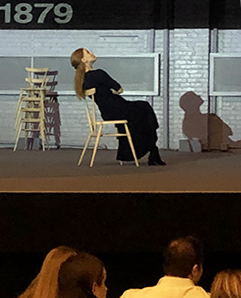
  • Chastain in A Doll's House at 5.07.58 PMRevolving on the barren Hudson Theater stage in an expansive orbit for 20 minutes before the first words of Henrik Ibsen's A Doll’s House are spoken, Jessica Chastain as Nora Helmer sits stationary as she in her chair marks the periphery. The edgy blacks and whites are not the way you imagine this classic Ibsen drama from 1879 would be set—more likely in the well-appointed, tastefully muted parlor of a proper home. In Jamie Lloyd’s revival, you have to see the living space in your mind’s eye, and ask yourself, why are the virtues of women in marriage so compelling a subject for men? Think Honore Balzac, Anton Chekhov, Leo Tolstoy—and Ibsen: why do him now?

    Amy Herzog’s fine adaptation distills Ibsen’s play to its essence: ditsy and chirpy, –a “femme enfante,” as the French would say–Nora keeps up her marital façade. Wife to Torvald Helmer (Arian Moayed), she’s his precious bird. But she’s more complicated than she looks; she’s mired in deception, and a naïve trust that her marriage is solid enough, that Torvald loves her enough, that he, though perhaps tarred, under the generous blanket that love weaves could bear any fault that she might present. Well, you know there’s trouble when only he has the key to the mailbox. Especially this mailbox!

    Among a pared down roster of minor characters, a nanny for the children (Tasha Lawrence), a schoolmate (Jesmille Darbouze), a wealthy, devoted best friend who might be called upon (a wonderful Michael Patrick Thornton), Nora seems well-situated in her world. And then there’s Nils Krogstad (Okieriete Onaodowan) with whom she’s bonded by a loan. Visually, when he comes to her, they are seated back-to-back, as though, pale as Nora is, and shadowy as Krogstad is lit, they form a single unit.

    (more…)

  • Paris
    While many quibble with this year’s Oscar list for its lack of female directors, this year’s Rendez-vous with French Cinema; a yearly event hosted by Film at Lincoln Center and Unifrance, features two women with superb films. For Opening Night, Alice Winocour’s Revoir Paris, translating to Paris Memories, stars this year’s Cesar winner for Best Actress, Virginie Efira. As Mia, she is the survivor of a terrorist attack in a Parisian café where nearly everyone was murdered. Mia, understandably, cannot return to life as usual, to her apartment, her boyfriend, her job in media, a Russian translator. Rather, haunted, she revisits the scene finding healing as she bonds with other survivors. While these emotions are tenderly evoked, Winocour does not skimp on the violence, the shooters seen from Mia’s eye view as she somehow fails to be hit. These scenes are nail-bitingly intense, explosive.

    Introducing her movie, Alice Winocour explained, she was not just exploring a random moment in the Zeitgeist. Who has not imagined oneself in such a terrifying circumstance? Her little brother was present at the Bataclan on November 13, 2015, when hundreds were gunned down. Interviewing many survivors, Winocour knew Mia’s trauma all too well.

    (more…)

  • CondoAt the Morgan Library last week, in celebration of a show of his drawings, painter George Condo spoke about knowing he was an artist at age 4. It took a while before language kicked in; enrolled in school, he said, he responded to lessons with artwork. As he matured, so did his influences: French writers: Rimbaud, Apollinaire, Celine. Jack Kerouac’s “automatic writing,” the spontaneous writing Kerouac used in composing his Book of Sketches made a big impression. Among Condo’s many credits, he wrote the introduction to the Viking Penguin publication in 2006. Beguiled by Picasso when he lived in Paris, Condo made several portraits in a cubist mode. Music brought Condo to Jean-Michel Basquiat—when they met, they talked about electronic music—but Basquiat was most inspiring in insisting Condo move to New York.

    At a dinner in Watermill, at the home of agent Andrew Wylie, Condo met novelist Salman Rushdie, who wrote about a Condo painting in his 2001 novel Fury. Titled “Psychological Puppeteer Losing His Mind,” (1994), Condo’s painting of Akasz Kronos, as Rushdie describes it, features “the puppet … broken free of the puppeteer’s control.” Rushdie’s writing here seemed most prescient as we think about Rushdie today, with a new novel, Victory City, even as the long-forgotten fatwa returned most unexpectedly, in all its horror this past summer, when a young man jumped the stage at a famed writers’ colony, badly knifing Rushdie.

    (more…)

  • The Bpy the Mole
    Jet-lagged as you might expect for a British writer/illustrator just arriving from L.A., having promoted his film, and looking as you might imagine a mad scientist crossed with Gene Wilder, Charlie Mackesy held forth at a luncheon at the Whitby Hotel, signing cupcake boxes, posters, copies of his book, and telling a story about how his teaching drawing to a Holocaust survivor helped the man, now 100, unleash painful memories. His energy seemed remarkable, but the occasion, a celebration of the film adapted from his beloved book, The Boy, the Mole, the Fox and the Horse, was nominated for a Best Animated Short Film Oscar. Then you realize he’s fueled by the film, a fable with a fresh message. Starting with an encounter between a boy and a mole who is looking for cake in a snowy landscape—(well, isn’t everyone?)—the film addresses a fundamental question: the mole asks, “What do you want to be when you grow up?” The boy answers: “Kind.”

    Okay. Simple enough. The mole voiced by Tom Hollander thinks he sees a cake, and even when he discovers it is a tree, there’s no disappointment, well, not really, because the tree is the most perfect tree, just as the boy, the mole, the fox, and the horse they encounter on their journey are drawn with a romantic perfection, becoming kind together, and yes, a family. The fox—gently voiced by Idris Elba—bares his teeth. He could just as easily have eaten the mole who saved him from a trap—but he doesn’t and saves him right back from drowning in fast-moving icy waters.

    (more…)

  • Nathen Lane
    In the avocado and sea greens of a suburban development décor, the Sultans, Irving and Jean, entertain their grown son Larry most weekends in Pictures from Home. A play version of photographer Larry Sultan’s 10-year project to capture his parents, posed and documented, so he can examine the sinews of their marriage and parenting strategy, Pictures from Home at Studio 54, is the story of the making of his celebrated photo project, and so Irving (Nathan Lane) and Jean (Zoe Wanamaker) “entertain” Larry’s (Danny Burstein) ambition more than amuse him, although they amuse him and the audience plenty in Sharr White’s dramatic adaptation.

    Irving’s life as a salesman meets a fate close to Willy Loman’s, except that here we see the demise pass through retirement to the desert, to a house with a pool looking onto a golf course. As Irving surveys his American Dream, he only hopes to live long enough to enjoy it. The familial patriarch, Nathan Lane is serious, and funny even as he attempts to hide his limp, hoping no one will notice he has one. Bartlett Sher directs his actors well. A master of physical humor, Lane is also adept at cutting down a son, and a wife, as needed. To these parents, Larry is pathologically intrusive, until his book is published with accolades galore, openings, parties, notoriety. Watch Nathan Lane beam.

    (more…)

  • Anniversity Gala
    Billy Crudup "has the kind of good looks that appeal even to straight guys,” quipped Bill Irwin, setting off the evening’s theme. Jokes about Billy Crudup involve his handsome, age-defying movie star mien. As the actor was honored and roasted at the Edison Ballroom this week by longtime friends and co-stars, among them Sam Rockwell, Jon Hamm, Victor Garber, and Jennifer Aniston, it was clear: no one was letting up on either the praise or the envy. The occasion was the 40th anniversary of The Vineyard Theatre, celebrating its longevity, mission to support theater and the artists who make it, and the long awaited post-Covid coming together at last. Vineyard did it up in grand style.

    Speakers included Deirdre O’Connell, who dazzled everyone in Lucas Hnath’s Dana H. and playwright Paula Vogel, whose How I Learned to Drive starred Crudup’s erstwhile girlfriend, Mary Louise Parker with whom he has a child. Both plays are reminders of the truly game-changing drama so valued at the Vineyard. Asking the dinner crowd to call out old New York favorite venues now vanished, Vogel mentioned her own, The Gotham Book Mart, before launching into a pitch for Vineyard support. Playwright David Cale, onstage with her, spoke about his play Harry Clarke, a brilliant tour de force one-man show performed by the guest of honor that proved above all else, Billy Crudup is not just another pretty face.

    (more…)

  • Julie BenkoPhoto: Kevin Alvey

    Birdland became Preservation Hall North as Julie Benko marched her band on stage for a set called Euphonic Gumbo. The performance, inspired by the French Quarter of New Orleans, was hardly a random soup, but more of a well thought out, scenic visit to the Crescent City, beloved by Benko and her husband, jazz pianist Jason Yeager who makes her arrangements of classic tunes entirely fresh for her.

    It helps that the seven-piece band includes first rate players: including Michael O’Brian on bass, drummer Jay Sawyer, Andy Warren on trumpet, Evan Christopher on clarinet and Ron Wilkins on trombone. Mixing up the music and her story-telling, Benko created a quiz with prizes that include Café du Monde chicory infused coffee, her CDs, and a return to her next Birdland gig—all great because, as she demonstrates amply, she is a master at the cabaret genre, her theme enabling her to provide a history of the beloved Louisiana city, as well as lovely renditions of the tunes.

    (more…)

  • PressmanThe marquee at the legendary Paris Theater this week said it all about how you celebrate the life of beloved movie producer Edward R. Pressman who died on January 17. A program featuring clips from his astounding film resume plus homages from stars, colleagues, friends and family was both heartfelt and hilarious. His wife Annie Pressman and son Sam Pressman emceed the entertaining memorial, that featured tributes from Jeremy Irons, Willem Dafoe, Christian Bale, Martin Sheen, John Lithgow, David Hare, and Sir Ben Kingsley, and others.

    David Byrne was auditioning actors for his upcoming Here Lies Love on Broadway and could not make it, but the Paris was packed with a who’s who of New York film makers and mavens from Barbara Kopple to David Denby to Bonnie Timmerman to Peggy Siegal. Abel Ferrara came in videoed from Rome, and thereafter many marveled that he was still around. That became a running joke. Ed’s brother Jim talked about his inheriting the family toy business While Ed went into film, and their upbringing at the Majestic playing stickball on West 70 Street. As you would imagine the funniest testimonials came from childhood friends and Fieldston classmates; his lawyer, Jim Janowitz talked about their work life. One time, he accompanied Ed to Cannes only to be airlifted by helicopter to an estate in Italy to meet with a potential backer. Balking at the price, the deep-pocketed Italian said, “I knew I was dealing with the producer of American Psycho, but I did not realize I was meeting with two American psychos.”

    (more…)

  • PianoThe piano at the center of August Wilson’s wise play The Piano Lesson is an object of beauty and resilience. Carved of a family history, this piano is a remnant of slavery, of ancestors being bought and sold, children separated from parents and siblings. Which is why the fight between Boy Willie (John David Washington) and his sister Berniece (Danielle Brooks) is so resonant, beyond property division. She and the piano live in Philadelphia with their uncle Doaker (Samuel L. Jackson); Boy Willie comes north, wanting to sell the piano so he can buy land. She’s hanging tough.

    Now closed, the play packed the Ethel Barrymore Theater for its entire run, and its not just because of the starry nature of the players, but the artifact itself. Announced this week: The piano will go into the Smithsonian.

    Yes, we’re talking family here: John David Washington is Denzel Washington’s son, and we’ve seen him in movies such as Spike Lee’s Blackkklansman. Denzel Washington starred in the recent Broadway of August Wilson’s Fences and in the film, vowing to ensure the revival of all of Wilson’s work. This revival of The Piano Lesson was directed by LaTanya Richardson Jackson, Samuel L. Jackson’s wife. Under Jackson’s superb direction, Washington’s Boy Willie is a jittery, fast-moving, fast-talking wannabe mover and shaker. As the lovelorn Berniece, Danielle Brooks can do much with a roll of an eye, wearing her hair in curlers or dressed for church. And Jackson’s Doaker provides wisdom as brother and sister duke it out verbally, evoking the supernatural. A fine supporting cast adds to the brilliance of this revival, probably this year’s Tony winner. Just saying.

    (more…)