
A Mumbai family leaves political duress in the homeland, migrates in a van to rural France, and mingles ethnic spices with haute cuisine across an embattled country road. This could be the recipe for a hokey immigration fable, but in director Lasse Hallstrom’s able hands, and with a cast led by the formidable Helen Mirren and Om Puri, The Hundred Foot Journey is the summer’s tastiest movie.

recent posts
- Marisa Tomei and Matthew Broderick at Guild Hall: The Plight of an Upper West Side Arts Space Gives A-List Actors The Big Chill
- Raul Esparza and Lily Rabe in The Winter’s Tale: Wet in Central Park
- Authors Night in East Hampton: If it’s Not One Thing It’s Your Mother
- Documentaries: Jocelyn Wildenstein The Lion Queen/ Tovah: How Jewish is It?
- Hamptons Journal: John Waters at Guild Hall: “Gay is not Enough” / “Cagney” at Bay Street/ “Signs” at the Bridgehampton Museum Tractor Barn
-
-
 The documentary’s catchy title, Keep On Keepin’ On, comes from the legendary trumpeter Clark Terry, now 94, a line he uses to inspire young musicians: Justin Kauflin, a blind pianist composer he’s nurtured, could not attend the special Summerdocs screening at Guild Hall in East Hampton on Friday night. Now in Los Angeles recording an album with Quincy Jones, Kauflin’s one of Terry’s successful students in jazz, but so is the Australian drummer and surfer who made this debut documentary, winner of the Audience Award at this year’s Tribeca Film Festival; the filmmaker Alan Hicks also took home the award for Best New Documentary Director. At a pre-screening cocktail party at The Maidstone, I had the opportunity to ask him how an Australian came to this landmark American music, and how he made his first film on a jazz legend’s story.
 -
Introducing Simon Pegg at the East Hampton Cinema last night, at a special screening of his new movie, Hector and the Search for Happiness, Gwyneth Paltrow announced of Pegg, the godfather of one of her children: “he’s the movie star in the family.” A pregnant pause followed these words, as the self-styled nerdy British comic hardly has the recognition of say, her mom, Blythe Danner, not to mention Paltrow herself. Was there irony in that praise? -
The theme may have been “One Thousand Nights and One Night: Sleepless Night of Sheherazade” at this year’s Watermill Center Benefit, but as we well know, Lady Gaga’s visual and conceptual incarnations can fire off a thousand and one narratives in anyone’s imagination. That conceit informs the slow moving videos of the “Born This Way” singer/ performance artist created by Robert Wilson, perhaps following Andy Warhol’s classic experimental work in that genre. Having made a live appearance last year, this weekend Lady Gaga was represented in images of impending demise, such as David’s “Death of Marat,” and Ingres’ “Mademoiselle Caroline Riviere.” Only Cindy Sherman has more poses. -
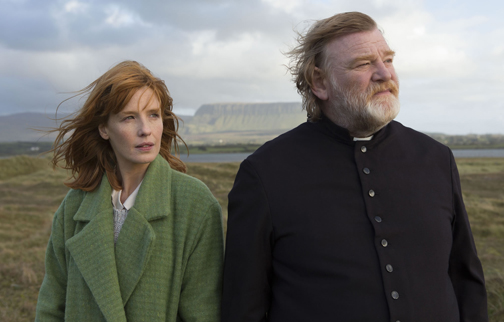
Scandals about pedophile priests bring many to tears. In John Michael McDonagh’s Calvary, a victim of abuse gets his day. No spoiler here. Make sure you are not late when you see this powerful, taut movie, which begins in a confessional. The camera is on Father James’ concerned yet calm face as the voice on the other side of the wall tells of the horrific acts done to him as a youth. Our priest is innocent, but the voice tells him to get his affairs in order, to meet him on Sunday at the beach, where he will kill him. -

The logical comparison to this Shakespeare-in-the-Park is not the Public’s more established revival of the bard’s genius at Central Park’s Delacorte Theater. The Classical Theater of Harlem’s stunning Romeo & Juliet most resembles in theme the play Holler If Ya Hear Me, inspired by the demise of Tupac Shakur. Each has a clear message about the horrors of gang violence, and with the work of very talented artists, illustrates the havoc done by such violence, on human values, identity, and life’s pleasures, like love. -
Marlo Thomas worked the homey sitting room at East Hampton’s Baker House on Saturday night: her husband Phil Donahue, Alec and Hilaria Baldwin, Bob Balaban and Lynn Grossman, Jordan Roth, his mom Daryl Roth, Blythe Danner and others ate sandwiches served on a silver tray by party planner Peggy Siegal. This was opening night of Joe Pietro’s play Clever Little Lies at Guild Hall, under David Saint’s fine direction. When we meet her in the living room of a suburban home, Thomas’ character Alice grouses about adorning the windows of her bookstore with copies of the sexually charged 50 Shades of Gray. By contrast, Alice’s family, including husband Bill (Greg Mullavey), son Billy (Jim Stanek), and daughter-in-law Jane (Kate Wetherhead) have other volatile issues. Nobody deploys the word, but “adultery” resonates, and compared with the sex in the best-selling book, the extra-marital sort seems genteel indeed. Son Billy has delusions of love– with a gym trainer—and plans to take off with her to Hawaii. Mom saves the day by coming clean about her own past, and dad well, Bill Sr. notes ruefully, “Someone always gets hurt.”
-

Woody Allen is up to his old tricks. Real ones, like pulling a rabbit out of a hat. In previous films he’s played the magician role himself, but in Magic in the Moonlight, a romantic comedy set in the luscious Provence landscape, he allows the dreamy Colin Firth to handle the willing suspension of disbelief, making elephants disappear, sawing women in two, misdirection, bedecked in chinoiserie. Even as an insufferable pompous egomaniac, Firth is so suave it is easy to fall in love with him. -
 It is a truth widely held, that ladies who lunch are wont to shop. The options for lavish spending were in sumptuous display at Jill Zarin’s Southampton waterfront home last weekend. While Valentino’s slinky gowns were not present, a sleek red smart phone case by the company Mophie sat enticingly under glass. Valentino and Mophie teamed up for the design. And for guilt free spending, the Samuel Waxman Cancer Research Foundation benefits from a portion of the sales. Dr. Waxman, a part time resident of East Hampton, was pleased with the Zarins’ support, helping the foundation grow in its efforts to fund researchers worldwide.
 -
Diane Keaton’s presence was felt on Long Island’s east end the day before her new movie And So It Goes premiered at Guild Hall last Sunday: she had a book signing at Bookhampton in East Hampton for her memoir, Let’s Just Say It Wasn’t Pretty, and Main Street was mobbed. At the screening, Keaton was a hot target too, and in her neurotic Annie Hall voice, she worried she was blocking the aisles. She was, but no one minded shimmying past her. -
The ecstasy around Richard Linklater’s Boyhood reached climax at the premiere at MoMA this week. A two and three quarter hour epic in which a boy goes from first grade to high school graduation, this landmark movie was filmed in yearly stages for over 12 years, meaning the actors portray themselves as they age. We see Patricia Arquette in several haircuts, Ethan Hawke with and without facial hair, and most dramatically, the kids, Ellar Coltrane and Lorelei Linklater, the director’s real life daughter, go from children to young adults, passing through their awkward teens. While this filming strategy pays off in stellar performances, in the big picture, the 12-year gestation is mere conceit. People love this movie for its glimpse into a family, broken marriage and divorce, change of schools, jobs, friends, in short, the quotidian we avoid by going to the movies. Engagement comes in the unfolding of these richly drawn lives, and the nostalgic reviewing of our own. It all seems so real, and yet, Boyhood is scripted in its major moments, with improvisation from the actors. -
The tensions between Ukraine and Russia make the news daily, but in Belarus, a regime has been in place for 20 years, imprisoning opposition, or eliminating it altogether. Andrei Sannikov, now in exile in Warsaw, Poland, attempted to run against President Alexander Lukashenko. After participating in a protest, he was imprisoned and tortured. On June 24, in Warsaw’s Museum of the History of the Polish Jews, I had the opportunity to talk to Andrei Sannikov about his exile in Poland and the documentary film about the suppression of free speech in his home country, Dangerous Acts Starring the Unstable Elements of Belarus, directed by Madeleine Sackler, to air on HBO.
-
Leafing through his well-worn script after a recent performance, Richard Kind enumerated the challenges of his role as Henry Carr in Travesties, a play replete with double entendres in every language you can imagine and then some. As fireworks rat-a-tatted in the background on the July 4th weekend, punctuating Kind’s grand kvetch about jokes that had to be explained even to him– like a colloquialism for German that might defy the recognition of any “echt” Berliner– he could not get over Czech playwright Tom Stoppard’s brilliance, and Bay Street Theater’s daring to stage this paean to verbal gymnastics and erudition during high beach season. Hello Dolly, it’s not, said Richard Kind after the standing ovation from the surviving audience. (Many left at intermission complaining of mental fatigue.) That fact begs an annoying question: To enjoy this play, do you, in fact, have to have read James Joyce’s Ulysses, need to know who Tristan Tzara was? Or, what Dada was compared to Surrealism? Or, how T. S. Eliot’s Prufrock measured out his life in coffee spoons? Or, care about the exact correlation of the political, the truly revolutionary, to ART? -
Wisdom has it, summer is for action thrillers, rom-coms, and other popcorn movies, but this season is particularly rich. Last week’s opening night for the BAM CinemaFest set the tone of excellence with Richard Linklater’s epic masterpiece Boyhood. With stellar performances by Patricia Arquette and Ethan Hawke as divorced parents, the film, shot in a dozen years, follows the growth and maturation of their two kids, played by Ellar Coltrane and the director’s daughter Lorelei Linklater. But this is “boyhood,” and therefore Ellar Coltrane’s film. A family saga unfolding in 2 hours and 45 minutes, the film is so deeply satisfying, the way a great novel takes you into a fully realized world. Perhaps it is a bit early to predict the award season picks, but this film has the vision, scope, Oscar dimension. At the BAM after party, directors Julie Taymor, who just completed filming her extraordinary Midsummer Night’s Dream, Bennett Miller, just back from the success of Foxcatcher in Cannes, and Oren Moverman, now editing his new film in which Richard Gere plays a homeless man, all agreed about Linklater’s achievement. -

Most theater does not translate well into film. The film genre invites expansion and theater can feel claustrophobic. Unless claustrophobic is what you want as in the case of Roman Polanski’s adaptation of David Ives’ stage play inspired by Sacher-Masoch’s novel, Venus in Fur, a kinky two hander involving a theater director at the end of a brutal day of auditions, and an actress who barges in at the last minute demanding attention. In the recent Broadway production Nina Arianda and Hugh Dancy faced off in these roles, but now on film, Roman Polanski cast his wife, the voluptuous Emmanuelle Seigner in a tour de force performance with Mathieu Amalric, whose Thomas could double for the director Polanski. The casting is adventurous in another way as Seigner brings a mature sexuality to Vanda: she is goddess, earth mother, a sex kitten to rival Bardot, a muse, tease or threat. Turning on a dime, her character sizzles. In an interview last month at the Soho Grand Hotel, Seigner spoke about her performance in this movie, working with her husband, and why this was such a good role for her. -

Just after the Father’s Day weekend, when Vaneese Thomas sang backup for Aretha Franklin at sold out shows at Radio City Music Hall, the singer had a launch for her new album, “Blues for my Father.” Her father was Rufus Thomas, a great singer who worked as a d.j. at a local radio station in Memphis, and who introduced Elvis Presley back in the day. Vaneese Thomas, the sister of Carla Thomas and Marvell Thomas, told the crowd at The Cutting Room that their dad was never inducted into the Rock and Roll Hall of Fame, an injustice, given that he helped found the ideals by which many others who followed him were inducted. Segueing into tunes she wrote for this album and others, songs like “When My Baby Gets Home,” “Southern Girl,” and “I Got the Blues,” she brought down the house with a first rate band, some very cool backup singers including her pal Berneta Miles, and violinist Katie Jacoby, behind her for “Blue Ridge Blues.” A good time was had by all.Graphic Design: Salpeter Ventura


-

A pretty, blue-eyed blond and a young boy say a tearful goodbye to one man, and in the next scene, leave by car with another. Border patrol, strip searches, humiliating intrusive interrogations lead to a refugee camp with more of the same. According to filmmaker Christian Schwochow after a screening of his nail-biting drama West, a film he co-wrote with his mother, Heide Schwochow based on a semi-autobiographical novel by Julia Frank, this was not an unusual situation for citizens leaving East Berlin for the West. In fact, this story, involving trust in the time of the Stasi, hews close to his family experience, and others’ he and his mother knew. As opening night of the Kino! Festival of German Films, this past Thursday at the Museum of the Moving Image in Queens, West is of a particularly German narrative, as is another fine movie, Hanna’s Journey, directed by Julia von Heinz, about a Berlin-based student who goes to Israel to complete credits in community service, needless to say, a transformative adventure. -
Sandra Bernhard makes me laugh. Her brassy, wild mouthed persona has always seemed an exaggeration of femininity, her humor bold, her image could be menacing as in her role in The King of Comedy, Martin Scorsese’s 1983 movie starring Jerry Lewis, out there as in a 1992 nude spread for Playboy, or mock kitten as in her stand-up routine, “Without You I’m Nothing, and With You I’m Not Much Better,” wearing little under a mink. When I heard she would be performing at Guild Hall on June 20, I wanted to know what she would bring to the East Hampton vacation community, after her sold out performances at Joe’s Pub. Recently, I had the opportunity to speak to this funny woman, and found her dead serious about her work. -

You’ve got to love a guy whose ex-wife speaks well of him, and so, in crafting a speech to honor Charlie Rose, Gayle King, called her to get some anecdotes. King was not the only one at the podium. It takes three women to toast him, and so his co-anchors on CBS This Morning, King and Norah O’Donnell presented along with Yvette Vega. Even the gracious Richard Plepler in receiving his award, managed to contribute two impersonations in gathering information on Charlie Rose: Henry Kissinger and Bill Clinton. Wanting to keep “shalom bayit,” Plepler thanked his wife. That and the hilarious John Oliver –deploying tee shirt cannon jokes–made for an unusually warm and entertaining benefit for the Museum of the Moving Image. As John Oliver made clear, “It’s worth going to Queens. It’s not just an airport!” Fareed Zakaria complained about following John Oliver, and nicely held his own.
-
Greta Gerwig is a big girl: she’s tall, and gangly in an appealing way, and like the “Girls” on the HBO series, she’s emblematic of the new woman finding her way through life’s challenges. That was her appeal in Frances Ha, directed by Noah Baumbach, and that’s what she embodies as Becky in a new play, The Village Bike, by the British playwright Penelope Skinner now making its American premiere in the MCC production at the Lucille Lortel Theater. Gerwig is even big in a video projected over the stage, riding a used bicycle, a pregnant woman with a big libido. -

“Did you have sex with that woman?” This is not a question from a bygone era’s congressional hearing, although the echo is unmistakable. Rather it comes from a wife, Leigh (Sarah Paulson) whose husband Tom (Garret Dillahunt), a dynamic theater teacher has been convicted of inappropriate behavior with a female student, and is just back home after having served three years in prison. Leigh is 99% sure he’s innocent, but Carey Crim’s Conviction, now in its world premiere at Bay Street Theater, is concerned about that 1%, and the effect of that margin of doubt not only on her, but their son Nicholas (Daniel Burns), and their best friends Bruce (Brian Hutchison) and Jayne (Elizabeth Reaser). -
Back in the 1970’s when Robert De Niro was breaking out in films—Bang the Drum Slowly, Mean Streets, Taxi Driver—his dad Robert De Niro, Sr. was a painter of note, influenced by the European modernists Manet, Matisse, and Picasso, but never to equal the fame of his actor son. By the time De Niro, Sr. died in 1993 of prostate cancer, he left behind a significant body of work, journals and other writings revealing pride in his actor son, homosexuality, and depression. Now De Niro, the son, encouraged by his Tribeca Films producing partner Jane Rosenthal put together a documentary about his father, Remembering the Artist, directed by Perri Peltz and Geeta Gandbhir that will air on HBO on Monday night. -
A plastic faced Glenn Close swivels her hips mechanically in The Stepford Wives or cackles maniacally as Cruella DeVille from 101 Dalmations, just two memorable images from a startlingly versatile film career. Last night at Stage 37, she was not celebrating the commercial moments, but rather her work in smaller, independent films like Robert Altman’s Cookie’s Fortune. Presenting the Vanguard Leadership Award to her at a gathering of filmmakers, actors, and distributors at the Sundance Institutes’ Celebration, Jeremy Irons who made three films with her and traveled from England to be there, said, when he heard he would co-star with “Glenny” in The Real Thing in 1982, he thought she was a man, an idea that was almost prescient given her passion project where she, as Albert Nobbs, plays a woman who passes as one.
-

Who is Shep Gordon? Aside from his career in rock & roll, as Alice Cooper’s manager among many other high profile clients, Shep Gordon invented the concept of the celebrity chef and adheres to the teaching of the Dalai Lama; he is, however, not a celebrity, a status he claims to prize. All of that is about to change. In Mike Myers’ directorial debut, Supermensch, the question of why Shep Gordon is no ordinary mensch is treated with enormous humanity, largesse, and humor. Not merely a supermensch, Shep Gordon is now a star. -
The television series Smash may have ended, too abruptly for some, but its memory lingers. At center in the first season, Smash featured the competition between two very talented young women to bring Marilyn Monroe to life in a new musical. Megan Hilty as Ivy Lynn effortlessly looked the part. Last night the Cafe Carlyle was filled with fans for this bold blond, now pregnant, with a confidence that suggests Lorelei without the fragility. Singing the classic from Gentlemen Prefer Blonds, “Diamonds are a Girl’s Best Friend,” Hilty knew how to work that intimate room, even asking for a volunteer to tape her on iPhone for the daughter she and guitarist Brian Gallagher are expecting. Few performers become that familiar, and few shows are this engaging.
 gossipcentral.com