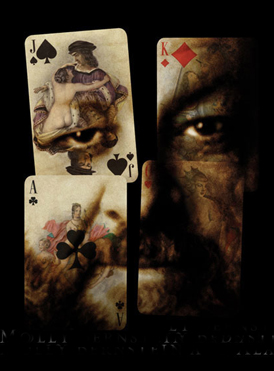
 How many assistants does it take to cut a watermelon? One of 52, if you ask master conjurer Ricky Jay who wowed the crowd at The Paley Center for Media last Thursday night. He has starred in a show, “Ricky Jay and his 52 Assistants” for years, expertly fanning his deck at nightclubs around the country. This occasion, however, was a PBS event celebrating a documentary profile called Deceptive Practice, part of Channel 13’s American Masters series, to air on January 23. Ricky Jay is the first magician to have a documentary portrait as part of the prestigious series begun by Susan Lacy several decades ago. Now with executive producer, Michael Kantor, it is evident the program continues to be in good hands.

recent posts
- Lorne Premieres at Lincoln Center: Glimpsing Lorne Michaels Backstage at Saturday Night Live
- Alden Ehrenreich and Patrick Ball: The Men in Becky Shaw on Broadway
- Audra McDonald and “Original Nepo Baby” Gwyneth Paltrow: Honorees at the NYWFT Muse Awards 23 March 2026
- Zach Bryan Buys the On the Road Scroll/ Happy Birthday, Jack Kerouac!
- William S. Burroughs/ Nova ’78 at MoMA/ Remembering James Grauerholz
-
-

No surprise: the Museum of Modern Art has extended its exhibition of Matisse’s cut outs as a result of popular demand. The same happened when the show featuring the master’s late in life career debuted in London’s Tate. But viewers in 350 American cities as of this week do not have to travel to get a state of the art tour through the galleries. As a result of a new film project, Exhibition on Screen, audiences can walk through the galleries of the show, a melding of the UK and US venues in their local cinemas, with many extras including curator talks, archival footage of the artist at work, and a view of the artist’s inspiration, in Matisse’s case, a ballet dancer’s lithe figure in performance. -
The big question when it comes to Cheyenne Jackson is whether or not the intimate cabaret stage is enough of a venue for this dynamic multi-talented performer who does Elvis complete with swiveling hips. At last night’s opening at the Café Carlyle, this Broadway star finessed the space with flair; you would think he was born to it. But no, growing up in Idaho with no running water and two goats, Harmony and Melody, as he charmingly informed the audience, he thought Broadway was one theater called Broadway. At six foot three, he was a likely candidate for football, but his understanding dad let him know, it was fine if running at giant guys wasn’t for him. As it turned out, running at guys may have been just the thing: his show, titled “Eyes Wide Open,” celebrates surviving a rough patch involving a divorce, the death of his grandparents, and awakening to another marriage, and sobriety. He met his husband at AA.
-
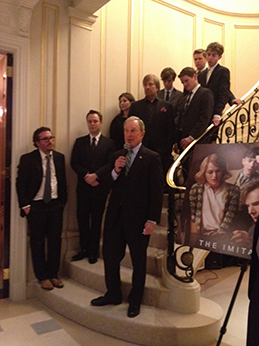 Benedict Cumberbatch and Keira Knightley, stars of The Imitation Game, were still in the U.K.—he shooting an episode of Sherlock Holmes– but everyone else from Morten Tyldum’s riveting movie about Alan Turing attended this final celebration in an exhilarating campaign season at the Christine and Stephen Schwartzman residence on Park Avenue Wednesday night. Michael Bloomberg, Eric Schmidt, Robert DeNiro, Charlie Rose, Trudie Styler, Damien Chazelle, Oren Moverman, Daryl Roth, Bob Woodruff were among those in heated discussion about Turing’s achievement in solving the unbreakable Nazi Enigma code, and then criminalized as a homosexual. Everything from your cell phone to laptop comes from Turing’s genius as a mathematician. His treatment as a gay man, forced to take debilitating drugs until he finally killed himself at age 41, was especially embarrassing to the Brits in the art-filled room–and there were many, including the talented young actor Alex Lawther, Turing in his youth, and Downton Abbey’s Allen Leech who here plays John Cairncross, Turing’s colleague.
 -

Bracing an icy rain, Harry Belafonte, Gay Talese, Henry Louis Gates, Jr., Ruben Santiago Hudson, Phylicia Rashad, Gayle King, Tamron Hall, and many others filled the grand ballroom of the Metropolitan Club on Tuesday for a luncheon honoring Ava DuVernay for her movie Selma. The journey was worth it. Backed by an ensemble of ten musicians, John Legend and Common performed their song, original for this historic film. With “We Are the World” on her mind, DuVernay gave these artists their freedom when she asked them to compose a special song for the film, but instructed them: it should be memorable. Coming at the end of this important movie about a benchmark moment in American history, “Glory” is a powerful anthem, but now performed at this special venue, you could hear the relevance of bringing the 1965 event into the present ethos. Ferguson is intoned, and you know the Martin Luther King, Jr.-led march across the bridge remains a metaphor for a democracy that is a work-in-progress. -
The New York Film Critics Circle announce their film honors early, so you know just who you are going to see at their annual awards dinner: with Boyhood taking top honors, the team was a distinct presence at Tao Downtown, with Patricia Arquette, Ethan Hawke, the star, Ellar Coltrane, and director Richard Linklater. The NYFCC’s impeccable choices included Marion Cotillard for two roles: in The Immigrant and Two Days, One Night, Timothy Spall as the painter Mr. Turner, J. K. Simmons, as the music teacher from hell in Whiplash. Patricia Arquette won the best supporting actress for her role over a dozen years as Mason’s mom in Boyhood: “Thank you for sharing your childhood and your chicken pox” she said to him. “Thank you for a role honoring all mothers.” -
It’s a cliché of the season to list award favorites, but it is also a thrill to be able to recommend so many good films: at this moment the pundit’s favorites are Boyhood, Birdman and Selma, with additional mention of Unbroken and The Theory of Everything. In a rich year, many films deserve our attention: -

“We like to make it intimate here at Joe’s Pub,” says Sandra Bernhard, illustrating her trademark penchant for frank talk, “You don’t need that Broadway Waspy Albee bull–.” Arriving onstage in a sequined Suzy Wong number and silver go-go boots, Bernhard sings, “Where am I going?,” delighted that she’s right here, accompanied by her long time music director Mitch Kaplan on piano, John Badamo on drums, and guitarist Kevin Andreas, for a happy, entertaining blend of snark and sass. She had the opening nighters of a six-day run at Joe’s Pub eating her brand—now that she is one– out of the palm of her hand, and buying “merch” in the Public Theater lobby, as candor gives way to commerce. -

The idea of Important differs from Best: for American Sniper, Selma, and Unbroken, Best is beside the point. Each film is enormously engaging, highly recommended, and grounded in history on a large canvas. While many reviewers are concerned with the qualities that push films into the awards race, and all three deserve the Oscar nod for Best Picture, it is the aspect of Important that makes them must-see films, even when the subject may be difficult. -
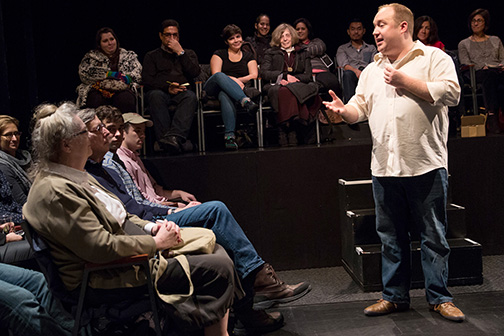
Jonny Donahoe walks around the theater dropping notes on the audience members’ laps as you are seated for Every Brilliant Thing. “Oh, you are the star, right?” observed a man picking up his paper. “I am the play,” said Donahoe. Well, not quite. I hope it is not revealing too much to say that his supporting cast is you, if you are adventurous enough to attend this brisk hour of an uplifting, funny play on a potentially grim subject. Author of this engaging night of theater with Duncan Macmillan, Donahoe treats the delicate subject of a suicidal mother and a son’s attempts to cheer her into life by listing as many brilliant things as can be imagined. -
You may remember Garrett Hedlund as Dean Moriarty in Walter Salles’ On the Road. The Minnesota-born actor played the character inspired by the famed fast talking fast driving, Neal Cassady, son of a Denver wino in the movie based on Jack Kerouac’s iconic novel. During his time in New York doing publicity for Salles’ 2012 film, Hedlund said a dealer was trying to sell him Cassady’s bathroom door. Such is the beat industry! Didn’t Johnny Depp buy Kerouac’s raincoat? There’s the literature, and then there are the artifacts: which is more important, and to whom? -
That Side Show will close its run at the St. James Theater on Broadway is sad news. After an ebullient first preview in late October, the revival had a meet & greet at Sardi’s. Many of the show’s producers had not yet met the musical’s stars, Erin Davie and Emily Padgett as the Hilton sisters, conjoined twins, whose pioneering showbiz story is retold, Matthew Hydzik and Ryan Silverman as the men/promoters in their lives, and David St. Louis as their loving caretaker. They also had not yet met director Bill Condon, who took a controversial piece about unusual acts (eh, freaks) in the age of burlesque and vaudeville, revised it from Bill Russell’s original book, amplifying the twins’ backstory, and made it soar. Henry Krieger’s music, especially “I Will Never Leave You” was always great. Rising to its Dreamgirls moment, this show was making the producers very happy. -
Remember in Pretty Woman when Richard Gere asks Julia Roberts what happens after the prince rescues Cinderella? Not missing a beat, she says, she rescues him right back. In Top Five, Rosario Dawson’s Chelsea Brown tells Chris Rock’s Andre Allen, Cinderella does what every woman who knows what she wants does: she leaves something behind. It’s all in the shoe. Keep your eye on the gold pump. -
Bewildered by many choices made in the new Mark Wahlberg film, The Gambler, a remake based on his quasi-autobiographical script with a nod to Dostoyevsky’s short story, James Toback was not quiet about his dismay that the new filmmakers, director Rupert Wyatt and screenwriter William Monahan, did not make a sequel to his movie, rather than try to redo the 1974 film starring James Caan. It would have been so easy, he said holding court at a banquette at Colicchio & Sons in the meatpacking. The filmmakers seem to know a lot about addiction, but not very much about gambling. -
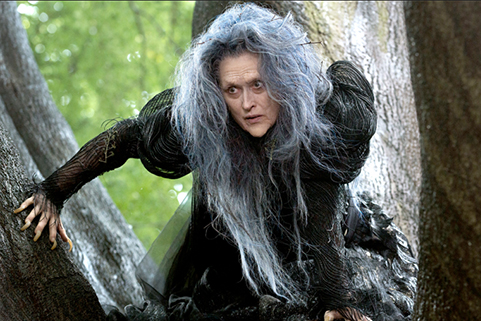
Missing from Monday’s lunch at The Leopard, Meryl Streep, wicked as an ugly witch in Rob Marshall’s movie adaptation of Stephen Sondheim’s musical Into the Woods, was on a train returning to the city from the Kennedy Center Honors. No matter. James Corden, who plays The Baker in the film’s intertwining fairy tales, spontaneously fielded questions in her behalf, reminding everyone of her witch preparation as Margaret Thatcher. This was a golden moment, proof in fact, that the British actor will be perfect as Late Late Show host on CBS, filling Craig Ferguson’s shoes when he retires. “They’ve made a big mistake,” Corden quipped, nailing British self-deprecation. “They’ve been trying for years to keep people like me off television.” -
Back in the day, Susan Sontag was the big anxiety of influence. Public intellectual, essayist, activist, provocateur, critic, and novelist, she was the giant thinker to topple for any woman. Few could claim her intellectual maternity. “I feel sorry for you,” said one male professor to the women in his class, as if we were competing with her. One of a kind, she was revered; even the most arrogant of men took notice of a woman who occupied so vital a cultural role, one to which men aspired. How odd it feels to write these words in a time when women can achieve anything, and yet I cannot think of anyone of either gender whose commitment to philosophy and politics could match hers. Now HBO will air a documentary about Susan Sontag directed by Nancy Kates, illuminating a moment in American letters when the quality of one’s mind was prized, admired and awarded. -
Okay. It was my fault. I was late for last night’s evening performance. Heavy rain. Snarled traffic on 8th Avenue. By 6 minutes for the 8 o’clock curtain. And was herded into the Golden Theater’s foyer to wait 45 minutes till the first intermission for Edward Albee’s A Delicate Balance. Twenty-five others waited too, with headsets, watching the play on an overhead monitor. Security gave us a pat down, searched our belongings. “Draconian,” exclaimed one woman at the theater’s latecomer policy, before she stormed off into the storm. “I’m outta here,” announced another prior to leaving too. The glass doors began to steam from the heat. The man next to me had rivulets running down his face. As to that monitor, you could not tell Glenn Close from Lindsay Duncan. It was a very expensive ticket.
-

The annual celebration of indie films kicking off the vibrant awards season every year gets more glamorous, honoring the outstanding and risk-taking films that are going to make it to Oscars—like Boyhood and Birdman, as well as those that are just great, likes’Laura Poitra documentary Citizenfour, Ira Sachs’ Love is Strange, Jonathan Glazer’s Under the Skin, and other exceptional films that do not fit any Hollywood formula. This week at Cipriani Wall Street, the sponsor Calvin Klein’s Euphoria embellished the stage, the fragrance’s name perhaps a metaphor for the high spirits: Bennett Miller was feted alongside Ted Sarandos and Tilda Swinton, the crowd of film insiders included Rene Russo in a French twist, and Scarlett Johansen in a short, smart do—it was decidedly downtown and chic. -
The story of a brilliant man, Alan Turing, brought to suicide after being disgraced for being gay, the movie The Imitation Game reflects the sexual politics of a bygone era. In the midcentury, homosexuality was a disease that could be cured, and surprisingly in the US Bible belt, some believe that canard today. In this riveting if conventional movie, directed by Morten Tyldum from Graham Moore’s screenplay, Benedict Cumberbatch plays Turing’s stunning mental power, bungling social grace, and naievete so compellingly, his demise at age 41 supplies an added irony to the history of his work in cracking the Nazi enigma code, using a machine that would be a forebear to the modern computer. But with all of his mind-bending intelligence, he lacked the resources to survive society’s ignorance. -
Last year we had Gravity, a chamber music concert compared to this year’s grand oratorio, Interstellar. As we all know, our planet is going to seed, or in this case, dust, and something must be done to save mankind, worthy or not. Epic, each in its way, Gravity’s outer space was intimate, a place for Sandra Bullock to heal with the help of George Clooney, while Interstellar’s is vast and unmanageable: Matthew McConaughey’s Coop is sent out there to fix that, to find a place for human migration. He leaves behind a family, most notably his devoted daughter Murph. Needless to say Interstellar is most successful as a movie when it is grounded in family, maybe because the acting is so good, Murph, young, older and old (Mackenzie Foy, Jessica Chastain, Ellen Burstyn) and the fathers (McConaughey, and Michael Caine to Anne Hathaway’s Amelia Brand). Interstellar is messier in space, maybe because the science is so garbled. Regardless, this movie must be seen as an essential part of this season’s conversation about the trendy subject of our planet’s demise, as well as its layered filmmaking. -
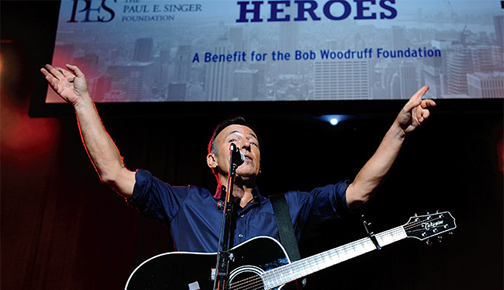
You have to love this night for both maximum heart and entertainment: Stand Up for Heroes, Wednesday night. Sponsored by The Bob Woodruff Foundation and Caroline’s Comedy Club, and kicking off the Comedy Festival, Jon Stewart, Jim Gaffigan, Louis C. K., John Oliver, headlined, and Brian Williams introduced the Chairman of the Joint Chiefs of Staff, General Martin E. Dempsey, who channeled Frank Sinatra on a rousing “New York New York.” After Bruce Springsteen sang (“Dancin’ in the Dark,” and more), and told some groan-worthy jokes, he did his thing, auctioning off his guitar. To sweeten the pot, he threw in a spin around the block in his motorcycle sidecar, guitar lesson, a lasagna dinner at his place, and the blue shirt off his back, his contribution raising $600,000. Fashion may soon help raise money too: -
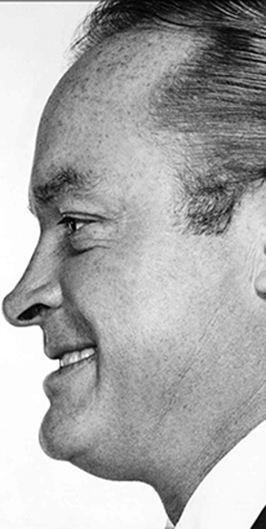 In his long dynamic career, Bob Hope’s story resonates as a cultural history of the last decade: a rags-to-riches immigrant, he was a pioneer in vaudeville, inventing stand up as we know it: he worked in movies and on television, and entertained the troops abroad. Not only was his profile, a ski slope nose, a world famous trademark, but so too were his walk and turns of phrase: “I wanna tell ya,” he would say. In a new biography, Hope, Time Magazine’s theater critic Richard Zoglin provides an engrossing read on Bob Hope’s life and times. I caught up with Richard Zoglin recently to find out why Hope mattered so much, the artist Jeff Koons would sculpt him in silver, and why Dick Cavett would walk his walk.
 -

Sarah Ruhl’s beautiful new play The Oldest Boy at Lincoln Center is informed by a quiet release into Destiny. A mother faces an unthinkable choice: a Midwesterner, she is married to a Tibetan restaurateur. Now when a lama and monk (James Saito and Jon Norman Schneider) come to her apartment to claim her son is a reincarnated beloved teacher, she is asked to give him up for the higher purpose, to be enthroned and educated at a monastery, far away from parental care. If Ruhl were working on a larger canvas, she might be making the kinds of spectacles for which Julie Taymor is best known. -
Jake Gyllenhaal’s Leo Bloom in Nightcrawler is as creepy as the movie’s title suggests. A bug-eyed loner who preys on the misfortunes of others, Bloom’s very language appropriates television-speak with information garnered on the Internet to make him reptilian. Negotiating his way through interactions, he acquires a camera and means to follow disasters, and finds a career as a videographer filming beyond the scope of decency: a man with gaping wounds after a car crash, a family shot in their mansion, their plush white carpets soaked in blood. Racing around in a beautifully shot L.A. in a red car, he doesn’t just follow crime scenes, he creates them. -

In a week when talk focused on the revamping of Renee Zellweger’s face, whether or not the Oscar winning actress went generic with plastic surgery, a voice from history affirmed choice for women of all ages and economics when it comes to feminine enhancement: “Beauty is power,” said Helena Rubinstein at a time when makeup was only associated with showgirls and prostitutes. A canny businesswoman, as a splendid new exhibition at the Jewish Museum establishes, the four foot ten inch Polish-born Rubinstein led the cosmetics field in face creams, and reinvented mascara wands; a rival to Elizabeth Arden, Helena Rubinstein surprisingly kept her Jewish name.
 gossipcentral.com