The first rate revival of Arthur Miller’s tragedy, All My Sons, at Guild Hall’s John Drew Theater is a reason to celebrate theater out east. With a cast led by Alec Baldwin and Laurie Metcalf, under Stephen Hamilton’s direction, the drama moves quickly through the moral dilemma of an American family, post World War II. The sons, one presumed dead, one alive, ask for accountability, a heavy load for Joe Keller—that’s Alec Baldwin, his baggy trousers skimming an ample belly held up by suspenders—who is boss, businessman, and bully. When son Chris (Ryan Eggold) asks the big questions about his possible role in the deaths of 21 fighter pilots, and the ruin of his partner’s family, Joe defends himself. He’s got a wife Kate, submissive, damaged, but spiritual, performed by the formidable Metcalf, and family to support, a good enough reason to risk sending out faulty airplane parts from his factory—and, in fact, to lie. To his sons, Chris and Larry, his ordinariness is crushing, tragic—he was Father, better than this moral slide. They could accept no less in Miller’s classic drama.

recent posts
- Marisa Tomei and Matthew Broderick at Guild Hall: The Plight of an Upper West Side Arts Space Gives A-List Actors The Big Chill
- Raul Esparza and Lily Rabe in The Winter’s Tale: Wet in Central Park
- Authors Night in East Hampton: If it’s Not One Thing It’s Your Mother
- Documentaries: Jocelyn Wildenstein The Lion Queen/ Tovah: How Jewish is It?
- Hamptons Journal: John Waters at Guild Hall: “Gay is not Enough” / “Cagney” at Bay Street/ “Signs” at the Bridgehampton Museum Tractor Barn
-
-
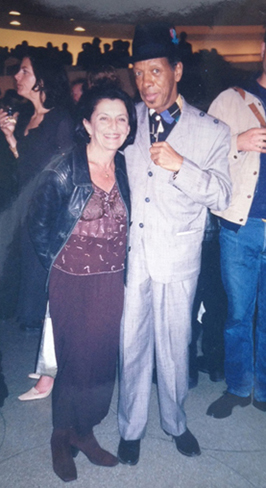 A Pulitzer Prize winner and MacArthur Fellow, jazzman Ornette Coleman died this week at age 85. Ornette Coleman’s extraordinary career as an alto saxophone performer dovetailed with several poetry movements in America including his friendship and collaborations with the Beat Generation writers. He made the soundtracks on David Cronenberg’s Naked Lunch (1991), based on William Burroughs’ classic novel, featuring a sequence in the “Interzone” marketplace, a stand in for Tangier, and Bernardo Bertolucci’s The Sheltering Sky (1990), based on Paul Bowles’ book about a Western couple travelling in Morocco.
 -
Maya Forbes’ autobiographical film, Infinitely Polar Bear, about her family coping with her father’s bipolar disorder, is set in the late ‘70’s, a time when few understood the impact of this mental malfunction. This smart feature may coincide with a hot topic in the Zeitgeist. Particularly as portrayed by Mark Ruffalo, there’s no question that Cam Stuart was infinitely charismatic and fun to be with, at the same time, questionable as a stay-at-home parent. Maya Forbes’ daughter Imogene Wolodarsky plays Amelia, the daughter most like her mother. When their mother Maggie (Zoe Saldana) goes to business school in New York, she leaves Amelia and little sister Faith (Ashley Aufderheide) with dad in charge in Boston, and all hell breaks loose in this very winning comedy. -
Alena Smith’s smart play, The New Sincerity, in its world premiere at Bay Street Theater in Sag Harbor, is perhaps the first drama to deal with the idealism of the Occupy Movement. Championed for its revolutionary goals, Occupy opened a dialogue about the ills of capitalism and social injustice. Many came to Zuccotti Park to camp out in support, like Django, one of four characters in The New Sincerity, expertly directed by Bob Balaban, who keeps the flow of characters in and out of the offices of a literary journal brisk for its 85-minute duration. Keep your eye on the word “sincerity” of the title, a playful take on the currency of authenticity.
-
I
n 1997, the last year of his life, poet Allen Ginsberg fretted that the first amendment battles won over his iconic epic Howl, would now face a reversal. Howl had been read on Pacifica radio, and censors now wanted to confine those readings till late night, lest innocent ears be compromised. Backtrack to 1955, the year of the poem’s composition: Howl had been the subject of a censorship trial, its language deemed obscene. The midcentury court ruled in Howl’s favor, finding the poem’s language reflective of redeeming human values, to frame the decision in some legal context. To all who understood the poem’s meaning, the court declared a victory for tenderness, and the right to express horror at society’s attempts to dehumanize and restrict individual freedom. Now, fast forward to 2015. Ginsberg’s fears are coming true in the nightmare news that David Olio, a beloved and much awarded Connecticut teacher, has been fired for reading aloud in an AP English classroom from Ginsberg’s poem, “Please Master.”
-

Among the many reasons to see Neil LaBute’s latest exploration of sexual relations, The Way We Get By, in its Second Stage Theatre production, is to see the actor Thomas Sadoski fussing, and to glimpse Amanda Seyfried’s bare breast as she changes her tee-shirt. The two-hander involves a couple after a night in bed. Is it a one-night stand? Or will they fall back into one another’s arms? -
Facing a crowd that included his mother and brother as well as Tony Danza, next up for a run at the Café Carlyle, Alan Cumming reminded everyone that he would be hosting the Tony Awards with Kristen Chenoweth on Sunday night, admitting that he was “freaking out.” That was hard to believe from the poised actor, prepared by years of M.C. workout in Cabaret. But as he deftly sang his “sloppy” mash-ups including one channeling Adele, Lady Gaga, and Katy Perry, he paused to sing from the Kander & Ebb musical, The Visit, a contender for Best Musical: “You, You, You,” a number sung memorably by Chita Rivera, herself nominated for Best Actress in a Musical.
-

Michele Lee, of ‘80’s era soap opera Knots Landing fame, will perform Cy Coleman tunes in a tribute celebrating the composer’s birthday at 54 Below for three nights, June 11-13. A great and giving storyteller, Lee’s engagement should be a music fest, yes, but also anecdote-laden treat, with some tasty Broadway legend tidbits. The multi-talented star, first came on my radar on television, in “The Many Loves of Dobie Gillis” and in my very first Broadway show, How to Succeed in Business Without Really Trying, with Rudy Vallee and a young Robert Morse, now known as Mad Men’s Bert Cooper. More recently off Broadway Lee was part of the rotating cast of Love, Loss, and What I Wore, written by Delia and Nora Ephron. I had a chance to talk to Michele Lee about her next great moment– on the intimate cabaret stage. -
Vera Brittain’s Testament of Youth, the famed memoir of the author’s time as a nurse during World War I, is now a major motion picture perfectly poised for summer. Leave it to David Heyman, the producer of the Harry Potter films, to put this book on screen. Heyman seems to specialize in coming of age stories, and this one, about a writer, is stunning. A love story set against the epic sweep of war, covering the terrain made famous in the literature of Ernest Hemingway and T. S. Eliot, this film, sad in its revelations about the emptiness of war, takes a grand anti-war stand when Brittain, played exquisitely by the lithe Alicia Vikander speaks to revenge-minded Brits about losses endured by everyone on every side, including Germans. Having lost her dear brother Edward (Taron Egerton), her friend Victor (Colin Morgan), and her poet fiancé Roland (the dreamy Kit Harington), Brittain knows of what she speaks. In our time of drone warfare, WWI appears quaint and bloody with its hand-to-hand combat. If any film is to capture the attention of vacationing crowds, it’s this gorgeous movie.
-
 You know the old joke: how do you get to Carnegie Hall? For jazz giant Nina Simone, it took more than practice. A classical piano prodigy, Simone, nee Eunice Waymon, was denied entrance to the Curtis Institute of Music, and could not be booked in clubs even after she showed she had the chops: she was black. For one gig, she was told she had to sing; it is for her unusual gift as a vocalist that she is best known. Liz Garbus’ documentary about Nina Simone: What Happened, Miss Simone? Had its New York premiere at the Apollo Theater Monday night, co-hosted by The Film Society of Lincoln Center. The Netflix movie limns this genius’ difficult life: married to a man who controlled and beat her, through her political activism, her mental decline, and her final years battling bipolar disorder and breast cancer. Her performances of “I Loves You, Porgy,” “I Put a Spell on You,” “My Baby Just Cares for Me,” and many other songs lift this film out of the usual biopic genre. Evocative archival footage, and interviews with family, friends and band mates, round out the lively portrait: you feel her vital, troubled, and singularly talented presence the whole time.
 -
Even though she loves awards, Meryl Streep did not show up to introduce Ann Roth at last night’s New York Women in Film & Television’s Designing Women evening, where the legendary costume designer was being honored for lifetime achievement. At a Roth tribute at the Hamptons Film Festival in 2013, the actress who had been dressed as Julia Child by Roth, as well as Donna in Mamma Mia!, not to mention many other characters, flew in from the Midwest set of August: Osage County for the occasion. Not this time. The multi-Academy Award winning actress sent a message to the presenter, Roth’s daughter, Hannah Sorkin, noting “I love her unequivocally” and “I cannot imagine what it would be like to have Ann Roth as a mother.”
-
You can tell the play Nice Girl at the Labyrinth Theater is set in the ‘80’s because when a woman in a housedress enters the living room and flicks on the set, the television has Jane Pauley on the Today Show. Her daughter, Jo, follows, to make breakfast for her mother before going off to work. Jo (Diane Davis) is a nice girl, a term that could translate to good girl: she’s quit her scholarship to Radcliffe after her father’s death to take care of this mother (Kathryn Kates), and she’s a bit of a frump with no social aspirations. At her humdrum secretarial job she takes a lunch break with Sherry (Liv Rooth), the kind of girl you knew in high school, who always pushed you beyond your comfort zone. Big haired, made up, and loud, Sherry is devastated by a recent breakup. The guy she hoped to make a life with just told her he was married. Not as trampy as she looks, like Jo, she wants a better life than she thinks she deserves. “Everyone should fall in love,” she says, “It’s like voting. A right.” You can see Jo’s reluctance, but she and Sherry resolve to go out to some bars. -
Whatever special kinks spice up your sex life, the particular coupling of spanking and faith in Robert Askins’ play, Permission, will having you laughing, and googling Christian Domestic Discipline (CDD) at intermission. Who knew this was a real life church sanctioned practice? In its world premiere at the Lucille Lortel Theater, under the direction of Alex Timbers, the MCC production of Permission, penned by the Hand to God playwright, relies on the conceit that marital bliss can be found if the husband assumes authority in marriage by acting like a man, that is, disciplining his wife with a firm hand (or belt) on the butt. -
This week’s opening of the American Ballet Theater’s Othello at the Metropolitan Opera House, a spectacular version of Shakespeare’s tragedy about the warrior king who succumbs to the manipulations of an ensign, and murders the love of his life, marks ABT’s commitment to newer works. As part of its 75th anniversary ABT had been showing the early works of George Balanchine, Agnes DeMille, Jerome Robbins, among others, but with this Othello, first produced in 1997, with Lar Lubovitch’s choreography and Elliot Goldenthal’s music, the ballet in 3 acts verges more toward opera than to traditional ballet. And with Julie Kent, Marcelo Gomes, and Misty Copeland, ballet superstars, the work was thrilling. For the Academy Award winning composer, this is a highpoint in a stellar career scoring movies, and other works in many genres. Most recently, he created sound for Grounded, a one-woman show starring Anne Hathaway, and directed by Julie Taymor at the Public Theater. I had the opportunity to talk to Elliot Goldenthal prior to this opening, about his work on Othello and Grounded, his Symphony in G Minor, the upcoming film release of A Midsummer Night’s Dream, and the career honors he is about to be awarded in Poland.
-
 On night two of her two-week not to be missed run, the Café Carlyle was packed with fans for Megan Hilty. Surveying the scene, Hilty spotted a girl front and center, and asked her what her favorite Broadway show was, hoping she would say Wicked. A debut for Hilty back in the day when she was an understudy, after the incomparable Kristin Chenowith left, Wicked launched Hilty, as it did Idina Menzel with whom she performed. Hilty went into her rendition of “Popular,” a hit from the show. Then again, all sentimental about little girls –Hilty and her guitarist husband Brian Gallagher just had one, naming her Viola Philomena-– the chance to sing a song for a little girl was clearly irresistible.
 -
Now that Mad Men has reached its endpoint, with critics dissecting its meaning and import, not to mention its influence and destiny during awards season, it is time to further point out its antecedents in literature. In a penultimate episode, the viewer could contemplate Don Draper’s demise by dropping from the windows of McCann-Erickson, as he took a look out and measured the window’s width, eying the vista sadly. The viewer could only conclude he would make this fatal jump. But in the finale, he’s seated in lotus position on a cliff at Esalin, chanting. The end of all his bad boy behavior, identity crises, marital troubles, ambivalence about the world, he’s on the West Coast far away from the business of advertising and family. Learning from Sally that Betty is soon to die of lung cancer, he is asked to stay away, finding out You Can’t Go Home Again, in the words of Thomas Wolfe, an American author of the early 20th century who died at age 33 after completing only four novels. Of course that’s a lesson he’s learned again and again through seven seasons. -
 Melissa Rivers was a perfect fit as honored guest at the annual Mamarazzi luncheon, hosted by The MOMS, Denise Albert and Melissa Musen Gerstein’s mother advocacy lifestyle brand. Not only one of the most famous of daughters, a mom herself, Melissa Rivers has a book out, The Book of Joan: Tales of Mirth, Mischief, and Manipulation. While Joan Rivers died unexpectedly, as we all know, a consequence of botched throat surgery, she still left her daughter clear instructions on what should happen should she die, and the reassurance that Melissa would get everything. That seems to include her mother’s hairdresser for the last ten years, Raymond Rosario, who deftly patted down Melissa’s sleek do, curling a stray strand, as she arrived at Juniper Bar, a chic Garment Center bistro.
 -
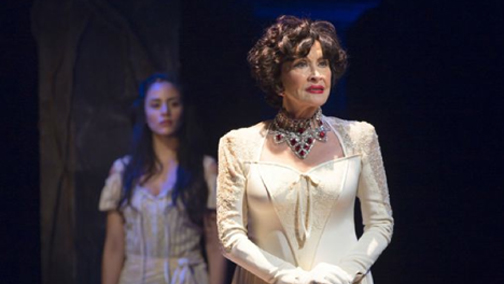
As Claire Zachanassian, the richest woman in the world Chita Rivera makes an outrageous demand in Friedrich Durrenmatt’s 1956 “The Visit.” Now a show at the Lyceum Theater, with Terrence McNally’s book, John Kander and Fred Ebb’s music, and choreography by Graciela Daniele, whether or not The Visit wins its Best Musical Tony, the show is one of best on Broadway, a deeply satisfying 90 minute parable with historic dimension. -
Blythe Danner is a sublime and funny actress, as we’ve seen in the Meet the Focker comedies, and decades of movies and stage plays. In I’ll See You in my Dreams, she’s the femme fatale of the geriatric set, sure to make you rethink 70. Vibrant, with it, her character Carol sings karaoke, plays golf, and is appropriately terrified of rats. She’s lonely, but not desperate, and perfect for a smooth guy named Bill who she begins to date. The actor Sam Elliott, with a miraculous shock of white hair, gives this mysterious stranger his joie de vivre. He’s attentive to Carol and knows what he wants. Not only that, he takes her into the water in his cabin cruiser for moonlight dinner. When he near proposes, to get his feet wet, he says, she says, get out of that water, stunned but not disinterested. He’s a good catch and they have chemistry. -
Playwright Mike Poulton spoke to a British contingent at the Morgan Library last week about adapting Hilary Mantel’s Man Booker prize-winning novel, Wolf Hall, for the stage. Tony-nominated Wolf Hall, parts I and II, about Thomas Cromwell and Henry VIII, his wives and politics, is now wowing audiences at the Winter Garden Theater. Poulton said he usually works on material when the author is dead. This time, he made an exception when he met Mantel, and they collaborated well together. Ah, a harmonious moment for writers!
-
 MoMA’s Titus I theater looked like a gathering for New York filmmakers and artists on Monday night: Wes Anderson, Noah Baumbach, Greta Gerwig, Jim Jarmusch, Laurie Anderson, Hal Willner, Gay Talese, and others, many of whom had already seen the Apu Trilogy as Satyajit Ray’s masterwork is called. They were there to see part 1, PATHER PANCHALI (Song of the Little Road), in a new 4K restoration. Based on books by Bibhutibhusan Banerjee, the films have their own dramatic story, involving a fire that destroyed the negative, and a painstaking restoration by hand of charred film, sprocket by sprocket. The result is now released by Janus Films in its rich black and white, and one of the great epics about a boy and his family in rural Bengal.
 -
Film festivals flourish in beautiful places. The Montclair Film Festival in Montclair, New Jersey, now at its midpoint, adds to that rule, expanding to ten days, and inaugurating awards for filmmaking in memory of two Montclair residents who died this year: New York Times media writer David Carr, and documentary filmmaker Bruce Sinofsky. -
Beginning with her first song, “Open the Door,” Judy Collins had her audience at the Café Carlyle on the opening night of her 2-week run in thrall. A performer for 56 years, her crystalline sound, whether she’s accompanying herself on acoustic guitar or at piano, rang clear. Not a glass clanked, nor dish rattled. And that’s for the intimate supper club the Café Carlyle epitomizes. The last time I heard her sing “Amazing Grace,” she commanded the stage at a ballroom in the Hilton with 2200 guests to the same effect of rapt euphoria. There’s nowhere else you’d wish to be than with her singing for you. -
 In Something Rotten!, as in the famed line from Hamlet, “there’s something rotten in the state of Denmark,” two Bottom brothers, one a talented poet named Nigel (John Cariani) and the other Nick (Brian d’Arcy James), compete with Shakespeare (Christian Borle), the rock star of the Renaissance. You can tell by his codpiece, he’s got something sizable going on.
 -
 Orange would not be the new black for Iris Apfel, who wore that color in fur for the movie premiere of Iris last week at the Paris Theater: the brighter the better, it was practically neon, and contrasted with saucer-sized turquoise beads. The outfit would be unusual for anyone, let alone the 93 year old “geriatric starlet” Iris Apfel whose resume includes textile designer, model, and now professor of fashion for students from The University of Texas, Austin. The students come to New York to learn “real” lessons about the glamorous world of fashion from this style icon: what’s trending, licensing, history; Iris complains that designers today do not know how to sew, a craft like beading near lost. Iris teaches the business side often omitted in the traditional curriculum. She knows from what she speaks, having had a giant successful show at the Metropolitan Museum, an honor normally accorded to high profile designers with world careers like Alexander McQueen or Jean-Paul Gaultier. She can put together ensembles most could never concoct, matching fantastic fabrics with highend designer dresses with street fare, but her specialty is layered bangles and neckpieces.
 gossipcentral.com