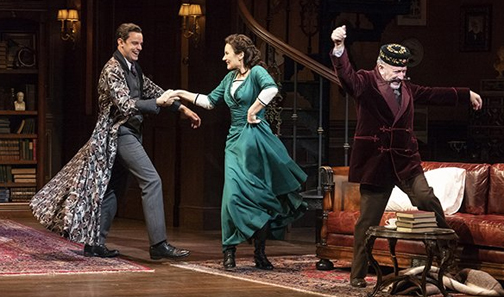
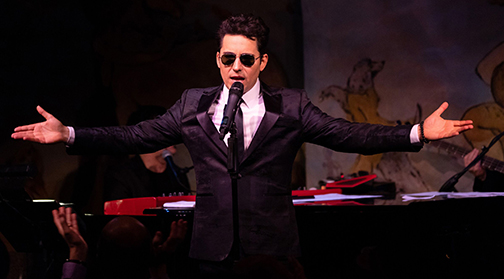
Celebrating a retrospective at MoMA, cult filmmaker Abel Ferrara showed his music chops. The museum lobby, its platform facing the garden became a stage for Ferrara’s long time friends and collaborators Paul Hipp and Joe Delia, and some surprise vocalists Willem Dafoe, Gretchen Mol among them. Mol’s duet with Ferrara on guitar for “Bebopalula” and “Walk on the Wild Side,” homage to the late great Lou Reed, sent chills through the downtown art crowd including Debbie Harry, Julian Schnabel and Louise Kugelberg, Marla Hanson; many have worked with Ferrara. This wild party, hosted by producers Annie and Ed Pressman, was most certainly a throwback to headier times.
recent posts
- Alden Ehrenreich and Patrick Ball: The Men in Becky Shaw on Broadway
- Audra McDonald and “Original Nepo Baby” Gwyneth Paltrow: Honorees at the NYWFT Muse Awards 23 March 2026
- Zach Bryan Buys the On the Road Scroll/ Happy Birthday, Jack Kerouac!
- William S. Burroughs/ Nova ’78 at MoMA/ Remembering James Grauerholz
- Jacob Elordi in Wuthering Heights: Monster Mash
-

Purple over orange is always a good color choice, regal and elegant. The Film Society of Lincoln Center has had a makeover; Film at Lincoln Center reflects a shift in name and logo hue. Celebrating its 50th birthday this week, the yearly gala honored, not one career as in its traditional Chaplin Awards, but rather its decades long life; the former “society’ screened clips of its five decades as a premiere film venue. Feting the art of filmmaking, they introduced the work of such mega talents as Bunuel, Bertolucci, Truffaut, Varda, Denis, Kurasawa, among many other directors. Personal tributes from a film world elite including Tilda Swinton, Pedro Almodovar, Martin Scorsese, Paul Dano and Zoe Kazan, and many others who had shown work there, illustrated how Lincoln Center broke boundaries, crossing geography, gender, and generations. In a backhanded compliment, contrarian John Waters said, at Lincoln Center, if you don’t see the films they anoint into their canon, the films they want you to see, you will go to film Hell. With his signature smirk, he walked off the stage. Funny how breaking barriers can go mainstream. -

Wow! No Glenda Jackson for being Lear, nor Mockingbird for Best Play! What are they thinking? Frankly, the list is good and thoughtful, and pleasing for a critic who studies the scene, and wonders from some reviews, did they see the same play as I did?First, Annette Bening in All My Sons, brilliant! And the play, nominated for Best Revival, is explosive. What makes it so great is her characterization as a woman who willfully pretends a truth about the death of her son in war. Arthur Miller’s play questions the high-minded motives for putting young men and women in harm’s way when governments wage war. The truth: industrialists win. For her to acknowledge this reality splits her in two. And it takes an actress at the level of Bening to get both sides of that personality. As director Jack O’Brien said, “There was no word for bipolar in the 1950’s.” That said, Janet McTeer deserves her Tony nod too, Sarah Bernhardt playing Hamlet.
-

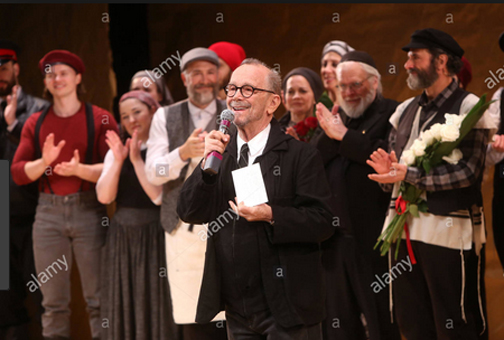
Oy! The Cossacks are coming! In the essential viewing Fiddler on the Roof in Yiddish at Stage 42, as we know, the Jews in the fictional town of Anatekva are threatened by pogroms. Eventually the lives of Tevye and Golde, their five daughters, and all town-folk are disrupted; they are forced to take refuge elsewhere. Could the creators of this marvelous 1964 play, Joseph Stein’s book, Jerry Bock’s music, Sheldon Harnick’s lyrics, have realized the extraordinary resonance of this story? Director Joel Grey’s genius, rendering it in the dying language of Yiddish, — (even the actors don’t know it)– is to make audiences consider this a blueprint of exile: perhaps, a “heimish” combination of old world sound in sepia tones against a threatening, violent outside world, one’s own family history. And no matter where you were born, it is. -

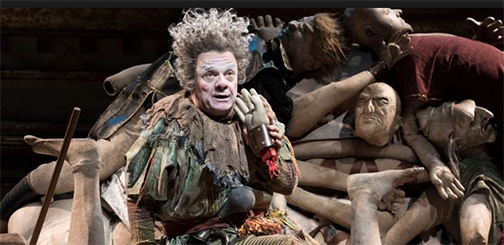
Can you imagine a premise more ridiculous than a play featuring maids tidying up at a dump? Nathan Lane and Kristine Nielsen perform a comedic pas de deux, squeezing the gas out of dead Roman corpses in a giant heap in Gary: A Sequel to Titus Andronicus at the Booth Theater. Cadavers require care: servicing them, Gary and Janice, (Lane and Nielsen) suck body fluid, and tend to erect penises, lucky to have jobs. What a dump!Echoing ancient politics: Gary proclaims, the mind has a lot to clean and organizes a coup, plotting to save the entire world and put an end to tragedy. Nielsen as Janice provides the appropriate skepticism, doing her signature grimaces and ambling among the bodies as choreographed by Bill Irwin and directed by George C. Wolfe. An optimist joins the couple: Carol (the adorable Julie White) in a lovely pink dress (Ann Roth’s costumes are superb), surely the color of high hopes as opposed to Gary and Janice’s hobo wear.
-

At Playwright’s Horizons, Halley Feiffer, author and actor is making it with a serial adulterer, with Hamish Linklater in the role, in her comedy “The Pain of My Belligerence.” A master at creating young women who laugh at themselves, Feiffer explains in her program note, her plays skim the neurons of her life, and they are funny until they speak sad truths. In this case her character Cat falls for Guy, who seduces by taking nips at her exposed shoulder on their first date, and in classic wrong guy mode, makes promises that he will not keep. The narcissistic fatuous Guy is especially good at being this “monster” man. Director Trip Cullman keeps their love story zipping along. We, her audience, are privy to Guy’s double talk, of course; he’s seducing us too. (Caution: there’s partial nudity too, and the players are very attractive.) But Cat suffering undiagnosed Lyme’s Disease, reflects Feiffer’s obsession with illness as metaphor, to borrow from Susan Sontag. What can be more physical than the deterioration of one’s body? -

The carpet was orange at Cipriani Wall Street, for the annual Food Bank of New York’s Can Do Dinner this week. The Four Tops in white sequined jackets as well as Neil Patrick Harris and his partner David Burtka basked in its glow. One prize auctioned at the gala was a meal cooked by Cordon-Bleu trained chef, Burtka for your guests at your home. The couple would take over your kitchen, Harris acting as mixologist. With Christie’s Lydia Fenet keeping it fast and funny, that item went for a tidy $30,000 with the money going to help the hungry. Among the honorees, Jose Andres was feted for the great work he’s done this year, particularly in bringing food to Puerto Rico still recovering from two hurricanes two years ago, when the island suffered food and electricity shortages. You do remember a certain orange person tossing some Bounty to the hungry populace. -

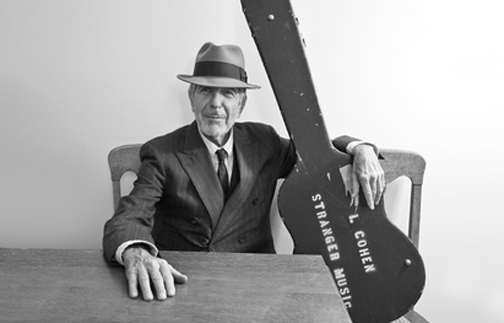
The Jewish Museum opens a dynamic homage to Canadian poet/ songman/ novelist/ cultural icon Leonard Cohen this week, focused on his art, and work from others inspired by his life and oeuvre. Staring up at an image of myself reclined comfortably, I experienced his “Famous Blue Raincoat” with words projected on the walls as well as images inspired by the song. This was Ari Folman’s contribution, “Depression Chamber,” an installation, like a therapy session, that must be experienced one person at a time. I anticipate lines, even with a timed reservation. It is just one piece from artists such as Christophe Chassol and Tacita Dean occupying three floors of the museum. Taryn Simon’s “New York Times, Friday, November 11, 2016,” the newspaper displayed in plexiglass illustrates the timing of Cohen’s death just a few days before our current president’s election to office. There is some symbolism there, especially in the juxtaposition of Obama and Trump’s first meeting, and an advertisement for Bernie Sanders’ book, Our Revolution. -

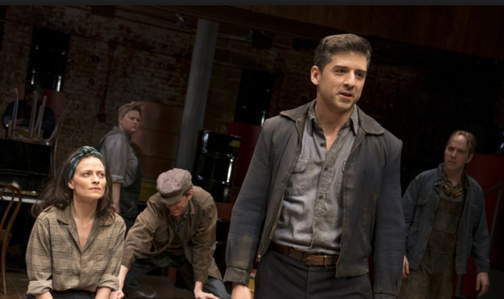
Nothing says worker like hair tied up in Rosie the Riveter do-rag. The Classic Stage Company’s revival of Marc Blitzstein’s 1937 song cycle, Cradle Will Rock, hits a proletarian note. The talented ensemble, led by Tony Yazbeck as Larry Foreman, made up of steel workers, cops, newsmen, church officials, or factory owners, attempt or resist unionizing. Not your typical subject for a musical, this leftist cry was very much reflective of between the wars issues.The genre of “art song,” with composers Ned Rorem, Paul Bowles, Blitzstein, and others using song whimsically or politically, was quintessentially American. At CSC, with only a piano (played by four actors) accompanying, characters emerge, all in service to Mr. Mister (David Garrison). This way, a lot gets rationalized, thrashed out, manipulated into “fake news” in song.
-

When filmmaker Ross Kauffman pitched the idea for Tigerland, his latest documentary film to air on the Discovery Channel, he proclaimed to producers, including Fisher Stevens, that he did not want to make another The Cove, fine as it was, another doc about the poaching of animals in the wild. Oops, Stevens had produced the Oscar-winning film about the endangered dolphins. Kauffman got the job anyway. Tigerland does address the diminution of the world’s tiger population, now only about 3400 in the wild, but as is this documentarian’s special skill, he gives the story a human face, focusing on the individuals, one in India, another in Russia, key figures who do the work of keeping the tiger species alive. -

If you tell Alex Brightman, the star of Beetlejuice on Broadway at the Winter Garden Theater that he was born to play this exuberant, over-the-top part, he says, Oh sure! I was born to play this dead, Jewish, crazed, demon from the Netherworld! As if to say mockingly, that’s no compliment! When, in fact, it is! Brightman brings the fast-talking giddy mania that he played so well in School of Rock, as if it had been a dress rehearsal for Beetlejuice, adding of course the black & white Escher-like optics. For the opening preview this week, fans of all ages mobbed B-way and 50th street, dressing up for the occasion. The composer of the historic “Day-O,” Irving Burgie, wouldn’t miss it. At 94, he exuded, “The song always turns them out.” -
Director/ writer Laszlo Nemes won the Best Foreign Film Oscar for his 2015 debut, Son of Saul, a daring fiction feature set in Auschwitz. I met him as he was making the rounds during the award season. On one memorable night, he faced a most anxious moment, meeting Elie Wiesel, the novelist who wrote about his experience in Auschwitz, including watching his father die. Of the dwindling generation of survivors, Wiesel (87 at the time) was a Holocaust elder statesman, an eloquent witness and not one to suffer fools gladly. He found the film a powerful representation of his experience of the place, a murder factory, and important. Before his death in 2017, he was dedicated to keeping the memories of genocide alive as a deterrent to future atrocities. That night, I asked Nemes what he was planning next: a film set in Budapest at the dawn of World War I, from the point of view of a woman. In Sunset, Irisz Leiter, an orphaned woman, tries to get a job at a hat emporium that used to belong to her family. From there, Nemes sets her plight against the larger historic moment, again, as in Son of Saul, in allegory. I had a chance to speak to Laszlo Nemes about Sunset on the phone from his home in Budapest. -
Of course the story of the Temptations, the R&B group topping the charts with hits like “My Girl,” and yes, “Ain’t Too Proud,” would have to acknowledge the girl groups of the era. As the Temps rose to fame, so too did The Supremes, and in the glorious musical Ain’t Too Proud at Broadway's Imperial Theater, they do get their cameo singing a medley of their hits. Rivals and perhaps romantic interests, the Supremes had their own dramatic story, limned by the hit musical Dreamgirls, but here they round out the men’s tale of collaboration, friendship, beautiful sound, and the business of making music for black men in America. As part of Dominique’s book, Mary Wilson gets a bit more than a shout out, and there she was in the audience on opening night, not minding a bit that the history is tweaked. On that, Mary Wilson “ain’t too proud.” -

This week Charles S. Cohen was presented with the insignia of Chevalier of the Legion of Honor at the Payne Whitney mansion, home of the Cultural Services of the French Embassy. Gerard Araud, Ambassador of France, conferred the honors, proclaiming, “I’m an ambassador so I’m not supposed to be funny.” Yet, he was. Following a speech by Mayor Bill De Blasio celebrating Cohen as a great New Yorker, Araud explained his levity, this was his last such ceremony as he was leaving office. Filmmaker Agnes Varda sent salutations via video, and Isabelle Huppert, currently in The Mother, an off-Broadway play, mingled with a delegation of French filmmakers and Unifrance, dedicated to promoting French culture on these shores. Unifrance partnered with the Film Society of Lincoln Center this week for the annual Rendez-Vous with French Cinema. The best thing about Charles S. Cohen vis a vis film: he has good taste. -

The annual fete de films, Rendez-Vous with French Cinema, a collaboration between Unifrance and the Film Society of Lincoln Center, opened this week with a comedy, The Trouble with You. Director Pierre Salvadori introduced the film noting that most filmmakers in France are French New Wave influenced, but he is more inspired by Hollywood. “It’s more about my love of stories, of fiction, of Ernst Lubitsch and Billy Wilder,” he explained. “My film is funny and sad. Feel free to laugh and cry.”And so when the Trouble with You opens with a violent police action, the movie seems a startling homage, until the realization hits: a police procedural is appropriated for farce as only the French can do. Salvadori brought with him his leading man, Pio Marmai, with whom he has worked in the past. In fact, the last time he came to New York to promote a Salvadori film, he—in a drunken state— got a tattoo, the word for fighter misspelled.
-

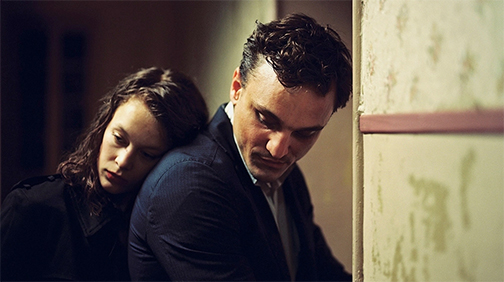
What does exile look like? What does geographic displacement do to identity, and to the psyche? These were dilemmas addressed in much midcentury fiction, found in the writings of William S. Burroughs, Paul Bowles, and others. Now Anna Seghers’ 1944 novel Transit is brought to the screen from the German filmmaker Christian Petzold. When we meet Georg (Franz Rogowski) he is on the move, a witness to war, blood, and death. Unwittingly taking on the identity of a dead writer, he lands in the port city of Marseille, an “Interzone” of sorts, as part of France’s “free zone,” Marseille interchangeable with Tangier, another evocative port city where people hung out waiting for papers, exit visas, boat tickets, “transit.” Cue Casablanca, the classic film an illustration of Tangier’s midcentury international zone. -

“I see a sea of red,” became the cliché of the night at Lincoln Center’s Appel Room for the Woman’s Day Red Dress Awards. Indeed, red was encouraged for stars on the red carpet, Angela Bassett, Susan Lucci, and everyone else, and it seemed a giant homage to Valentine’s Day and the Chinese Lunar New Year celebration all wrapped in one. But the unifying image was the heart, meaning heart health for women. Lucci, the queen of soap operas, told a story of being the picture of health and suddenly feeling pressure in her chest in October, averting a heart attack. Bassett, the queenly Ramonda in Black Panther, lost her mother in 2014 to heart disease. She wanted to create awareness for the link between Type 2 Diabetes and heart disease. Each speaker, and including doctors Dr. Sharon Hays and Mary N. Walsh, had a message: these episodes are preventable. -

When we ran into Melody Herzfeld at the Tony Awards, she seemed stunned at the place history had taken her. This week at a special screening of Song of Parkland, an HBO documentary directed by Amy Schatz, she had her Tony Award by her side, still stunned, and feeling guilty. She would have preferred a prize for merit, she said. Instead she was honored for her heroism in a tragedy, coolly ushering 65 students into a back storeroom closet for two hours as a gunman murdered 17 at the Marjory Stoneman Douglas High School in Parkland, Florida where she taught drama. At HBO, dozens of her former students attested to her epic qualities as a teacher. While she was not falsely modest, part of her charm is a self-effacing humor worthy of Joan Rivers. Then again, as she told us at the Tony’s, she was from these parts, from New Jersey. -
Among the many fascinations of Eco Village, a new play by a gifted young playwright, Phoebe Nir, in production at the Theater at St. Clement’s Church, is a revision of communal life from the ‘60’s, reimagined for this generation of millennials. For many of us who remember our youthful era of sharing resources, it was an edenic time for those who had little to share, welcoming the bounty of those more prosperous. In Eco Village, that ethos takes on current trends, toward ecology, conservation, and respect for the earth. Keeping a small footprint, so to speak, is a goal. But humans being, well, human, loyalties shift among the fictive characters in this alternate world, in ways that make Eco Village register more cynical than utopian. But then again, how do you change the world? -

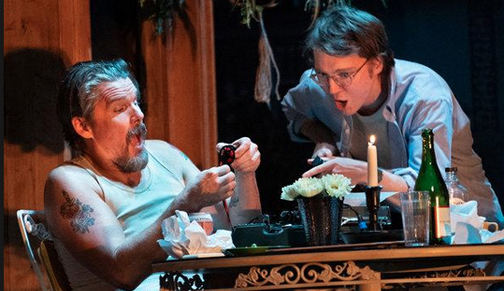
I have always thought of Sam Shepard’s True West as a two-hander. The brothers at the center of this heated drama, the screenwriter Austin and ne’re-do-well Lee, are entwined physically and spiritually; it’s their tension that enthralls. At the American Airlines Theater in a thrilling Roundabout production, they are Paul Dano and Ethan Hawke respectively. Of course there is a producer, Saul Kimmer (Gary Wilmes) ably aiding, abetting, and underscoring their sibling dis-function, and their dithering mother (Marylouise Burke), at least one half of the source. The other is the unseen father, allegedly a drunk who some time ago receded from society into the Southern California desert. Needless to say, the fruit does not fall far from that tree. -
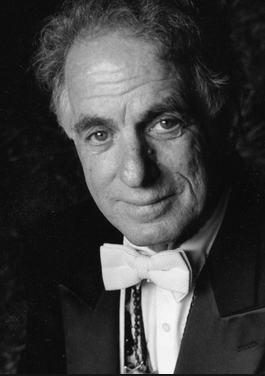
How do you get to Carnegie Hall? It’s an old, corny joke, and here’s an alternate answer. Get the incomparable composer and ethnomusicologist David Amram to conduct. And then a world unfolds: The Concert of Solidarity for the Rohingya Refugees at Carnegie Hall this week featured an orchestra comprised of musicians from 33 countries, stellar soloists, and a chorus from Montclair State University. The orchestra performed Amram’s “Elegy for Violin and Orchestra,” and he conducted, featuring soloist Elmira Darvarova on violin. This divine performance was followed by Beethoven, “Symphony No. 9 in D minor, Op. 125” culminating in “Ode to Joy,” with George Mathew conducting. The evening was to benefit the Rohingya refugees and the important work of Doctors Without Borders. Carnegie Hall was packed for this extraordinary night of music and moving accounts from Rohingya survivors.