
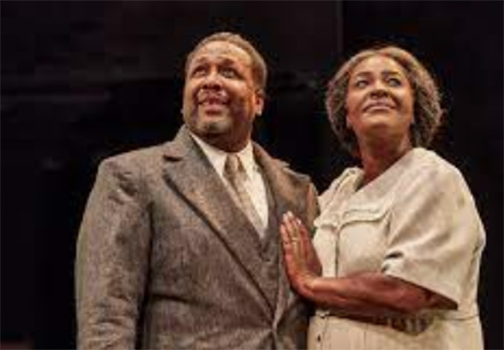
Willy Loman, Arthur Miller’s Everyman, is a plum role for any actor: the character speaks to everyone. Wendell Pierce’s portrayal of this “salesman,” puts this emblematic character, the center of Death of a Salesman, through the Hudson Theater roof in this latest superb revival, recently moved from London. Back in the day, Miller oversaw a production in Beijing. Even under Communism, men, fathers, heads of households, could relate to the dreams that propel Loman’s arc, even if they are more fantasy than real. The play’s toxic male energy, passed from Willy to his sons Biff and Happy, is grounded by his wife Linda with Sharon D. Clarke doing the heavy lifting, guarding Willy’s illusions of grandeur even from their boys, who inherit and suffer his pathological delusions. All this is the play’s familiar territory, but now the family is black in a white community, spinning the story in a fascinating way.
Catching up with Pierce post performance, we glimpsed his perspective on Miller’s genius, how it was crucial to Pierce to keep the character fighting till the end. He comes in buoyant even as he’s learned he’s lost his job. Belief in his exalted view of himself comes from a kernel of hard work, valiant ambition, even when it comes to naught. The critical scene when Biff barges in on his dad in a fling in Boston, with a white woman, takes on new meaning for a flashback set in midst of prohibition. Grabbing her things, the woman leaves the hotel room saying, “I hope no one sees me in the hall.” Yeah, you think she’s worried that she’s half naked. Then again, what did interracial impropriety mean in those years? Never mind the way witnessing this moment warps Biff’s future.
 gossipcentral.com
Leave a comment