
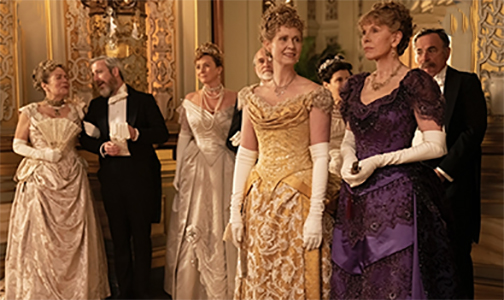
Mountains of gorgeous food: lobsters, roasted meats, salads, caviar. The eye filling opulence of Julian Fellowes’ Downton Abbey follow up series, The Gilded Age on HBO more than sates any desire for decadence. Forget Stanford White’s magnificent design for the newly completed Russell mansion on turn of the century Fifth Avenue; nothing says conspicuous consumption more than the spread Bertha Russell (Carrie Coon) hoped would lure the city’s elite to her home to solidify friendships in wealth. Not surprisingly, snobbery does not work that way. No one shows up. Any readers of the novels of Henry James and Edith Wharton would know how the hierarchies among the rich work, their laws finite. Christine Baranski as Agnes van Rhijn looks her chiseled nose down on her neighbors, nailing the divide between Old New York and New. And viewers are left to look on hungrily at the grandeur, and guffaw at the Russell’s servants’ dumping amply piled silver platters into garbage bins.
Fellowes was brilliant with the splendors and spectacle of Downton Abbey, both upstairs and down. And on these shores, and in this series, he explores these comings and goings as well as the plight of a heroine, Marion Brook (Louisa Jacobson, a daughter of Meryl Streep), a niece, an innocent, who comes from Pennsylvania to live with Agnes and her sister Ada Brook (Cynthia Nixon). As you know from episode one, she meets Peggy Scott (Denee Benton), an aspiring young black writer on her train journey to New York, and so a theme of Blacks in New York emerges. Satisfying a (guilty) itch for gossip, The Gilded Age has its own allure—featuring a cast that includes so many American stage actors we’ve missed in the Broadway lockdown, Audra McDonald and Kelli O’Hara head the long list that also includes Kristine Nielsen, Katie Finneran, Donna Murphy, a wildly over the top Nathan Lane, to name a few. Just seeing them brings a smile.
 gossipcentral.com
Leave a comment