
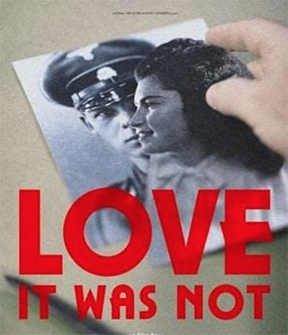
 Maya Sarfaty’s Love It Was Not, a most unusual documentary, tells the improbable story of the infatuation of a high-ranking SS officer with a Jewish inmate at Auschwitz. An Austrian-Israeli coproduction, the film was part of a program at New York’s Museum of Jewish Heritage, with a Q&A with the director and Austrian producer, Kurt Langbein, and is to date one of the most affecting films to reimagine Auschwitz in scope and day-to-day detail: the focus on the relationship between Franz Wunsch and Helena Citron allows for a glimpse into the death camp from the perspective of young love. Yes, this really happened amidst the gas chambers and crematoria, an open secret romance.
According to her girlfriends—interviewed post-war for this film, having survived and benefitted from the special attentions of Wunsch (20), Helena Citron (19) was a beauty. Family photos attest to her looks, and later, interviews with a much older woman show the angles of her cheekbones and fierce eyes, a cross between Kim Novak and Eva Gardner. She and her friends were assigned to the Kanada warehouses, where they sorted the belongings of inmates sent to be gassed. When she had typhus, Wunsch nursed her to health. One day, Helena’s sister arrived with her two children. Wunsch plucked her from their arms amidst a crowd ready to be murdered, allowing her to work alongside her sister. The plight of the children haunts the rescue; the ambivalence of survival at Auschwitz could not be better illustrated. Wunsch was known to be a beast, beating male inmates, and yet was capable of gentle emotions toward Helena.
Maya Sarfaty spoke about the challenges of making the film, an extended version of a short on the subject, The Most Beautiful Woman, that had won a gold medal at the 2016 student Academy Awards. There’s not much footage of Auschwitz, said Sarfaty, and what there is has been mined. The filmmakers developed a strategy using snippets of photos—creating a paper doll/ collage effect– to illustrate scenes when cutting away from talking heads. Beauty, it seems, like survival, is complex and double edged. And we learn in the war’s aftermath, what may have sheltered Helena from the ultimate solution, does not shield her from memory.
 Another true Holocaust era film, When Hitler Stole Pink Rabbit, is Academy Award winning Caroline Link’s adaptation of Judith Kerr’s memoir about living in exile during the war. She won Best Foreign Language Film in for Nowhere in Africa (2001). A German filmmaker clearly attracted to the fairy tale version of the Holocaust, Link makes beautiful, color saturated films, tracing encroaching anti-Semitism in Germany, the beginnings of aggression against Jews in schoolyards in “Rabbit,” and on ski vacations in Nowhere in Africa, through journeys of escape, harrowing for children who are often hungry, yet nurtured by intact families.
Especially remarkable is the fact that the father, here called Arthur Kemper, is based on a famous critic who manages to elude Hitler’s specific mandate for his arrest. A dream father to the brave and talented Anna (Riva Krymalowski), Arthur (Oliver Masucci) comforts the family even when he cannot feed them. The Kempers endure their exile, proud of being Jewish, albeit secular.
With the snow-capped Alps in the background, the film radiates a “Sound of Music” optimism even with menacing Nazis around. Just like the book on which it is based, this film is an ideal starter for introducing young people to a dark side of history.
 gossipcentral.com
Leave a comment