
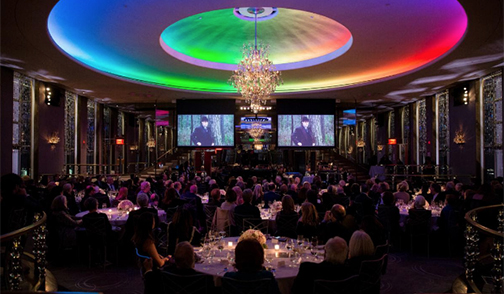
Even against a gloomy sky, The Rainbow Room with its magnificent city views defied yesterday’s weather, an impending pandemic, democrats duking it out. At Guild Hall’s most festive winter celebration, honoring achievement in the arts and philanthropy, serenity reigned, although most honorees greeted guests and neighbors with fist bumps and elbows over the usual bear hugs and double cheek air kisses. Among those cheering on Dorothea Rockburne in the Visual Arts, Barry Sonnenfeld for Performing Arts, Ted Hartley for Philanthropy and “a life well lived,” and Salman Rushdie for the Literary Arts, were Philippe Petit, Ralph Gibson and Mary Jane Marcasiano, Tovah Feldshuh, Blythe Danner, Jordan Roth, Toni Ross, Patti Kenner, and many more representing the vibrant community, many attendees former awardees. April Gornik promised that the long-awaited Sag Harbor Arts complex will open this spring. And Eric Fishl raised a glass to the memory of Michael Lynne.
Adam Green once again exercised his comic chops as M. C., as guests dined on a divine Skuna Bay Salmon Wellington with wilted spinach and caviar butter, a feast overseen by Florence Fabrikant. Alec Baldwin introduced Ted Hartley, but not without making a slightly risqué remark about passing his wife Hilaria a sexy note, seen by the wrong woman. Richard Armstrong introduced painter Dorothea Rockburne, who assisted Robert Rauschenberg back in the day. Kelly Ripa insisted that despite Barry Sonnenfeld’s fine career in film, few know that he makes a dry martini and a juicy brisket. The artist Taryn Simon delivered an esoteric appraisal of what novelist Salman Rushdie might have going on in his brain as he writes. A frequent visitor to the East End, Rushdie said he was first invited by Kurt Vonnegut and Jill Krementz to their Sagaponack house, after his huge success with his 1981 multi-award-winning Midnight’s Children. Vonnegut told him, the day will come when you will not have a book to write, but will have to write one anyway.
Overhead, as he spoke, covers of his books rotated on video screens, including The Satanic Verses (1988), a cause celebre that put him under a fatwe for years as he went from safe house to sanctuary. Oddly, the novel is not listed among his credits in the evening’s program. And without mentioning it, he recounted a fancy dinner party at which the host told him she loved his work in such a way that he knew she had not read any of it. Feeling naughty, he inquired which, to wit she replied, “You know, the one about the devil.”
 gossipcentral.com
Leave a comment