
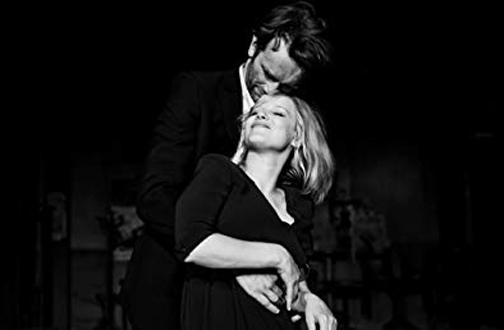
For Oscars, the Best Foreign Language Film category is often a fierce race with some of the year’s best offerings. When The New York Film Critics Circle anointed Alfonso Cuaron’s Mexican-language Roma best film, the move acknowledged a “darling” that’s been on many critics’ “best” and “favorite” lists beating out American or English language hits such as Green Book, A Star is Born, and The Favourite, among many others hotly debated. That selection also made room for Cold War as Best Foreign Language Film. At this year’s New York Film Festival, where I first saw it, this black & white gem, the Polish Academy Award entry, resonated deeply for me, a reaction confirmed at a more recent second viewing following a Q&A at the Brasserie Ruhlmann between the actress Rachel Weisz and Cold War director Pawel Pawlikowski.
Weisz questioned Pawlikowski’s obsession with women. Cold War is set, as is his Academy Award winning Ida, in a stark WWII aftermath, a Europe marked by dislocations and anomie, especially for his female protagonist. Cold War’s Zula finds a niche for herself singing and dancing in a folk music ensemble, a throwback to a nostalgic pre-war innocence, peasant kitsch an approved artsy medium for the Communist regime that took over Poland. Her lover, Wiktor (Tomasz Kot), a conductor for the group, lures her to Paris, where he has defected, living in an attic, and playing jazz at a club, nothing more than a sophisticated ghetto for her. Joanna Kulig is crazy good as Zula, and, in a fair world, should get a Best Actress nomination. As a couple Wiktor and Zula are sworn to one another, but have nowhere to go.
Pawlikowski dedicated the story to his parents, a mix-matched pair, she a dancer and he a doctor, noting that in their old age they seem perfectly happy. The family knew something about dislocation and anomie. While he lived for a time in London, the filmmaker returned to Warsaw and now lives seven kilometers from the place where he grew up. As in Ida, he filmed some Cold War scenes in Lodz, stating, “The city is something of a film set.” But his landscape could be anywhere; barren and belonging to the psyche, it becomes a Beckett inspired backdrop for existential myth.
While Rachel Weisz, already honored for her acting in The Favourite and Disobedience, has never worked with Pawel Pawlikowski, she’d like to. She winked, “He knows.”
Graphic Design: Salpeter Ventura


 gossipcentral.com
Leave a comment