
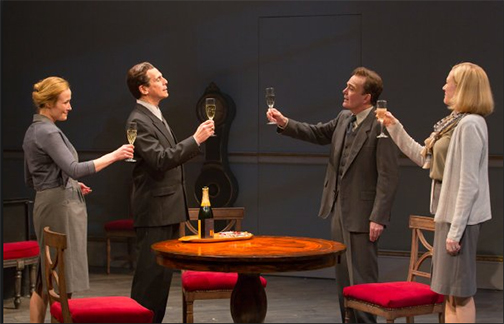
The great achievement of the Oslo Peace Accords, on which the entertaining drama Oslo is based, was bringing to the table Israelis and the Palestinian Liberation Organization. Anyone who has ever been to the Middle East, knows the hostility in the air, with Jews worried about security and the future of the Jewish state, and Arabs enraged at occupation and the loss of autonomy. The eyes and ears of the world have been glued to this unbridgeable divide. For theater, Oslo, now with 7 Tony nominations, defies the expectation that peace talk alone can be highly engrossing rather than morbidly serious and stressful. In fact, J. T. Rogers’ Oslo, directed by Bartlett Sher, is provocative and humorous, because it teases out the personalities of those figures plucked from the news, and finds their humanity and common ground even when the politics don’t match up.
Oslo provides something of a history lesson in that, as the playwright asserts in his note: here is a story that is documented, yet almost completely unknown—a backstory, as it were to a great historic moment of enemies coming together to try to find a way to move toward a common good will. The dramatis personae include the Norwegian couple that masterminded the meetings, Terje Rod-Larsen (Jefferson Mays) and Mona Juul (Jennifer Ehle), a fiery Israeli Uri Savir (Michael Aronov), Director General of the Foreign Ministry, and PLO Finance Minister Ahmed Qurie (Anthony Azizi) to name a few of the excellent players. Negotiations do move forward, and back again; conflict and war are projected on the large Vivian Beaumont wall, leavened by the civility of homemade waffles, Norwegian fish and copious amounts to drink. Oh, the indelible image of three men on the White House lawn and a handshake! What did it mean?
I entered the play thinking I’d be nostalgic for the dream of peace these meetings made so tantalizing, wistful at the memory of loss of opportunity. Now I think the great achievement of Oslo—and why it must be seen– is its vision of the miracle that these meetings were as occasion for framing the dialogue to the present day. This is how we talk, about a two-state solution, boundaries, and so on. And then we ponder, given how the world has shifted in so many ways from 1993, is this framework of a bygone era the only solution for peace? Oslo ends on this question.
Graphic Design: Salpeter Ventura


 gossipcentral.com
Leave a comment